



Quick Summary
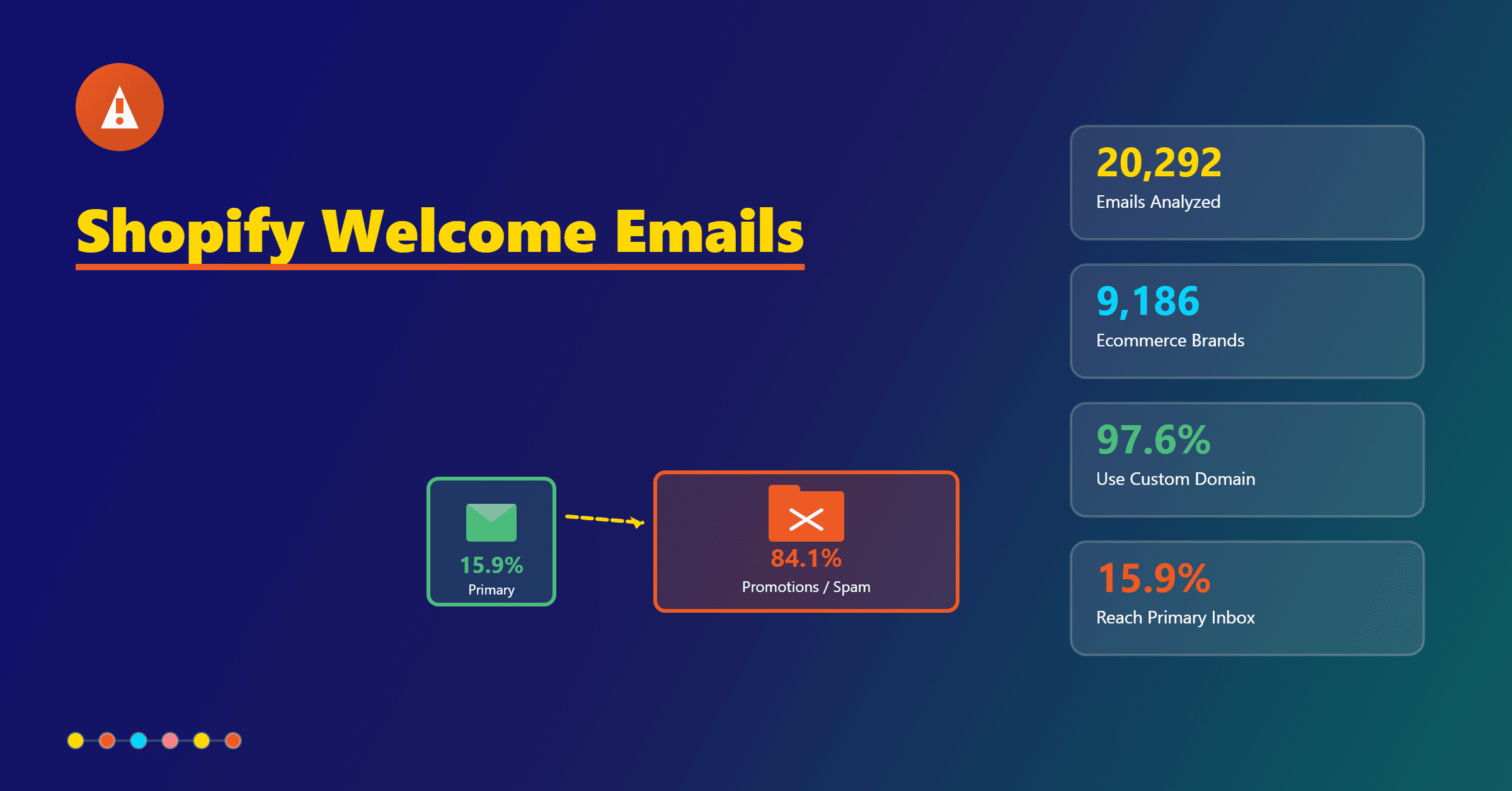
- 📉 Primary Inbox placement has a hard ceiling without optimization: Across 20,292 emails from 9,186 brands, only 15.9% reached the Primary Inbox, while 10.6% landed in Spam—making send timing, cleaner copy, and structured welcome flows critical to unlock more revenue.
- ⏰ Send timing directly influences inbox visibility: Wednesday is the most saturated day with 4,423 emails, including 2,362 in Wednesday morning alone, while Sunday’s lower-volume window of 2,197 sends offers a valuable opportunity to gain attention and improve placement.
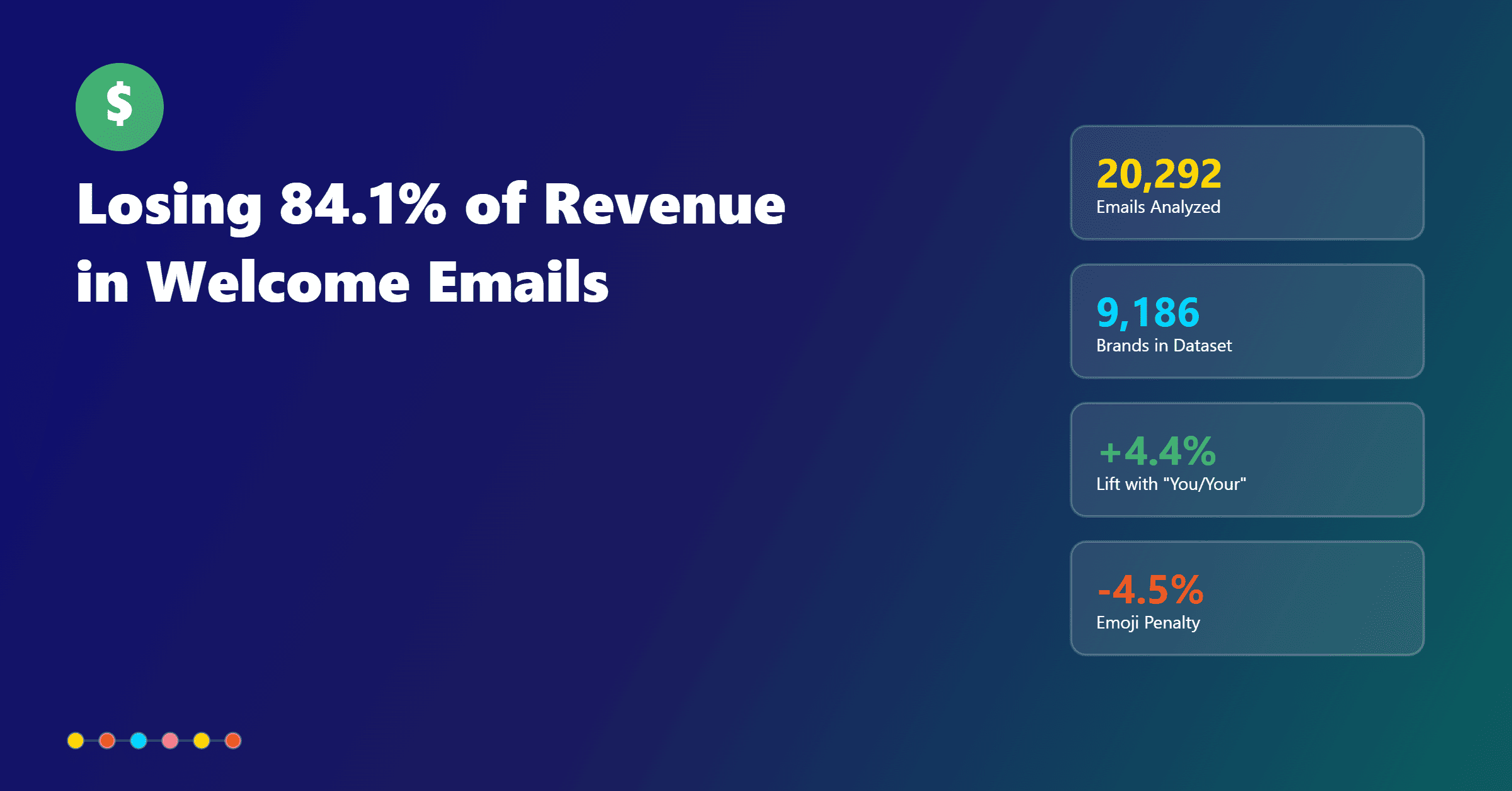
- ✍️ Simple, direct subject line wording improves inbox placement: Using “You/Your” in 4,172 emails aligned with a 4.4% higher inbox rate, and concise subject lines averaging 5.8 words help improve clarity, mobile readability, and filtering outcomes.
- 🚫 Emoji subject lines reduce inbox success for welcome emails: Among 6,307 emails using emojis, inbox placement was 4.5% lower than text-only alternatives, reinforcing that clean, professional subject lines protect your brand’s first impression.
- 🔁 Multi-email welcome sequences consistently outperform single sends: Brands sending 3+ welcome emails rank in the top 20.8% of performers, and pairing clear CTA text with buttons—used by 33.8% of programs—improves attribution, conversion visibility, and revenue growth.
If your welcome email marketing isn’t driving first-purchase revenue the way it should, you’re not alone.
Across 20,292 emails sent by 9,186 brands, Primary Inbox placement for unoptimized campaigns tops out at just 15.9%. When nearly one in ten messages, 10.6% on average, falls into Spam, your very first impression risks getting buried.
For e-commerce teams, that means slower activation, missed revenue, and wasted paid traffic.
The good news is that precise changes to timing, copy, and sequence design can shift your welcome email campaign from lost in transit to reliably seen and clicked.
Market Baseline And Why It Matters
What this dataset covers
The benchmarks below come from a study of 20,292 emails sent by 9,186 brands, with performance clustered around inbox placement, spam incidence, timing concentration, copy elements, and sequence structure.
While every brand’s list quality and product mix differ, this dataset offers a realistic reference point for welcome email marketing decisions, especially your first 7 days of messaging.
Why this baseline matters for ecommerce welcome email ROI
Your welcome series does three essential jobs: capture intent while it’s fresh, guide first-product discovery, and collect the clicks and conversions that justify your list growth.
If only 15.9% of unoptimized emails make the Primary Inbox, your funnel is throttled before it starts.
Pair that with a predictable 10.6% Spam “buffer zone,” and you can explain underperforming first-purchase rates without blaming your offer or landing pages.
The baseline helps you triage what to fix first and quantify realistic upside as you optimize.
Deliverability Reality Check
The inbox cap and the buffer zone
In this dataset, unoptimized campaigns cap out at 15.9% Primary Inbox placement, or 3,230 emails that make it where shoppers actually look.
The flip side is the Spam Risk Factor: an average of 10.6%, or 2,150 emails, landing in Spam.
Consider that 10.6% your operational buffer zone, the avoidable loss you must reduce to unlock early revenue.
If you do nothing, your welcome email marketing leaves money on the table before the copy ever gets read.
What to change to beat the cap
Deliverability is cumulative. Small, compounding wins, subject-line clarity, strategic send times, reduction of risky elements like emojis, and reliable CTA tracking work together to push more messages into the Primary Inbox.
Within this dataset, two controllable levers rise above the rest: text-only subject lines and direct personalization with “You/Your,” which correlates with a 4.4% higher inbox placement when used in subject lines or preview copy.
Layering those choices with a better send window and a multi-email sequence is the fastest way to beat the 15.9% cap.
Timing strategy: win the send window
Avoid the Wednesday crush
Wednesday is the most competitive day, with 4,423 sends in this dataset.
The crowding intensifies on Wednesday mornings alone, where 2,362 emails stack up in a single window.
If you’re seeing low opens and slow first-click times, this midweek morning spike is likely part of the cause.
Your welcome email campaign is fighting for attention in a saturated inbox, and even great creative struggles when queued alongside thousands of similar messages.
Test the Sunday “Blue Ocean”
Sunday has the lowest send volume at 2,197 total sends—functionally a blue ocean for visibility.
For e-commerce, lower competition can translate into higher real estate in the inbox and a calmer decision environment for shoppers.
Treat Sunday as a strategic test day for your first or second touch, especially for high-consideration products that benefit from less noise and more reflective browsing.
Stagger send times intelligently
Avoid defaulting to top-of-hour morning sends, particularly on Wednesdays.
Instead, stagger by late morning to mid-afternoon in your subscriber’s local time or test early evening when shoppers are relaxed.
Pair these timing experiments with audience segments, new subscribers with high-intent behaviors (site views, cart activity) may still perform well on busier days if you target off-peak hours within that day.
The key is to escape the 2,362-email Wednesday morning pileup without creating new bottlenecks.
Copy Tactics That Lift Inboxing
Personalize with “You/Your” for measurable gains
Among 4,172 emails that used “You/Your,” inbox placement correlated with a 4.4% lift.
This is clean, low-risk personalization that avoids the brittleness of first names while still signaling relevance.
A subject line like “Your 10% Welcome Is Ready” or “You Left Something Worth Keeping” reads as helpful rather than gimmicky and aligns with the way subscribers scan for value.
Aim for the 5.8-word professional standard
Subject lines in top-performing cohorts averaged 5.8 words. That brevity concentrates meaning, reduces truncation on mobile, and helps spam filters classify intent quickly.
Treat 5–6 words as your professional standard, with the first three words shouldering the core value proposition.
Pair with a plain-language preview text that expands on the promise in 8–12 words, keeping the entire package skimmable in under two seconds.
Skip the emojis to avoid a 4.5% inbox penalty
In this dataset, 6,307 emails used emojis in the subject line, and on average, they saw a 4.5% lower inbox rate than text-only lines.
Emojis may feel on-brand, but for welcome email marketing, that small penalty is too costly on your most important send.
Build your brand’s personality with word choice, not glyphs.
If you must test them, reserve them for downstream campaigns once you’ve confirmed stable inboxing and strong engagement.
Structure your welcome email campaign for revenue
Why 3–5 beats one-off welcomes
Moving from a single welcome to a 3+ email sequence places your brand in the top 20.8% of performers, represented by 1,917 brands in this dataset.
This isn’t about spamming inboxes; it’s about meeting shoppers as their intent unfolds.
A first-touch discount may prompt quick wins, but later touches earn incremental conversions by answering questions, lowering risk, and highlighting social proof.
Serial contact also improves deliverability by gathering more opens and clicks across multiple messages, engagement that ISPs reward.
A high-performing 3–5 email ecommerce welcome email flow
Email 1 should arrive within minutes and focus on the offer and value. State the reason to open in 5–6 words, use “You/Your” for clarity, and spotlight one primary action.
If you include an incentive, keep it visible above the fold and make the CTA trackable with UTM-tagged text links and a button.
Email 2 should layer in social proof and bestsellers within 24–48 hours.
Highlight reviews, star ratings, and top categories that match the subscriber’s entry intent.
For brands using TargetBay Reviews, bring photo and video reviews into the email body to lower purchase anxiety.
Email 3 should handle objections 2–4 days after sign-up. Speak to returns, shipping timelines, sizing or fit, and materials.
Position this as a helpful concierge note that makes purchase success more likely, with a soft incentive reminder if applicable.
Email 4, optional for higher AOV or longer consideration paths, can feature deeper education. This might be a how-to guide, a comparison chart, or a story that reframes value beyond price.
If your program includes loyalty, gently seed how TargetBay Rewards members stack perks from day one.
Email 5, a final reminder at day 5–7, should create a clear choice. Reiterate the best first-purchase pathway, the incentive’s expiry if used, and one friction-free CTA. Keep this message the most concise of the series to concentrate on action.
Measurement essentials
Make every CTA trackable to iterate faster
Only 33.8% of emails in this dataset included trackable CTA text, a missed opportunity to prove revenue impact. The fix is simple and non-negotiable.
Mirror every primary button with a text link, tag both with UTM parameters that reflect campaign, creative, and touch number, and keep anchor copy consistent.
Doing this across all touches lets you isolate which email, section, and phrasing moved revenue, so you can scale the parts that work.
Watch the right metrics in the right order
Prioritize inbox placement and spam rates first; if you’re invisible, clicks can’t happen.
Once stable, focus on open rate and read time to validate subject and preview clarity. Then measure click-through rate by CTA placement and content block.
Finally, track first-purchase conversions and revenue per subscriber across the full welcome email campaign to judge downstream impact, not just first-touch vanity metrics.
Quick-start checklist (welcome email tips)
Send outside Wednesday morning to escape the 2,362-email crush.
Mid-afternoon on weekdays and Sunday tests often yield cleaner real estate and calmer decision environments.
Embrace local-time sending when possible and avoid default top-of-hour drops that bunch you with competitors.
Write 5–6 word, emoji-free subject lines and use “You/Your” whenever it makes the promise clearer.
Keep preview text direct and additive, and test one variable at a time so you can attribute gains cleanly.
Plan a 3–5 email ecommerce welcome email series to join top performers.
Space messages logically over 5–7 days based on your buying cycle, and assign a single job to each touch: welcome and offer, social proof, objection handling, education, then final reminder.
Make every call-to-action trackable, not just buttons. Pair buttons with UTM-tagged text links and consistent anchor phrases so you can compare performance across placements and devices without ambiguity.
Protect deliverability by avoiding risky choices early.
Skip emojis in subject lines, stagger send times, and keep body copy simple and scannable.
If you add incentives, foreground them cleanly without shouting in all caps or stacking too many exclamation points.
Conclusion
Welcome email marketing performs when it clears three hurdles: it reaches the Primary Inbox, appears at a time when subscribers can see it, and guides a frictionless first purchase over several short, purposeful touches.
The data here points to precise, repeatable moves, avoid Wednesday morning congestion, shorten and personalize your subject lines, keep emojis out of your first impressions, expand from one email to a 3–5 touch flow, and make every CTA trackable.
For e-commerce teams that prefer unified tooling, TargetBay Email & SMS, TargetBay Reviews, and TargetBay Rewards work together to launch compliant flows fast, showcase proof where it matters, and tie welcome-series clicks to real revenue without duct-taping platforms.