



⭐ Quick Summary
📬 Strong deliverability starts from a realistic baseline: Only 9.2% of abandoned cart emails reached the Primary inbox, while 50.2% went to Promotions and 34.9% landed in Spam. Plan your program to perform well even from Promotions.
⚖️ Frequency is a compliance and reputation lever: Many EU guidelines flag more than 2–3 emails as aggressive. We found 57 brands exceeding three messages and one sending seven, a pattern that raises GDPR compliance risk and invites complaints.
⏱️ Timing cannot solve promotion placement: Promotions and Spam spike during the same hours, with 12 AM–4 AM sends showing the highest Spam likelihood. Avoid these windows and keep cadence tight to reduce friction and filtering.
🧠 Message framing nudges placement: Reassurance-focused preview text proved the safest emotional trigger, while urgency and value-forward discounts pushed more messages toward Promotions and Spam compared with no-offer variants.
🔐 Trust the sender identity recipients recognize: Name@ and clear brand-aligned sender addresses outperformed sales-heavy handles. A monitored reply-to and consistent domain signal service, reduce complaints, and support stronger inbox performance.
If you’re unsure whether your abandoned cart emails are “transactional” or marketing under GDPR, you’re not alone.
The confusion is real, and the consequences are costly. In our analysis of 756 abandoned cart emails from 497 brands, only 9.2% reached the Primary inbox, 50.2% landed in Promotions, and 34.9% went to Spam.
That means most brands are battling Promotions by default, and a third are losing to Spam entirely.
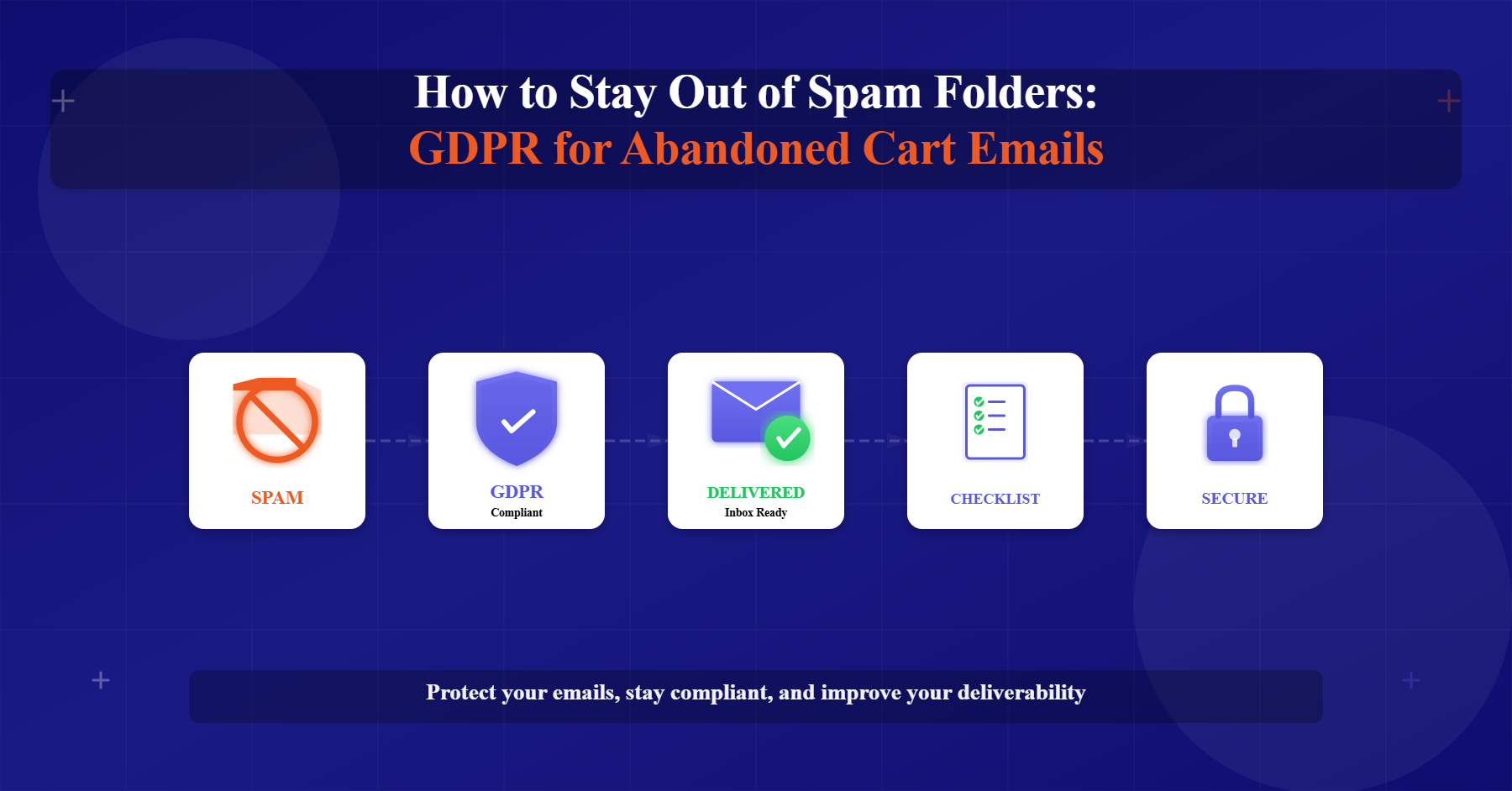
This guide explains how to approach GDPR abandoned cart emails with both compliance and deliverability in mind.
You’ll learn when these emails are considered marketing, how many follow-ups are safe, why timing won’t fix Promotions placement, and how sender identity and copy style influence inboxing.
GDPR Status: Marketing vs “Transactional”
Under GDPR and e-privacy rules, abandoned cart emails generally count as marketing because no purchase has taken place.
That distinction matters. If no transaction occurred, the message is not a purely “transactional/service” communication.
You should treat abandoned cart emails and GDPR as a marketing use case, meaning you need consent or a valid legitimate interest paired with the e-privacy “soft opt-in” where that framework applies.
The legitimate interest route requires that you collect the email during checkout, the email promotes similar products or services, and you include a simple way to opt out.
Abandoned Cart Email Playbook
Turn abandoned carts into revenue with plug‑and‑play recovery flows, timing templates, and copy frameworks for ecommerce brands.
Documentation is essential, from your balancing test to your privacy notice. It’s also wise to map which EU and UK jurisdictions allow soft opt-in for cart recovery and which require explicit consent.
In other words, abandoned cart emails are not exempt from GDPR; they are a regulated practice.
Frequency also affects the analysis. Many EU guidelines consider more than two or three abandoned cart follow-ups aggressive or non-compliant.
In our dataset, 57 brands sent more than three cart emails in a single flow, and the longest sequence we found was seven messages.
That pattern increases risk under cart abandonment GDPR rules and raises the likelihood of complaints, which also hurts deliverability.
More Abandoned Cart Email Marketing Resources for You
Frequency Limits and GDPR Sensitivity
If you’re asking, “Are abandoned cart emails GDPR compliant?” the safest answer is yes, when you cap frequency, get the legal basis right, and provide easy opt-out.
A practical ceiling for gdpr abandoned cart email compliance is one to three touches over 24 to 72 hours.
That keeps the intent service-oriented and reduces perceived pressure.
Cadence matters as much as count. A helpful first message within a few hours can feel like customer service. A thoughtfully timed second nudge the next day can remind and clarify.
A final light-touch reminder within 72 hours can close the loop. Beyond that, the odds of diminishing returns, regulatory concern, and Spam complaints rise quickly.
Deliverability Baseline: you’re fighting Promotions, not just Spam
The deliverability reality is stark. Across the 756 emails we reviewed, only 9.2% reached the Primary inbox, while 50.2% were sorted into Promotions, and 34.9% were flagged as Spam.
The implication is that you should build expectations and flows assuming Promotions placement as the default, not the exception.
That means optimizing for attention in Promotions rather than chasing Primary at all costs. Prioritize a clean sender reputation, consistent identity, and respectful messaging.
Think lifecycle context, not conversion-only copy. When your emails look and feel like service, filters and people are both more likely to treat them kindly.
Send-time Realities: Timing Won’t Fix Promotions; Bad Timing Can Worsen Spam
Send time alone won’t lift you from Promotions to Primary. In fact, Promotions and Spam volumes spike at many of the same hours, with predictable patterns.
From 6 AM to 11 AM, brands send heavily and see mixed placement. Between 7 PM and 9 PM, there’s a large surge in Promotions placement.
The late-night window from 12 AM to 4 AM shows the highest likelihood of Spam relative to total volume, and 6 AM carries both a Promotions spike and a noticeable Spam cluster.
If you want to prevent damage to your sender’s reputation, avoid late-night sends, especially in the 12 AM to 4 AM window for your recipient’s local time.
Pair that with fewer total follow-ups to reduce complaints.
Timing alone won’t rescue Promotions, but poor timing consistently increases Spam risk, and for GDPR and abandoned cart emails, nuisance is both a legal and deliverability problem.
Weekday vs Weekend: Understand your Risk Profile
Weekends don’t fix inboxing either. On weekdays, we recorded 49 Inbox placements, 265 Promotions, and 146 Spam.
On weekends, there were 25 Inbox placements, 137 Promotions, and 134 Spam. The weekend pattern shows Spam almost catching up to Promotions, which is a cue to be conservative with your weekend sends.
If you do send on weekends, stick to a single, service-forward message and avoid additional follow-ups until Monday.
Treat weekends as higher-risk periods that need extra care around copy, identity, and preview text.
From-address Patterns that Build Trust
Sender identity shapes how subscribers and filters perceive your intent.
We observed the following from-address patterns across the 497 brands: 296 used a name@ handle, 200 used info@, 85 used hello@, 72 used support@, 48 used sales@, 19 used care@/wecare@/customercare@, 15 used help@, and 21 used other formats.
The prevalence of name@ and info@ suggests a split between personal and general-brand approaches.
For cart recovery, recognizable and monitored is better than a generic and no-reply.
A name@ tied to a clear brand signature often reads as more human and elicits fewer complaints.
If you prefer a functional address, choose hello@ or support@ over sales@, which can feel overtly promotional and trigger Promotions placement.
Pair your visible “From” name with a consistent domain and a real reply-to.
Two-way communication signals service intent and mitigates frustration when people want help.
More Abandoned Cart Email Marketing Resources for You
Copy, Incentives, and Preview Text: Nudge Placement the Right Way
Tone is a strong placement signal. Most abandoned cart copy we analyzed was neutral, with more than 650 emails sitting in that middle ground.
We found only 20 that leaned “soft and reassuring,” and 50 that were clearly aggressive or urgency-driven.
The softer language proved safer for both compliance and deliverability. Phrases like “We saved your cart,” “No worries,” and “Still here if you need help” reduce pressure and complaints.
By contrast, “Hurry,” “Last chance,” “Don’t miss,” and “Final call” skew aggressive and increase the odds of being sorted into Promotions or even Spam.
Incentive messaging also matters. When an email included an offer or savings, we saw 160 end up in Promotions, only 20 in the Inbox, and 96 in Spam.
With no offer, 242 landed in Promotions, 54 reached the Inbox, and 184 hit Spam. Offers can push you deeper into Promotions and slightly elevate Spam risk.
If you rely on discounts, consider holding them until the second or third message, and keep the first email informative and service-centered.
Preview text echoes the same story. Neutral preview copy showed the largest volumes, with 339 in Promotions, 61 in Inbox, and 244 in Spam.
Value-forward previews that highlight savings or discounts skewed toward Promotions and Spam, while urgency was the riskiest of all.
Reassurance performed safest for deliverability, with 21 in Promotions, 7 in Inbox, and 13 in Spam.
That makes reassurance the best emotional trigger when you’re trying to balance recovery with compliance.
Subject and Preview Strategies that Help
If you’re optimizing abandoned cart email GDPR outcomes and deliverability together, think clarity and calm.
Use subjects like “We saved your cart at [Brand]” or “Need help finishing your order?” Pair them with preview text that explains the benefit without pressure, such as “No rush—your items are still available for a bit” or “Questions? Reply, and we’ll assist with checkout.”
Save discounts for later in the flow, and even then, frame them as a customer courtesy rather than a time bomb.
The same principle applies to content. Show the product left behind, offer helpful details like sizing or shipping timelines, and guide the recipient to a low-friction path back to checkout.
Keep tracking pixels, excessive links, and promotional banners to a minimum.
The simpler your design and the more service-led your language, the better your placement odds.
Abandoned Cart Email Playbook
Turn abandoned carts into revenue with plug‑and‑play recovery flows, timing templates, and copy frameworks for ecommerce brands.
Practical Compliance Checklist for GDPR and CAN-SPAM
If you’re navigating abandoned cart emails and GDPR, start by deciding your legal basis.
Consent is the clearest route, especially when you capture it during account creation or checkout.
Legitimate interest paired with the e-privacy soft opt-in can also work where permitted, provided you only market similar products or services, you collected the email during checkout, and you include a straightforward opt-out in every email.
Document your reasoning, update your privacy notices, and audit your data collection flows so they match your messaging.
Limit follow-ups and choose respectful timing. Capping at one to three messages within 24 to 72 hours strikes a balance between recovery and recipient expectations.
Our study shows 57 brands exceeded three messages, and one brand topped out at seven, which raises flags for gdpr abandoned cart email compliance and increases complaint risk.
Avoid late nights and early mornings when Spam likelihood spikes, and don’t pile on weekend sends.
Get the essentials right in every message. Identify your brand clearly, use a recognizable From name and address, include a working unsubscribe, and avoid misleading subjects.
Keep creative restrained, reduce overt sales tactics in the first email, and use reassurance in your preview text.
These steps don’t just help placement; they support a respectful, rights-centered approach.
If you send to multiple regions, treat cross-border rules as a floor, not a ceiling. For the United States, a CAN-SPAM abandoned cart email is allowed without prior opt-in, but it must comply with commercial email requirements: clear sender identity, a physical postal address, honest subject lines, and a functioning unsubscribe link processed promptly.
For EU recipients, apply the stricter GDPR and e-privacy standards and avoid assuming the US framework will carry you.
Doing so minimizes risk and aligns your brand with best practices globally.
Conclusion
Abandoned cart emails are powerful when they respect both the law and the inbox. Under GDPR and e-privacy, treat them as marketing messages that require consent or a documented legitimate interest with soft opt-in where permitted.
Cap your flow at one to three messages over 24 to 72 hours. Favor reassurance over urgency, avoid late-night sends, and use a From address that feels human and accountable.
Managing all of that is easier when your lifecycle, deliverability, and compliance levers live in one place. TargetBay Email & SMS helps e-commerce teams set frequency caps, choose safe send windows, test subject and preview language, and keep sender identities consistent. Pairing that with TargetBay Reviews and TargetBay Rewards creates a trust-rich, data-informed loop that improves both customer experience and inbox outcomes. Keep your abandoned cart strategy helpful, compliant, and steady in the Promotions tab, and you’ll win more revenue with less risk.
This article is for general information only and does not constitute legal advice. For specific guidance, consult your legal counsel.
Transparency & Disclaimer
This guide is based on an analysis of 756 abandoned cart emails from 497 e-commerce brands, collected between 1 August 2024 and 5 June 2025 through InboxEagle.com, a platform that tracks public e-commerce email campaigns.
Important context for interpretation: Reported percentages and averages represent trends within this dataset, not universal benchmarks. Results can vary by industry, audience, region, and email platform. Metrics such as inbox placement, opens, and clicks are also influenced by list quality, deliverability, and recipient behavior.
Disclaimer: All emails analyzed were sourced from third-party e-commerce brands. TargetBay has no affiliation with any brands in the dataset.
These insights are intended as directional guidance and benchmarking, not guaranteed outcomes. Brands should validate and adapt strategies based on their own performance data.