



⭐ Quick Summary
✉️ Keep subject lines short and human: The sweet spot is 6.74 words and 38.5 characters, with friendly or question-led tones outperforming urgency for inbox placement and opens.
👀 Treat preview text as a second headline: Aim for about 127.86 characters and 38.59 words, add value or reassurance, and avoid excessive urgency to reduce spam risk.
🧠 Personalization is more than a name: “You” appeared 438 times and “your cart” 179 times; combine these with product mentions to make abandoned-cart emails feel unmistakably relevant.
🎁 Use offers strategically: Only 125 subject lines and 93 previews included discounts. Protect margins by placing incentives later in the flow and keeping the abandoned checkout tone service-first.
👉 Make CTAs specific to the task: “Shop now” is common at 283 uses, but cart-specific prompts like “Return to your cart,” “Complete your purchase,” or “Checkout now” make the next step obvious and reduce friction.
E-commerce brands lose revenue every day because shoppers start checkout and drift away.
The fix sounds simple: send an abandoned cart email, but generic messaging rarely moves the needle.
Across 756 abandoned cart emails from 497 brands, we found clear patterns that correlate with opens, clicks, inbox placement, and ultimately revenue. If your abandoned cart email copy is vague, too urgent, or under-personalized, you’re leaving sales on the table.
This guide translates the data into practical, brand-safe tactics your team can ship this week.
Subject line benchmarks to model
Subject lines do most of the heavy lifting in cart recovery. In our dataset, the average high-performing length was 6.74 words and 38.5 characters.
That sweet spot creates enough room for context without triggering truncation on mobile. When you write subject lines for your abandoned cart email text, aim for clarity over cleverness, and plan for the smallest screens first.
Style matters, and the distribution shows what brands rely on most. Out of the 750+ emails analyzed, friendly tones appeared 428 times, questions 168 times, reminders 125 times, and urgency only 35 times.
Friendly and question-led approaches dominate because they’re natural, non-pushy, and less likely to trip spam filters. Urgency can work, but the dataset and inbox placement trends suggest using it sparingly.
Abandoned Cart Email Playbook
Turn abandoned carts into revenue with plug‑and‑play recovery flows, timing templates, and copy frameworks for ecommerce brands.
Emojis show up less than you might think. Only 13.3% of emails—107 out of 756—used emojis in subject lines. That doesn’t mean emojis are off-limits; it means they should be a test, not the default.
Emojis can add warmth, but can also flag Promotions or Spam in some inboxes. Use one, make sure it’s contextually relevant, and check deliverability before scaling.
Keyword choices help anchor recognizability. “Left” appeared 124 times, “still thinking” 22 times, and “your items” 10 times.
These phrases reflect shopper intent and situational awareness. They also subtly confirm the email’s relevance.
Examples that fit the 6–7 word, ~38-character window and lean-friendly or inquisitive include “You left something in your cart,” “Still thinking this over?” and “Your items are waiting, just for you.”
If you want to test an emoji, “You left something behind 🛒” is an option, but run it through a subject line deliverability check first.
The practical rule of thumb is simple. Keep your abandoned cart email copy short, personal, and human.
Lead with “you,” “your cart,” or a product name when possible, and align the subject style with your brand’s voice while staying inside the data-backed length window.
More Abandoned Cart Email Marketing Resources for You
Abandoned cart email preview text
Preview text is your second headline, not a throwaway. Across the sample, the average preview length landed at 38.59 words or 127.86 characters.
That length gives you room to share value or reduce friction without writing a paragraph. Treat your abandoned cart email preview text as an extension of your subject line: add detail that nudges action, but avoid repeating the subject verbatim.
Emotion in the preview text should be subtle. Most emails were neutral—638 out of 756—with just 93 value-driven, 14 urgency-led, and 11 reassurance-led. That distribution signals what the inbox tolerates.
A gentle value add, like a reminder of free shipping thresholds or a quick highlight of an in-cart benefit, tends to be safer than shouting about limited time.
For example, “Pick up where you left off—your cart is saved, and you’ll see delivery estimates at checkout” clarifies the next step and lowers friction without sounding like a countdown timer.
If you’re writing for a brand with a calm voice, try something like, “We saved your cart for the next 48 hours—sizes and colors are still in stock.”
If your brand skews premium, use reassurance and guidance: “Your selection is reserved. See fit details, delivery dates, and easy returns inside.”
For value-led brands, a data-backed line could be, “You’ll see your full savings, shipping options, and returns policy when you hop back in.”
Each of these fits inside the preview-length benchmark and reduces decision anxiety.
The core principle is to add clarity and comfort without tripping spam signals. Avoid ALL CAPS, a parade of exclamation points, or exaggerated urgency.
Keep your abandoned cart email copywriting measured, informative, and focused on the next best action.
Personalization that signals relevance
The most consistent personalization signal is simple language that recognizes the customer.
Across the dataset, “you” appeared 438 times, “your cart” 179 times, and “your items” 6 times. Those words pull readers back into their context and make it clear the message is about them, not a blast. Don’t stop at pronouns.
Use product names, sizes, or colors when available, and mention recently viewed items to sharpen relevance.
For an abandoned cart-friendly tone copy, try an opening that sounds like a person wrote it. “We set your cart aside, Sarah—your Oak Leather Mini in Cognac is still available.”
If you capture behavior, use it. “You were weighing two sizes in Alpine Blue; here’s our fit guide and what customers say after 30 days.”
The strongest personalization blends identity, product detail, and a helpful nudge, which is the heart of effective cart abandonment email copy.
Balance detail with brevity. One or two product mentions usually suffice, especially on mobile. When you need to show more items, stack them visually in the email body and keep the text tight.
Your abandoned cart reactivation message copy should never turn into a product catalog. Keep the focus on finishing checkout with one clear path forward.
Offer messaging: when and how to use it
Discounts are not a prerequisite for recovery. In our analysis, only 125 subject lines used offers, and just 93 preview texts explicitly included them. That tells you two things.
First, offers can help, but they’re not the primary lever for opens.
Second, putting discounts in the subject or preview can drag you into Promotions or Spam and can condition your list to wait for deals. Protect your margins by positioning offers later in the sequence.
For a three-step flow, start with value and reassurance in Email 1, repeat value and overcome objections in Email 2, and only bring a modest incentive in Email 3 if the cart remains idle. A sequence might look like this in practice.
For Email 1, use a friendly subject like “You left something in your cart” with a preview that confirms the cart is saved and includes shipping estimates.
For Email 2, pivot to a question such as “Still thinking it over?” with a preview like “See reviews, fit tips, and delivery dates before you check out.”
For Email 3, explicitly introduce a modest incentive only if needed, for example, “A little something to finish your order,” with a preview that explains the value clearly without shouting.
When you do use an offer, keep the tone low-friction and the code easy to apply. Lean on value framing rather than urgency.
“Enjoy complimentary shipping on your cart—applied at checkout” or “Your savings appear automatically in your cart” perform better than a hard countdown in many inboxes.
This approach improves your abandoned checkout email tone and helps your brand stay out of Spam while still nudging the undecided shopper.
High-performing CTAs for cart abandonment email copy
Calls to action close the loop. In the data, “Shop now” appeared 283 times, “Complete your purchase” 33 times, “Checkout now” 31 times, “Return to cart” 15 times, and “Get my discount” zero times.
The absence of “Get my discount” confirms that overly discount-forward CTAs aren’t the norm in high-performing abandoned cart email copy.
Action-first buttons like “Shop now” are familiar, but they can be vague for cart recovery. Consider testing a more specific cart pathway.
A good baseline is a primary CTA that speaks directly to the next step. “Return to your cart” is precise.
“Complete your purchase” feels definitive and works well when your audience wants a confident prompt. “Checkout now” can serve conversion-minded brands that trade on speed.
If your brand voice is softer, “Pick up where you left off” keeps momentum without pressure. Make your primary button prominent above the fold, and include a secondary text link below the cart items for accessibility.
Action-first versus value-first is worth testing. For many brands, a value-first microcopy line above the button boosts clicks.
A line like “Free exchange on your first order” or “Ships in 24 hours” placed near “Complete your purchase” can remove lingering objections.
The safest design rule is clarity. Your cart abandonment email copy should make the path obvious with one dominant CTA, minimal competing actions, and a frictionless return-to-cart URL that maintains state across devices.
More Abandoned Cart Email Marketing Resources for You
Tone vs inbox placement: what actually lands
Friendly tones landed in Promotions 209 times, in the primary inbox 44 times, and in Spam 175 times.
Questions found Promotions 85 times, inbox 20 times, and Spam 63 times.
Reminders appeared in Promotions 91 times, inbox 9 times, and in Spam 25 times.
Urgency-heavy emails skewed risky, with 17 Promotions, just 1 inbox, and 17 Spam placements.
This distribution makes a clear case: lead with a friendly or question-led tone and deploy urgency with restraint.
Start the flow with a warm, human voice. “We saved your cart for you—want to take another look?” reads like a nudge, not a demand.
Use questions to invite the shopper back. “Still thinking about the Oak Leather Mini?” pulls the product back into the conversation.
Keep reminder frames straightforward and respectful, for example, “Quick reminder—your cart is still ready.”
Reserve hard urgency for a final nudge and consider a mild time frame rather than a countdown. “We’ll keep your items reserved for 24 hours” feels service-oriented instead of alarmist.
Inbox placement is multi-factor, but copy is one variable you control. If your team needs a safety rail, write two subject-line variants per email in the flow: one friendly and one question-led.
Measure placement and open rate for each. Over time, refine your abandoned cart email text with the tone that consistently avoids Spam for your list composition and brand.
Proof of scale
These benchmarks come from 756 abandoned cart emails across 497 brands, spanning categories from fashion to home and health.
The sample is large enough to show reliable patterns while leaving room for brand nuance.
The best abandoned cart email text for your store will still come from testing, but starting from these data-backed ranges shortens your path to conversion.
A simple optimization plan works well. Write subject lines at 6–7 words and about 38 characters.
Write preview text around 120–130 characters with a light value or reassurance note. Open with a friendly greeting, reference “you” or “your cart,” mention one product detail, and keep the CTA specific.
Hold offers until the third touch, unless your price point demands earlier incentives. This approach balances deliverability, persuasiveness, and margin protection while giving your abandoned cart email copywriting team a repeatable playbook.
Abandoned Cart Email Playbook
Turn abandoned carts into revenue with plug‑and‑play recovery flows, timing templates, and copy frameworks for ecommerce brands.
Free Abandoned Cart Email Copy Examples
Here’s a three-email flow built around the benchmarks, with copy you can adapt.
For the first email, pair a friendly tone with clear context.
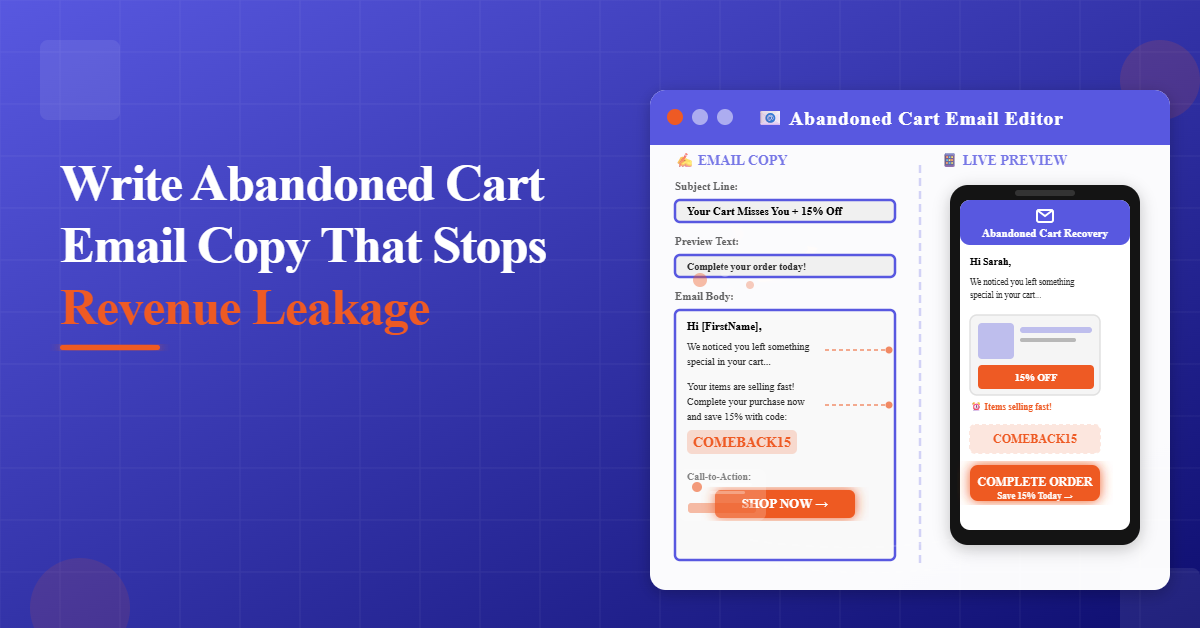
Subject: “You left something in your cart.”
Preview: “Your cart is saved—see delivery dates and easy returns when you hop back in.”
Opening: “We set your cart aside, and your Oak Leather Mini in Cognac is still available. Finish in a click and see shipping options tailored to your address.”
CTA: “Return to your cart.” Supporting line: “Free exchanges on first orders.”
For the second email, shift to a question that reduces friction.
Subject: “Still thinking this over?”
Preview: “Get size guidance, reviews, and delivery estimates before checkout.”
Opening: “Unsure about fit or finish? Customers rate the Oak Leather Mini 4.8 stars after 30 days of use. Our size guide and returns policy are one click away.”
CTA: “Complete your purchase.” Supporting line: “Ships within 24 hours.”
For the third email, introduce a light incentive and a gentle time window.
Subject: “A little something to finish your order.”
Preview: “We added complimentary shipping to your cart for the next 24 hours.”
Opening: “We saved your selection and included complimentary shipping to make this easy. Your items are still in stock in your size.”
CTA: “Checkout now.” Supporting line: “Offer applies automatically in cart.”
These examples keep within the recommended word and character ranges, use friendly and question-led tones that avoid Spam triggers, and deploy a modest offer late in the flow.
They demonstrate cart abandonment email copy that feels helpful, on-brand, and conversion-minded without sacrificing inbox placement or margin.
Conclusion
Every cart recovery message carries a small set of decisions that compound into meaningful revenue.
Subject lines in the 6–7 word range, preview text that clarifies value, personable personalization, restrained offers, clear CTAs, and a friendly or question-led tone consistently perform across brands.
If your team wants a faster path from idea to launch, TargetBay Email & SMS helps e-commerce marketers build, test, and automate abandoned cart sequences that follow these benchmarks. Pair that with TargetBay Reviews for social proof inside your emails, and you have the highest lost revenue recovery.
Transparency & Disclaimer
This guide is based on an analysis of 756 abandoned cart emails from 497 e-commerce brands, collected between 1 August 2024 and 5 June 2025.
Important context for interpretation: Reported percentages and averages represent trends within this dataset, not universal benchmarks. Results can vary by industry, audience, region, and email platform. Metrics such as inbox placement, opens, and clicks are also influenced by list quality, deliverability, and recipient behavior.
Disclaimer: All emails analyzed were sourced from third-party e-commerce brands. TargetBay has no affiliation with any brands in the dataset.
These insights are intended as directional guidance and benchmarking, not guaranteed outcomes. Brands should validate and adapt strategies based on their own performance data.