



⭐ Quick Summary
❤️ Emotion + value wins: The strongest subject lines blend emotion, gifting intent, and value. The most-used terms in non-spam placements were “valentine” (1,751), “day” (1,229), “gift/gifts” (557), and “love” (400), supported by value cues like “off” (372), “free” (158), and “save” (128).
🚫 Word bans don’t fix spam: There was no meaningful correlation between subject word choice and spam placement. Deliverability improves with list hygiene, proper authentication, and consistent, engagement-led sending—not avoiding specific words.
😊 Emojis ≠ inbox placement: With emojis, 99.20% of emails landed in Promotions and 0% in the primary inbox. Without emojis, placement was 98.74% Promotions and 0.63% Primary. Emojis should add clarity or tone, not be used as a placement tactic.
📅 Later-week sends perform best: Friday (0.79% spam) and Thursday (0.72%) delivered the strongest reach with low risk. Wednesday (0.90%) and Sunday (0.95%) are solid test days, while Tuesday showed the highest spam rate at 1%.
📱 Optimize for mobile scanning: Average subject lines were 46.8 characters and 7.9 words, preview text 64.4 characters and 12.5 words, and CTAs just 7.6 characters and 1.4 words. Short, scannable copy correlates with stronger engagement in crowded Valentine’s inboxes.
Valentine’s is a revenue moment you can’t afford to miss, but guessing your way to a great subject line or send day is a quick route to low opens and wasted budget.
The good news is you don’t need to rely on hunches.
Using real campaign data across Valentine’s sends, this guide distils what actually correlates with reach and clicks, down to which words to use, how long to make your copy, when to blast, and how to structure your offers.
If you’re searching for Valentine’s Day email examples that are proven to get opened and clicked, you’re in the right place.
Skip to Valentine’s Day Email Examples
Subject Line Anatomy That Lands in the Inbox and Promotions
The most dependable way to land where shoppers can see you is to blend emotional intent with clear value and gifting language.
Subject Line Performance: Top Keywords
Strategy Breakdown
Keyword Frequency
Across non-spam placements, the most-used keywords were “valentine” (1,751 mentions) and “day” (1,229), with strong supporting roles from “love” (400), “gift/gifts” (557), “off” (372), “sale” (182), “special” (163), “free” (158), “perfect” (138), “save” (128), and “last” (127).
Lead with an occasion or emotion that cues relevance, then reinforce with value or convenience.
“Love” and “perfect” set the mood, “gift” signals intent, and “off,” “save,” or “free” make the click feel worthwhile.
This pairing prevents you from sounding either too sentimental to sell or too transactional to feel seasonal.
You can apply this to both Valentine’s Day email marketing campaigns and your evergreen flows. An occasion-forward line like “Love is here: perfect Valentine gifts” resonates early.
As you move into Valentine’s week, swap in value cues such as “Save 20%” or convenience cues like “Arrives by 2/14” to address buyer anxieties.
The data suggests you don’t have to choose between emotion and utility—your strongest subjects combine both.
💕 Win Hearts This Valentine’s!
Get the Valentine’s Day Email Playbook
Steal the show this February with proven campaigns that drive love (and sales!)
Spam Myths, Debunked for Valentine’s
Many marketers avoid words like “free,” “sale,” or “last” for fear of the spam folder. The numbers don’t back that up.
Among the most common words in spam-tagged subject lines, “last” appeared 3 times, “gift/gifts” 5 times, “minute” 2 times, and “need” once—hardly a pattern and certainly not enough to establish a rule.
There’s no meaningful correlation in this dataset between Valentine’s subject line word choice and spam placement.
Instead of banning words, double down on sending practices and list hygiene.
Keep your domain authenticated with SPF, DKIM, and DMARC, mail consistently from a warmed, dedicated sending domain, and suppress chronically unengaged contacts ahead of Valentine’s week.
Segment by engagement recency so your highest-volume blasts go to the people most likely to open.
Those practices matter far more to placement than whether you say “free” or “sale.”
Email Deliverability is holistic. Clear unsubscribe paths, preference centers, and normalized sending cadences reduce complaint spikes that trigger filtering.
If your send practices are sound, you can confidently use value language that your buyers actually want to see.
More Valentine’s Day Email Marketing Resources for You
Free Valentine’s Day Email Templates
75 Proven Valentine’s Day Email Subject Lines
8 Ways To Nail Your Valentine’s Day Email Campaign
Valentine’s Day Email Strategies: What Works & How To Prepare
Emoji or No Emoji? What the Placement Data Says
Emojis are not a deliverability hack. When emojis appeared in subject lines, placement skewed heavily to the promotions tab at 99.20% (620 emails), with 0.80% to spam and 0% to the primary inbox. Without emojis, placement was 98.74% promotions (938), 0.63% spam (6), and 0.63% inbox (6).
The small uptick to the primary inbox without emojis suggests emojis certainly don’t improve inboxing.
Use them sparingly and purposefully, only if they replace a word or clarify meaning on mobile.
A single heart can add warmth to a gift-focused line, but multiple emojis or decorative stacks tend to reduce clarity.
Think utility first. If the emoji adds scannability or helps truncate the message, it’s worth testing. If it’s decoration, skip it.
Send-time Playbook for Peak Reach with Low Spam Rates
Valentine’s volume clusters later in the week, and you can follow the crowd without tanking deliverability.
Non-spam blasts were most common on Fridays (376), Thursdays (277), Wednesdays (220), and Sundays (209). Even at those peaks, spam rates remained low.
Friday saw a 0.79% spam rate across 379 total sends, Thursday 0.72% across 279, Wednesday 0.90% across 222, and Sunday 0.95% across 211. Tuesday carried the highest spam rate at 1% across 201.
If you want increased reach and relative safety, plan heavier sends on Thursday and Friday, test Wednesday and Sunday for incremental audience capture, and keep a closer eye on Tuesday.
Set up a progressive cadence: an occasion-led warm-up midweek, a gift guide or value-forward send Thursday, and a final nudge Friday if your shipping cutoffs allow.
As Valentine’s Day approaches, stagger reminders by time zone and consider morning and early evening tests for mobile-first audiences.
Use your own open-time data to fine-tune hours, but the day-of-week pattern above is a strong starting point.
CTA Copy that Converts
CTA language signals what happens after the click, and shoppers respond to clarity.
The most-used CTA power words were “shop” (724 uses), “buy” (203), “get” (181), “order” (96), “learn” (64), and “explore” (61). The pattern suggests three simple tiers.
For transactional intent, “Shop” and “Buy” are your default workhorses. They are direct, short, and universally understood on mobile.
When you’re promoting a discount or value add, “Get” works well because it frames the offer as a benefit.
If you’re earlier in the Valentine’s funnel, “Learn” and “Explore” cue softer discovery for gift guides and editorial features.
As you near shipping cutoffs, “Order” helps align the click with fulfilment urgency.
Keep CTAs brief. The average CTA length was 7.6 characters, roughly one to two words. That’s ideal for thumb-sized buttons and quick scanning in crowded Valentine’s layouts.
Match the CTA tense to the decision you want. “Shop Gifts,” “Buy Now,” “Get Offer,” “Order Today,” “Learn More,” and “Explore Now” all align naturally with the buyer’s mindset at different points in the journey.
More Valentine’s Day Email Marketing Resources for You
Free Valentine’s Day Email Templates
75 Proven Valentine’s Day Email Subject Lines
8 Ways To Nail Your Valentine’s Day Email Campaign
Valentine’s Day Email Strategies: What Works & How To Prepare
Campaign Mix and Message Strategy
Valentine’s programs are dominated by occasion and gifting angles, and your mix should reflect that.
Occasion or gifting-led sends made up 55.49% of campaigns (874 emails), discount-led made up 37.08% (584), urgency-led accounted for 7.05% (111), and purely informational sends were rare at 0.38% (6).
Language followed the same arc. Emotional or occasion-led subject lines appeared in 98.03% of cases (1,544 emails), numeric offer-led lines in 16.51% (260), urgency-led in 11.43% (180), and branded subjects, where the brand name is mentioned, were only 2.48% (39).
This distribution implies a winning sequence. Lead your program with emotional and gifting narratives that help people think about the recipient first.
As you approach the purchase window, layer in numeric offers and comfort features like free returns. In the final days, introduce light urgency aligned to shipping cutoffs or digital delivery.
Keep brand mentions out of the subject unless they deliver clear added value; the tiny share of branded subjects in this dataset suggests shoppers care more about the occasion and the outcome than who’s speaking.
Copy Length Benchmarks to Hit
Valentine’s shoppers scan fast on mobile, so copy length matters. The average subject line landed at 46.8 characters and 7.9 words, tight enough to avoid truncation on most devices while still conveying emotion and value.
Aim for seven to nine words and watch character count if you add a colon or dash.
Preview text averaged 64.4 characters and 12.5 words. That gives you room to clarify the offer, name the benefit, and pre-handle a worry like delivery timing.
Use this line to complete the promise, not repeat the subject.
CTA text averaged 7.6 characters and 1.4 words. Keep your button compact so it reads quickly and doesn’t wrap on smaller screens.
Short, precise CTAs also force you to decide the next action you want—critical during a busy Valentine’s inbox moment.
💕 Win Hearts This Valentine’s!
Get the Valentine’s Day Email Playbook
Steal the show this February with proven campaigns that drive love (and sales!)
Plug and Play Valentine’s Day Email Examples
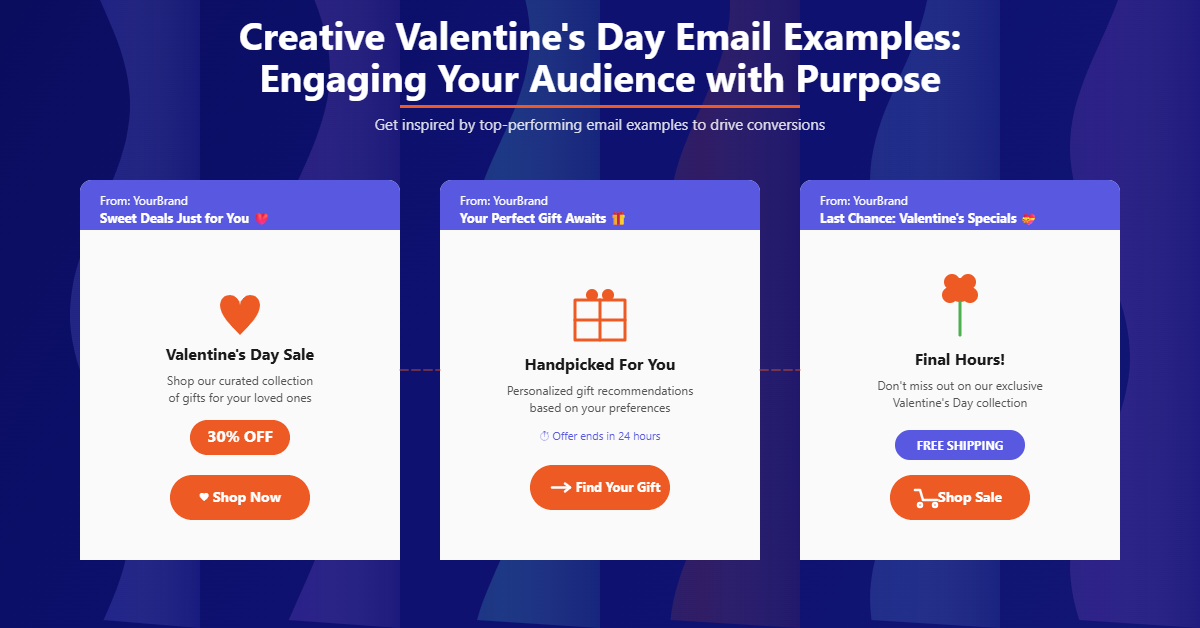
The following Valentine’s Day email examples combine the most-used keywords with emotional framing and ideal lengths.
Each includes a subject, preview, and CTA you can paste into your Valentine’s Day email templates and adapt to your brand voice.
Campaign types vary, so you can slot them into your calendar at the right moments.
Example 1: Occasion/Gifting-led
Subject: Valentine love, perfect gifts that say it all
Preview: Find the gift they’ll love, with fast delivery by Feb 14.
CTA: Shop Gifts
This pairs emotion with gifting intent and a delivery reassurance in the preview, using “love,” “perfect,” and “gifts” to match common open-driving cues.
Example 2: Discount-led value
Subject: Take 20% off Valentine’s gifts they’ll love
Preview: Limited-time savings on bestsellers—free returns make it easy.
CTA: Buy Now
Here, “off,” “Valentine’s,” and “gifts” are balanced with a risk reducer in the preview. It’s ideal for your Thursday or Friday push when shoppers compare offers.
Example 3: Urgency with delivery
Subject: Last chance: Valentine gifts that arrive by 2/14
Preview: Still on time for the big day—choose fast shipping at checkout.
CTA: Order Today
“Last chance” and the date bring urgency, while the preview clarifies the path to on-time delivery. Use this close to your cutoff.
Example 4: Editorial gift guide
Subject: Say it with love: perfect Valentine’s gift guide
Preview: Explore thoughtful, budget-friendly picks for every kind of love.
CTA: Explore
This serves early-funnel discovery with “love,” “perfect,” and “gift”, while the CTA invites browsing. Great for building add-to-cart volume before your value push.
Example 5: Free shipping incentive
Subject: Free rush shipping on Valentine’s gifts they’ll love
Preview: Get it there in time with free rush—limited windows apply.
CTA: Get Offer
For buyers worrying about timing, “free” plus “rush shipping” can unlock clicks. Keep the subject clear and use the preview to set expectations.
Example 6: Price-led curation
Subject: Valentine gifts under $50 that feel special
Preview: Perfect picks for partners, friends, and you—save without compromise.
CTA: Shop Under $50
This reinforces “perfect,” “gifts,” “save,” and a price anchor. It’s strong for budget-conscious audiences and retargeting warm browsers.
Example 7: Early countdown planning
Subject: Two weeks to Valentine’s Day: perfect gift plan
Preview: Learn what sells out first and pre-order to save your spot.
CTA: Learn More
Use this as a warm-up. The subject builds a time cue while the preview sets a helpful expectation about availability.
How to Turn these Examples into Your Calendar
Map these Valentine’s Day email ideas to your funnel. Start with an editorial gift guide and a price-led curation to capture browsing behavior.
Move into a discount-led value message with a shipping assurance in the preview. Add a free shipping incentive if your margins allow.
In the final days, switch to urgency with clear delivery options or pivot to digital gifts and e-gift cards once shipping windows close.
For segmentation, prioritize engaged contacts first with your highest-volume sends on Thursday and Friday.
Follow with browse or cart retargeting to lift conversion.
If you use SMS, reserve it for urgency and last-chance reminders. Short, value-forward copy translates especially well to text during this period.
Conclusion
Winning Valentine’s Day is a prime opportunity to align emotion with value. When you do that and time your campaigns right, you see it in the clicks and sales.
If you want to execute quickly, TargetBay Email & SMS can help you build and launch these sequences with AI-assisted drafting and automated segmentation. Layer TargetBay Reviews to bring social proof into your Valentine’s creative, and use TargetBay Rewards to make gift purchases feel even better with points or perks.
Transparency & Disclaimer
This guide is based on an analysis of 1,575 Valentine’s Day emails from 600+ e-commerce brands, collected over a 56-day period from January 2, 2025 to February 26, 2025, via InboxEagle.com, a third-party platform that tracks email campaigns across public e-commerce sites.
The percentages and trends shared (including inbox placement, timing, subject lines, CTAs, and offer formats) reflect patterns observed within this dataset and time frame only. They are not universal rules, and results may vary based on industry, audience, sender reputation, deliverability practices, and execution.
Inbox placement and engagement are influenced by factors outside the scope of this analysis, including list quality, segmentation, authentication, and recipient behavior.
Disclaimer: The emails analyzed were sent by third-party brands. TargetBay has no partnership, sponsorship, or affiliation with the brands included in this dataset.
All examples and recommendations are intended as benchmarks and guidance, not guaranteed outcomes. Brands should test and adapt these insights based on their own performance data.