



Your Valentine’s Day email blast will almost certainly land in Promotions.
That isn’t a hunch, it’s what the numbers show. Across 1,575 emails from 610 brands, only 0.38% reached the Primary inbox, and a massive 98.92% landed in Promotions.
For e-commerce marketers, this means your campaign is competing for attention in the busiest tab of the season, where sameness in timing, subject lines, and CTAs can bury even a great offer.
The upside is that Promotion placement isn’t a dead end. Use the data below to schedule smarter, reduce spam risk, and build a Valentine’s sequence that stands out when it matters.
Market Visibility Benchmark: what 1,575 Valentine’s emails reveal
The season is saturated. Of the 1,575 emails analyzed from 610 brands, only 6 emails, just 0.38%, hit the Primary inbox.
Eleven emails, or 0.70%, were filtered to Spam. The overwhelming majority, 1,558 messages or 98.92%, were placed in Promotions.
That split builds a clear picture for valentines email marketing: your visibility challenge has less to do with deliverability and more to do with relevance within Promotions.
For most brands, the goal is twofold.
First, maximize performance within Promotions by sending at less crowded moments, using sharper copy and creative, and pairing offers with intent-led CTAs.
Second, experiment with inbox-friendly formats and engagement tactics that can shift a small but meaningful slice of campaigns into Primary, especially to your highest-intent segments.
💕 Win Hearts This Valentine’s!
Get the Valentine’s Day Email Playbook
Steal the show this February with proven campaigns that drive love (and sales!)
Peak send windows to target and avoid
Inboxes crowd fast around midweek through the weekend.
Among non-spam emails, Friday saw 376 sends, Thursday 277, Wednesday 220, and Sunday 209.
If your Valentine’s Day email blast is scheduled for these days, you’re competing directly with the bulk of the market.
Time of day matters just as much. The most common windows for non-spam blasts were 3–6 pm with 326 sends, 9 am–12 pm with 258, 12–3 pm with 253, and 6–9 pm with 218.
Marketers are clustering around late afternoon and early evening, likely chasing end-of-day browsing habits.
That clustering makes off-peak timing a strategic lever for inbox visibility and engagement, especially for segments that reward earlier or later sends.
Using off-peak sends as an advantage is simple. Identify your core segments, loyal customers, recent browsers, gift buyers, and test sends outside the heaviest windows.
Early morning can work for certain audiences, late evenings can pick up post-work intent, and early-week cadence adjustments can meaningfully reduce competition without sacrificing conversion.
More Valentine’s Day Email Marketing Resources for You
Free Valentine’s Day Email Templates
75 Proven Valentine’s Day Email Subject Lines
8 Ways To Nail Your Valentine’s Day Email Campaign
Valentine’s Day Email Strategies: What Works & How To Prepare
Spam risk during blast peaks and how to keep it low
Spam risk rises slightly on heavy-send days.
During peak blast days, spam rates were 0.79% on Friday with 379 total sends, 0.72% on Thursday with 279, 0.90% on Wednesday with 222, 0.95% on Sunday with 211, and 1% on Tuesday with 201.
These percentages are small, but they scale quickly with volume and can harm the sender’s reputation over time.
Protect your placement with clean lists and clear intent. Suppress inactive subscribers who haven’t opened in 90–120 days, throttle high-volume sends across time zones, and ensure authentication is airtight with SPF, DKIM, and DMARC.
Keep subject and preview lines aligned with the offer to reduce ambiguity that can spike complaints.
If you’re running back-to-back valentines marketing ideas, add a preference link and respect reply-based opt-outs to preserve domain reputation.
Hourly inbox placement snapshot #1: what morning tests signal
Morning shows small but real Primary breakthroughs. In our sample, 1.68% of sends between 6–9 am reached Primary, compared to 0.77% from 9 am–12 pm and 0.46% from 6–9 pm.
The numbers are modest, yet they suggest a viable test bed for high-intent segments.
Use the morning window intentionally. Send a plain-text or minimal-design note from a named sender to subscribers who recently purchased gifts, browsed romantic categories, or engaged with your Valentine’s collection.
A conversational tone that invites replies can help your domain build the kind of engagement ISPs look for when considering Primary placement.
Follow up later in the day with your visual, offer-led creative to convert shoppers who first noticed your brand earlier.
Hourly placement snapshot #2: why late afternoon and evening dominate
Overall placement, meaning successful delivery across tabs, spikes later in the day.
Between 9 pm–12 am, the placement rate hit 100% across 135 emails. From 6–9 pm, it was 99.54% across 217 emails, 3–6 pm came in at 99.39% across 326 emails, 12–3 pm at 99.22% across 253, and 9 am–12 pm at 98.08% across 256 emails.
These windows align with peak browsing times and high buyer intent, even if most messages still land in Promotions.
Late afternoon and evening often pair best with offer-forward creative.
Run your hero send in the 12–6 pm window to capture shoppers as they enter decision mode, then a succinct evening reminder for stragglers or cart abandoners.
If you’re running a limited-time perk like free expedited shipping, the 6–9 pm window is a healthy place to amplify urgency without tipping into spammy language.
Hourly spam rates to avoid and guardrails for tests
Some hours carry more risk. From 12am to 6am, spam placement rose to 2.01% across 4 emails.
From 9am–12pm, it was 1.15% across 3 emails, and from 12–3pm, it was 0.78% across 2 emails.
Overnight sends are particularly risky, especially when paired with aggressive subject lines or repeat blasts to the same segment.
Use guardrails for valentines email marketing tests. Cap frequency at one promotional blast per day per subscriber during the final week, and isolate re-sends to a non-open segment with refreshed creative.
Avoid all-caps, excessive punctuation, and misleading urgency.
If you must send late-night reminders on deadline day, minimize promotional imagery, keep copy concise, and send only to engaged, recent openers.
Copy and structure benchmarks that reduce guesswork
Right-sized copy and structure help you fight through Promotions clutter.
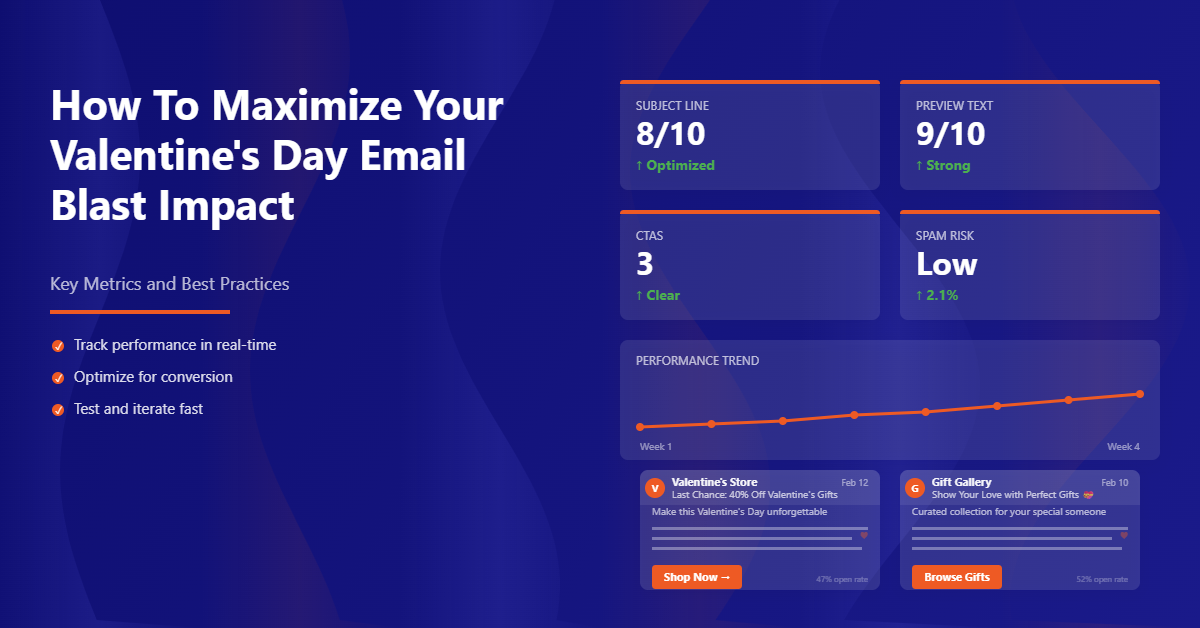
The average subject line length was 46.8 characters and 7.9 words, the average preview text was 64.4 characters and 12.5 words, and the average CTA text was 7.6 characters and 1.4 words.
When you build your Valentine’s Day email blast, aim for 45–50 characters in the subject and 60–65 in the preview. Keep your main CTA to one or two words so it scans instantly on mobile.
Most subject lines leaned into the occasion. Emotional or occasion-led angles appeared in 98.03% of subject lines.
Numeric offer-led subject lines were present in 16.51%, urgency-led in 11.43%, and branded mentions in only 2.48%.
This skew explains why feeds feel repetitive. To stand out, combine occasion with specificity, tie a numeric perk to a gift use case, or foreground shipping cutoffs without drama.
Subject line angles that actually differentiate
Direct beats generic. A clear, concrete promise, paired with Valentine’s context, builds relevance without resorting to clichés.
These examples stay near the 45–50 character range and balance occasion with value.
“Valentine’s gifts they’ll actually use—under $50” marries intent and price clarity.
“A little early love: free rush shipping ends tonight” balances warmth with a concrete deadline.
“Last-minute Valentine? Done-in-2-day gift sets” focus on speed and utility.
“Her wish list, simplified: jewelry bestsellers” narrows the category and signals curation.
“Make it personal: monogrammed gifts for 2/14” highlights personalization and date-driven intent.
“For him, for her, for them—gift guides inside” plays inclusively while telegraphing navigational value.
These lines earn open because they tell shoppers exactly what they’ll get.
If you need to tilt toward Primary for a small segment, test a plain-text note with a human sender like “A quick Valentine’s tip from Maya at [Brand]” and keep the preview tight and conversational.
💕 Win Hearts This Valentine’s!
Get the Valentine’s Day Email Playbook
Steal the show this February with proven campaigns that drive love (and sales!)
Preview text that adds intent
Your preview should complete the promise of the subject rather than repeat it. Aim for 60–65 characters that clarify the lead benefit.
Pair “Valentine’s gifts they’ll actually use—under $50” with “Curated favorites, fast shipping, and easy returns.”
Combine “A little early love: free rush shipping ends tonight” with “Arrives by 2/14 when you order by 8 pm.”
These previews reinforce decision criteria, price, shipping certainty, and ease, without fluff.
CTAs that don’t blend in
Shoppers skim, and most CTAs look the same. The most-used phrases were “shop now” with 412 uses, “shop the sale” with 188, and “buy now” with 121.
Others that appeared frequently included “order now,” “find a gift,” “view collection,” “get the gift,” “explore gifts,” “send love,” and “last chance.”
Rotating to intent-led CTAs helps you stand out in Promotions without sacrificing clarity.
For gift discovery, “find a gift” and “explore gifts” reduce friction for shoppers who don’t know what to buy.
For high-intent buyers, “get the gift” or “add to cart” push action faster. For urgency without shouting, “send love” paired with a shipping promise feels seasonal and effective.
Keep it to one or two words, and match the CTA to the stage of the journey.
A guide-led campaign needs “see gift guide” more than “buy now,” while a restock of a Valentine’s bestseller deserves “grab yours.”
More Valentine’s Day Email Marketing Resources for You
Free Valentine’s Day Email Templates
75 Proven Valentine’s Day Email Subject Lines
Creative Valentine’s Day Email Marketing Ideas
Valentine’s Day Email Strategies: What Works & How To Prepare
What high-frequency senders prove. And what to change
High-frequency brands show that heavy sending doesn’t always trigger spam, but it does cement Promotions placement.
Uncommon Goods reached the Primary inbox 15% of the time, with the remaining 85% in Promotions and 0% in Spam.
Other high-frequency senders like CB Crab Cakes, The Turtle Source, and Lovely Skin had 0% inbox, 100% Promotions, and 0% Spam.
The lesson is clear: reputation alone won’t pull you out of Promotions if your cadence and creative look like a sale blast.
To shift the balance, break the pattern.
Swap one of your promotional sends for a plain-text note inviting replies, such as a short message from your founder sharing top gift picks and asking what the recipient is shopping for.
Segment a high-affinity audience and send a thank-you email with loyalty points, then follow with a Valentine’s offer.
Mix promotions with value, conversation, and recognition, and you’ll accumulate more signals ISPs use to consider Primary for a portion of your list.
Tools can help, especially when you coordinate timing, creativity, and rewards. TargetBay Email & SMS makes it easy to segment engaged buyers, throttle sends across time zones, and launch quick A/B tests with its AI email agent.
Pair that with TargetBay Reviews for fresh photo and video testimonials to drop into Valentine’s product features, and TargetBay Rewards to add points or perks that increase click intent without overusing discounts.
A step-by-step plan to optimize your Valentine’s Day email blast
Start by choosing your send windows based on your audience.
Run your hero blast between 12–6 pm to tap into the 99%+ placement windows, and schedule a segmented reminder between 6–9 pm for cart abandoners and browsers.
For a Primary push, test a 6–9 am plain-text note to your most engaged segment a day earlier.
Build your subject and preview within proven lengths.
Aim for 45–50 characters in the subject with a clear benefit and 60–65 in the preview to add detail like shipping certainty or price anchors.
Keep your primary CTA to one or two words and match it to the stage of the funnel.
Layer in occasion without clichés.
Use emotional framing, but make the value specific, under-$50 lists, guaranteed-by-2/14 shipping, and bestsellers by recipient.
If your Valentine’s marketing ideas include bundles or personalization, highlight that up front.
Protect your sender reputation during peak weeks.
Suppress unengaged subscribers and remove hard-bounces before each send.
Cap daily promotional frequency at one per subscriber and use a different creative concept for re-sends to non-openers.
Measure beyond opens. Track inbox category placement, read time, and reply rates to understand if your tests are moving you closer to Primary for key segments.
Then document what worked and roll those learnings into your post-Valentine’s retention play.
Conclusion
Winning Valentine’s season depends on smarter timing, credible promises, and frictionless paths to purchase.
Use afternoon and evening windows for your hero creative, reserve a morning test for your most engaged buyers, and keep your copy tight and value-led.
When you coordinate campaigns across email, SMS, reviews, and rewards, you reinforce intent at every touchpoint.
TargetBay gives eCommerce teams a unified way to do exactly that. TargetBay Email & SMS helps you segment, test, and schedule with confidence. TargetBay Reviews supplies fresh social proof that boosts clicks, and TargetBay Rewards adds loyalty perks that lift conversion without racing to deeper discounts.
Put the pieces together now, and your Valentine’s Day email blast will do more than show up; it will sell.