



⭐ Key Takeaways
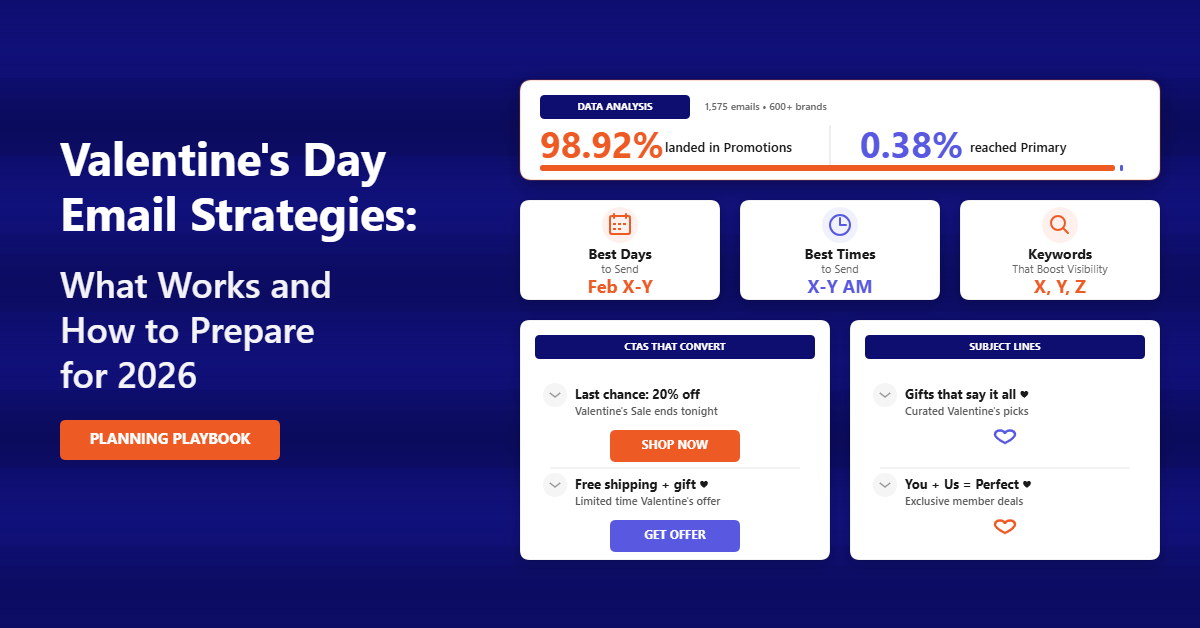
🧩 Promotions dominate: Promotions is the norm with 98.92% of Valentine’s Day emails landing there, and only 0.38% reaching Primary. Plan to win inside Promotions with stronger timing, clarity, and creative rather than chasing inbox placement alone.
⏱️ Best send windows: The best send windows for non-spam emails were Friday and Thursday, with 3–6 pm delivering 20.84% of sends and strong engagement. Secondary windows of 9 am–3 pm and 6–9 pm reminders still perform well for urgency-driven messages.
✉️ Subject line tips: Subject lines that combine “Valentine,” “gift,” and an element of value or urgency outperform generic language. Words like “love,” “special,” “perfect,” “free,” and “last” help you signal intent and timing in a crowded Promotions tab.
🎁 CTA strategy: “Shop now” remains the top CTA with 412 uses, but gift-focused CTAs like “Find a gift” and “Explore gifts” better match the season’s buying intent. Use a clear primary CTA above the fold and echo it near the close, keeping microcopy focused on delivery and returns.
💡 Offer layering: Lead with a numeric offer, used in 29.08% of campaigns, then layer a value-based perk as the deadline approaches. Free shipping, free gifts, or BOGO style incentives—seen in 6.16% of emails—unlock extra conversions without over-discounting.
Valentine’s Day is a gift-driven occasion with a narrow buying window, yet most campaigns never get a fair shot at attention.
In our analysis of 1,575 Valentine’s Day emails from 600+ ecommerce brands, 98.92% landed in Promotions, and only 0.38% reached the Primary inbox
If your Valentine’s Day email performance stalls, it could be due to your timing, subject line choices, and offer packaging, as well as the reality that promotions are where nearly every brand plays.
This guide turns those realities into wins you can publish fast. You’ll see the exact days, times, words, CTAs, and offer formats that moved engagement, along with deliverability lessons from high-frequency senders.
You’ll also get practical Valentine’s Day email marketing ideas, example copy, and creative guidance for banners, templates, cards, and even email signatures so you can ship campaigns that stand out, even in Promotions.
What We Analyzed and Where Emails Landed
The dataset covers 1,575 emails across 610 brands, giving us a clear view into how Valentine’s Day campaigns perform.
Placement data show that 1,558 emails were sent to Promotions, resulting in a 98.92% rate. Only 6 emails were delivered to the Primary inbox, at 0.38%, and 11 were flagged as spam, at 0.70%.
Treat Promotions as your main stage rather than a penalty box. With the right timing, subject lines, and offer framing, Promotions can deliver high-quality clicks from buyers actively shopping for gifts.
The goal is to optimize within Promotions while steadily improving inbox odds on select sends with segmented, conversational tactics.
💕 Win Hearts This Valentine’s!
Get the Valentine’s Day Email Playbook
Steal the show this February with proven campaigns that drive love (and sales!)
Best Send Days and Times for Valentine’s Day Campaigns
Best Days to Send Valentine’s Day Email
The data show that Friday was the strongest single day in terms of send volume and non-spam placement, with 376 emails recorded.
Thursday followed with 277 emails, while Wednesday and Sunday provided additional lift with 220 and 209 emails, respectively.
If your calendar can only support one or two big Valentine’s pushes, prioritize Thursday and Friday, and consider Sunday for last-minute gift reminders and digital delivery offers.
Constant “daily” sending is not required to win.
Instead, anchor your main send on Friday, schedule a supporting offer or reminder on Thursday, and deploy a timely weekend angle around Sunday for shoppers who wait or shift to experiences and gift cards.
Best Times to Send Valentine’s Day Email
Afternoon sends outperformed other windows. The top slot was 3–6 pm with 326 emails, representing 20.84% of non-spam sends.
Morning showed strength as well, with 9 am–12 pm at 258 emails and 16.50%, and midday 12–3 pm close behind at 253 emails and 16.18%.
The early evening window of 6–9 pm still performed adequately with 218 emails and 13.94%, particularly useful for urgency pushes and final reminders.
Default to one of two windows to cover decision-making moments.
Use 3–6 pm for your main Valentine’s Day email when attention peaks and carts get finished, then rely on 9 am–3 pm for complementary sends when shoppers are planning and browsing.
Add a 6–9 pm reminder only for high-intent segments when urgency matters.
More Valentine’s Day Email Marketing Resources for You
Free Valentine’s Day Email Templates
75 Proven Valentine’s Day Email Subject Lines
8 Ways To Nail Your Valentine’s Day Email Campaign
Essential tips for preparing your e-commerce store for valentine’s day
Subject Line Data to Boost Opens
Keywords That Correlate with Visibility
Subject lines that leaned into occasion relevance and gift intent were prevalent and useful.
The word “valentine” appeared 1,751 times and “day” 1,229 times, indicating that clarity about the occasion matters.
Terms tied to the purchase moment, like “gift” or “gifts” at 557 mentions and “love” at 400 mentions, created a strong thematic match with buyer intent.
Value and urgency appeared consistently without spamming caps or symbols. “Off” registered 372 mentions, “sale” 182, “special” 163, “free” 158, “perfect” 138, “save” 128, and “last” 127.
Pairing one or two of these value cues with core event language helps your Valentine’s Day email signal relevance in crowded inboxes.
Emotional and Creative Tones That Spark Curiosity
Non-spam inbox placements struck a balance between emotion and clickbait. “Love” appeared 400 times and “gift/gifts” 557 times, then “special” 163 and “perfect” 138 for specificity.
“Celebrate” had 81 mentions, “treat” 77, “sweet” 72, “heart” 58, and “romantic” 29.
These words help your subject lines resonate with shoppers who are buying for someone else or looking to treat themselves.
Combine an event anchor with one emotional cue and one value promise.
For example, “Valentine gifts they’ll love—last chance to save,” “Perfect Valentine’s Day gift ideas + free shipping,” or “Sweet Valentine picks for every budget.”
Keep your preheader practical by clarifying the offer, the deadline, or the shipping cutoff.
CTAs That Convert Clicks into Revenue
In our dataset, the most common primary CTA was “Shop now,” used 412 times, because it’s familiar and direct.
“Shop the sale” appeared 188 times and works well when the hero creative strongly signals a discount, while “Buy now” with 121 uses helped drive action at the bottom of the funnel and on limited-time deals.
Brands also used gift-centric language to meet the occasion’s intent.
“Order now” tracked 96 uses, “Find a gift” 84, “View collection” 79, “Get the gift” 71, “Explore gifts” 63, “Send love” 52, and “Last chance” 46.
For a Valentine’s Day email, use “Find a gift” or “Explore gifts” for discovery-based collections, then switch to “Shop now” or “Buy now” as availability tightens or offers appear.
Prioritize one dominant CTA above the fold with clear contrast, then repeat a contextual CTA near the close.
If your email shows multiple categories or price tiers, add subtle inline links that reflect each section’s intent, such as “Under $50,” “For her,” or “Ship today,” while keeping the main CTA consistent.
Offer Framing You Should Test
Numeric offers were used in 29.08% of emails, or 458 campaigns, making them the most common and straightforward for shoppers.
Value-based offers showed up in 6.16%, or 97 emails, and included free shipping, free gifts, and buy-one-get-one incentives that heighten perceived value without eroding price integrity.
Lead with a clean numeric offer for your first big Valentine’s Day email, then layer a value-based incentive in follow-ups to reach fence-sitters.
A simple path is to launch with a percent-off or flat discount, follow with free shipping as the deadline approaches, and close with a gift on the last day to push hesitant shoppers to convert.
This sequence respects urgency and value without overcomplicating your message.
Deliverability Lessons from High-Frequency Senders
High-frequency senders mostly landed in Promotions, yet avoided spam.
Uncommon Goods reached the Primary inbox 15% of the time, with 85% in Promotions, while CB Crab Cakes, The Turtle Source, and Lovely Skin sent heavy volumes that placed 100% in Promotions and 0% in the inbox, with all four reporting 0% spam in this sample.
This shows that sending often won’t necessarily trigger spam, but it won’t guarantee inbox visibility either.
Treat inbox placement as a targeted tactic rather than a universal goal.
Use segmented, plain-text style messages to VIPs and recent purchasers when you want replies or two-way engagement, and reduce links and images in those sends.
For broader Valentine’s Day campaigns, design for Promotions and win on clarity, creativity, and timing.
Consistency across your Valentine’s Day email calendar, combined with intentional plain-text touchpoints, helps you build a healthier sender reputation without sacrificing reach.
More Valentine’s Day Email Marketing Resources for You
Free Valentine’s Day Email Templates
75 Proven Valentine’s Day Email Subject Lines
8 Ways To Nail Your Valentine’s Day Email Campaign
Essential tips for preparing your e-commerce store for valentine’s day
Actionable Valentine’s Day Email Ideas You Can Use
Timing Playbook for Fast Wins
Anchor your main send on Friday between 3–6 pm to ride the 20.84% performance window, then add your secondary send on Thursday to capture planners and browsers.
If your audience spans multiple regions, send based on local time zones to meet shoppers at their decision moments.
Use a final push Sunday evening for last-minute gift cards, digital items, or experiences that don’t depend on shipping.
Subject Line Formulae Built on Data
Start with an occasion anchor like “Valentine” or “Valentine’s Day,” add a gift-oriented term, and finish with either urgency or value.
Subject lines such as “Valentine’s Day gifts they’ll love—last day to save,” “Perfect Valentine finds with free shipping,” or “Sweet gifts for every budget—special ends tonight” follow this structure.
Keep preheaders functional by confirming shipping cutoffs, return windows, or the bonus awaiting in-cart.
CTA Placement and Micro-copy That Drive Action
Use a single, unmissable CTA above the fold, either “Shop now” or “Find a gift” depending on whether you lead with an offer or a collection.
Mirror the CTA at the end of the email and make sure any secondary CTAs reinforce your content, such as “View collection” under a curated grid or “Order now” beside a shipping reminder.
Microcopy should reduce friction by clarifying delivery expectations and returns within one short line under your main button.
Offer Strategy and Sequencing for Higher Uptake
Launch with a percent-off or dollar-off headline so shoppers can quickly calculate value, then switch to a perk-led reminder such as free shipping or a gift with purchase.
If your AOV is high, consider a tiered discount that references gift budgets, and follow it with a time-bound gift to nudge indecisive buyers.
Always track whether value-based perks lift conversion more among late-stage shoppers or first-time buyers to refine your last 48-hour strategy.
Creative Building Blocks: Banner, Template, Email Card, and Email Signature
Your banner should prioritize a single idea in two lines or less, such as the collection theme or the discount, with occasion imagery that feels on-brand rather than generic hearts.
Valentine’s Day email templates perform best when they load quickly, use a clear hierarchy, and keep copy short; aim for one hero, one grid, one trust bar, and a footer.
For an email card concept, design a simple animated or static “open me” motif that clicks through to a curated gift experience, while your email signature can carry a soft prompt like “Send love with instant gift cards” linked to a guaranteed-delivery option.
Full Campaign Flow Examples You Can Ship This Week
A simple three-email flow works well for most brands.
Start Tuesday or Thursday with your main offer and gift finder.
Follow with a Friday afternoon reminder that clarifies shipping cutoffs and features bestsellers.
Then close Sunday with a digital or last-minute angle that includes a value-based perk for stragglers.
If you have room for five emails, add a VIP or repeat-buyer plain-text message that requests a reply or offers early access to build inbox engagement.
Aligning Valentine’s Day Email Marketing Ideas With Vertical-Specific Needs
If you sell physical goods, build your calendar backwards from shipping deadlines and move to gift cards as cutoffs pass.
If you sell experiences, lean into “romantic,” “celebrate,” and “treat” language with flexible scheduling and instant delivery.
Subscription brands can pitch the gift of ongoing delight while using value-based perks like bonus months to stimulate gifting rather than self-purchase.
💕 Win Hearts This Valentine’s!
Get the Valentine’s Day Email Playbook
Steal the show this February with proven campaigns that drive love (and sales!)
Valentine’s Day Email Subject Lines, Banners, Templates, and Campaign Examples
For subject lines, lead with clarity and care. Phrases like “Valentine gifts they’ll love—special ends tonight,” “Perfect Valentine’s Day picks under $50,” or “Sweet deals for your sweetheart—free shipping today” hit the right blend of occasion, gift intent, and value.
Keep preheaders informative with notes like “Order by 3 pm for on-time delivery” or “Free gift ends at midnight.”
A strong banner pairs a simple headline with one decisive visual. If you feature a hero product, keep the contrast high between type and image, and let the CTA sit close to the hero.
Avoid clutter and eliminate any extra banners that compete with your main message.
For a high-performing template, keep the layout scannable.
Use a hero with a single CTA, a small grid of three to six products aligned to price tiers or recipient types, social proof or benefits for confidence, and a short footer that reiterates returns and delivery.
Ensure that every section can be understood in under five seconds.
A Valentine’s Day email card can create a charming moment. Consider an “open your card” micro-animation at the top that reveals the gift guide or an exclusive perk.
If you sell personalized items, the card can showcase a name or monogram style with a “Preview yours” click-through.
Even your email signature can add value during Valentine’s season without feeling salesy.
Include a one-line reminder such as “Send love in minutes with instant gift cards,” linking directly to a frictionless purchase page.
Keep it understated so your main offer remains the focal point.
For campaigns and examples in practice, imagine a three-part push.
Email one, “Find a gift they’ll love—15% off Valentine favorites,” with a hero of bestsellers and quick filters for budget, recipients, and shipping speed.
Email two, “Last chance for free shipping on Valentine’s Day gifts,” centered on delivery confidence and trust badges.
Email three, “Forgot shipping? Send love instantly,” featuring digital gift cards, experiences, or printable cards with a small bonus to convert procrastinators.
A Final Note on Execution
Executing a high-performing Valentine’s Day email program is faster when creative, segmentation, and messaging live together.
TargetBay Email & SMS gives e-commerce teams the ability to build and schedule event sends quickly, with an AI email agent that helps write subject lines, copy, and offers using your brand voice. Pair your campaigns with TargetBay Reviews to spotlight photo and video reviews that boost gift confidence, and use TargetBay Rewards to offer value-based perks like bonus points or gifts that close last-minute sales.
With one stack coordinating your holiday calendar, your brand can embrace Promotions, improve inbox odds where it matters, and deliver a Valentine’s Day experience that feels timely, heartfelt, and easy to buy. The result is less guesswork, more clarity, and campaigns you can ship fast with confidence in the outcome.
Transparency & Disclaimer
This guide is based on an analysis of 1,575 Valentine’s Day emails from 600+ e-commerce brands, collected over a 56-day period from January 2, 2025 to February 26, 2025, via InboxEagle.com, a third-party platform that tracks email campaigns across public e-commerce sites.
The percentages and trends shared (including inbox placement, timing, subject lines, CTAs, and offer formats) reflect patterns observed within this dataset and time frame only. They are not universal rules, and results may vary based on industry, audience, sender reputation, deliverability practices, and execution.
Inbox placement and engagement are influenced by factors outside the scope of this analysis, including list quality, segmentation, authentication, and recipient behavior.
Disclaimer: The emails analyzed were sent by third-party brands. TargetBay has no partnership, sponsorship, or affiliation with the brands included in this dataset.
All examples and recommendations are intended as benchmarks and guidance, not guaranteed outcomes. Brands should test and adapt these insights based on their own performance data.