



⭐ Quick Summary
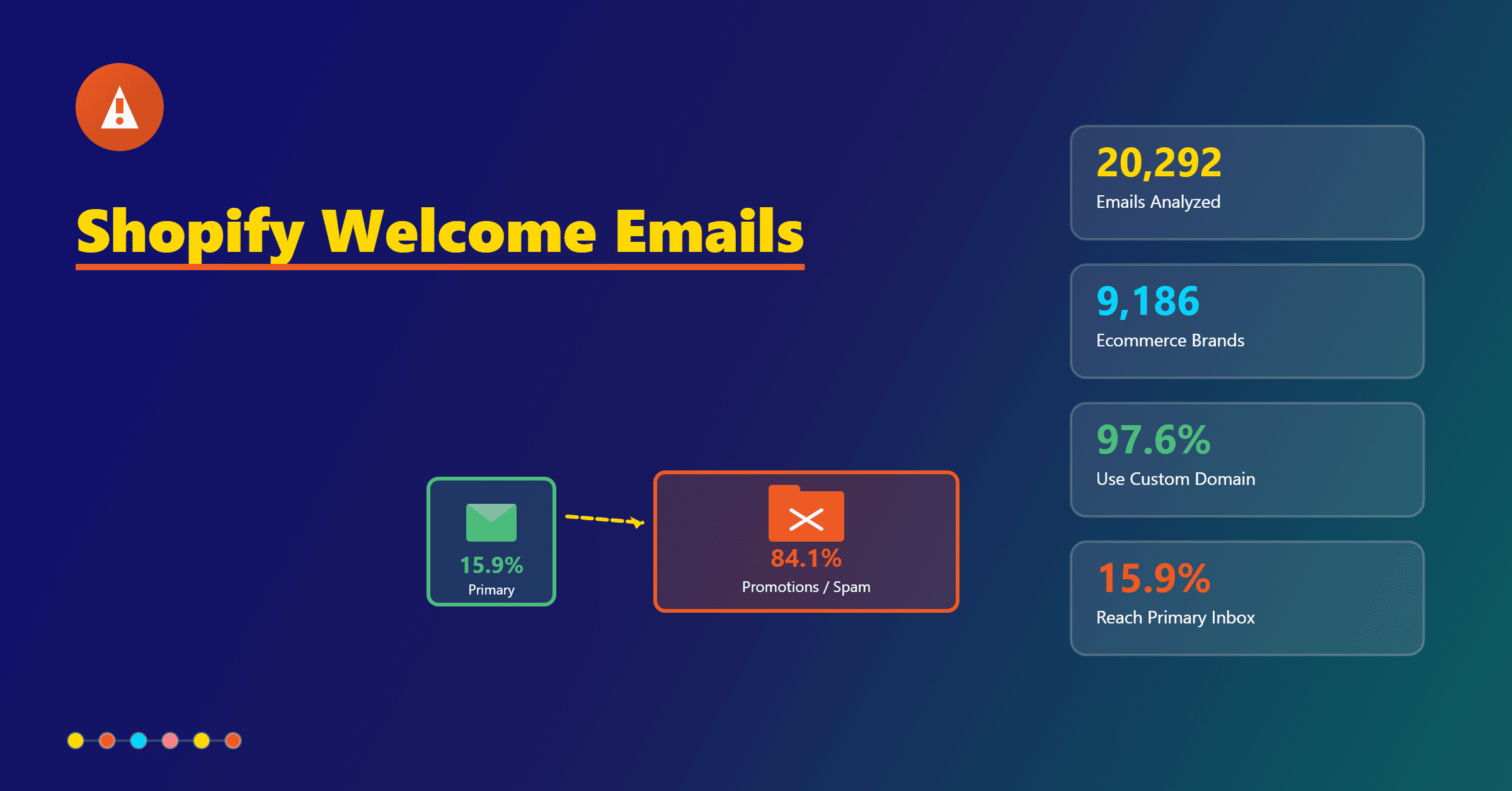
📬 Deliverability drives growth: Deliverability is the growth throttle. Only 15.9% of analyzed messages—3,230 emails—reached the Primary Inbox, which means authentication, domain alignment, and clean content are non-negotiable for revenue from a Shopify welcome email.
🏷️ Custom domains build trust: Domains and identities must be professional. A dominant 97.6% of successful messages—19,815 emails—used a custom root domain, while only 477 used generic Shopify sender patterns. Across 9,186 brands, including the brand name in the “From” field is the clear industry standard.
✂️ Clarity wins opens and clicks: Most subjects—12,253 of them—sat in the 21–40 character range, and 13,983 brands opened with “Welcome,” proving brevity and explicit intent outperform vague or lengthy lines. Pair that with a simple, visible, and trackable “Shop Now” CTA, adopted in 33.8% or 6,866 emails.
🎁 Consistency converts better: Offers should be simple and consistent across channels. With 806 brands using a “10% off” hook, your differentiation comes from message match and execution rather than originality of the number. Maintain the same promise across popup, email, and landing page to reduce drop-off and build trust.
⏱️ Timing and flow depth matter: Depth and timing separate winners. The average flow depth is 2.2 emails, signaling that a focused 2–3 message automated welcome email Shopify sequence is the sweet spot for conversion. Triggers peak between 10 AM and 12 PM UTC, so immediate sends plus time-zone alignment help you reach subscribers when they are most likely to act.
If you run a Shopify store, your welcome email represents one of the most valuable opportunities you have to convert a new subscriber into a paying customer.
At the exact moment someone signs up, their interest in your brand is at its highest level.
They have just discovered your products, they are curious enough to share their email address, and they are far more likely to open and engage with your message compared to any email you send later.
However, despite this advantage, most Shopify welcome emails fail to perform as well as they should.
The problem is not usually the product, the offer, or even the design of the email. Instead, the problem often begins with something far more fundamental: inbox placement.
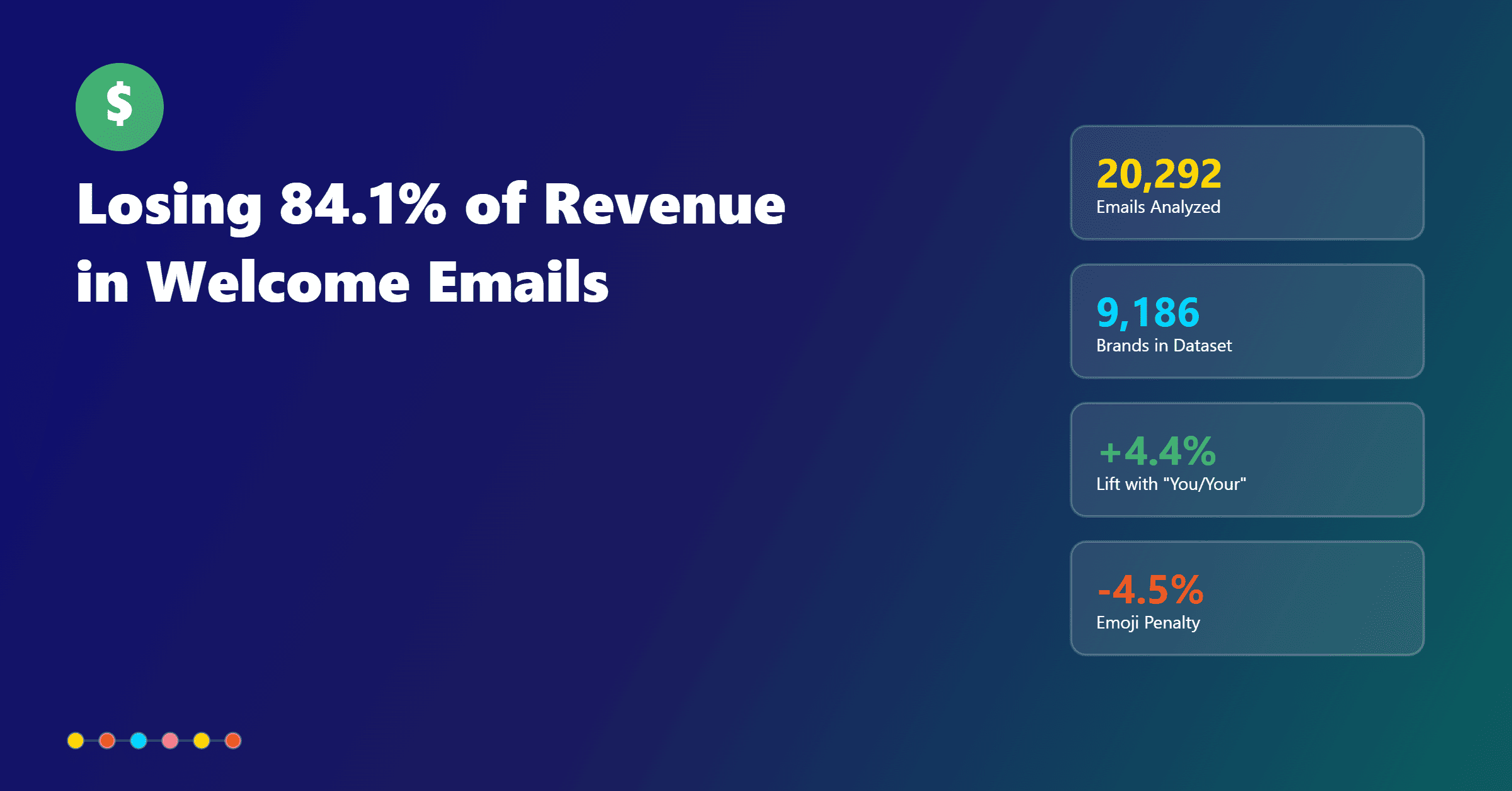
In an analysis of 20,292 emails sent by 9,186 ecommerce brands, only 15.9% of those messages reached the Primary Inbox.
The majority were filtered into Promotions or Spam folders.
This means that even before the subscriber has a chance to evaluate your offer, your welcome email is already competing for attention in a less visible part of the inbox.
For Shopify merchants, this has serious implications.
When your welcome email lands in Promotions instead of Primary, the likelihood of it being opened decreases significantly. And when open rates decrease, conversions naturally follow the same pattern.
Understanding why this happens is the first step toward fixing it.
Why Your Sending Domain Has a Direct Impact on Shopify Welcome Email Deliverability
One of the most important factors influencing inbox placement is the domain you use to send your emails.
The data shows that 97.6% of the emails in the dataset were sent using a custom root domain, such as hello@yourbrand.com, rather than a generic sending address.
This finding highlights a critical best practice that many Shopify merchants overlook when they first set up email automation.
When you use a properly authenticated domain, inbox providers such as Gmail and Outlook are able to verify that your email genuinely comes from your brand.
This verification happens through authentication protocols such as SPF, DKIM, and DMARC, which Shopify allows you to configure.
Without these authentication measures, your welcome email may appear less trustworthy to inbox providers, even if your customer willingly subscribed.
As a result, your email is more likely to be filtered into Promotions or Spam.
From the customer’s perspective, using a recognizable sender address also builds confidence.
When they see an email coming from your brand’s domain, they are more likely to trust the message and open it.
This simple technical step can make a meaningful difference in both deliverability and engagement.
Why Subject Lines Play a Crucial Role in Shopify Welcome Email Open Rates
Even when your welcome email reaches the inbox successfully, your subject line determines whether the subscriber actually opens it.
The analysis revealed that subject lines between 21 and 40 characters were the most common among high-performing welcome emails.
This range appears to strike the right balance between clarity and readability, especially on mobile devices where screen space is limited.
Additionally, the word “Welcome” appeared in 13,983 subject lines, making it by far the most frequently used opening word.
This makes sense when you consider the subscriber’s mindset. They have just signed up and expect to receive a welcome message.
When your subject line clearly reflects that expectation, it reinforces trust and encourages them to open the email.
On the other hand, subject lines that are vague, overly long, or unrelated to the signup experience may cause hesitation, which reduces open rates.
This does not mean your subject line needs to be overly creative. In fact, clarity often performs better than cleverness in welcome emails.
Why Shopify Welcome Email Incentives Work Best When They Are Simple and Clear
Many Shopify store owners wonder whether they need to offer an aggressive discount to make their welcome email effective.
The data suggests that this is not necessarily the case.
The most commonly used incentive was a 10% discount, which appeared in 806 welcome emails.
This indicates that moderate, standard offers are widely accepted and effective.
What matters more than the size of the discount is how clearly it is presented.
Subscribers should immediately understand:
- What the offer is
- How to redeem it
- Where to use it
If these details are unclear, subscribers may lose interest before taking action.
A clear call-to-action also plays an important role. The phrase “Shop Now” appeared in 33.8% of the emails analyzed, making it the most common CTA.
This familiarity helps guide subscribers toward the next step without confusion.
Why Shopify Welcome Email Automation Should Include More Than One Email
Another important finding from the data is that the average welcome flow contained only 2.2 emails.
This suggests that many merchants rely on a single welcome email, or at most two, to convert new subscribers.
While a single email can generate some conversions, it does not fully leverage the opportunity created by the signup.
Customers often need more than one interaction to feel confident making a purchase.
A well-structured welcome flow can gradually build trust by introducing your brand story, highlighting your best products, and addressing common questions.
A tight 2–3 touch sequence combines trust-building with a timely nudge to purchase.
Start with Email 1, focused on value plus incentive. Lead with “Welcome,” state the promise from your pop-up or landing, and surface a single, visible CTA.
Keep friction low by repeating the code and linking to the most relevant collection or product set.
Follow with Email 2 to highlight social proof and your unique selling proposition.
Showcase top-rated products, star ratings, and short testimonials to reduce perceived risk.
If you use a platform like TargetBay Reviews, you can embed fresh photo and video reviews to make the case tangible and timely.
Close with Email 3 is designed for FAQ and objection handling.
Address common blockers like shipping timelines, returns, size guidance, or ingredient sourcing in brief, scannable chunks, and re-present the primary CTA.
Consider including a gentle reminder of the incentive’s expiration without using alarmist language that could trip filters.
Shopify’s automation tools make it easy to create multi-step welcome sequences, and doing so can significantly improve overall performance.
How Timing and Engagement Influence Long-Term Deliverability
Timing also plays a role in welcome email success.
The analysis showed that many automated emails were triggered between 10 AM and 12 PM UTC.
However, the most important factor is ensuring that your email reaches subscribers when they are likely to check their inbox.
Sending the first welcome email immediately after signup is generally the best practice, as it aligns with the moment of highest interest.
Equally important is engagement. Inbox providers monitor whether recipients open and interact with your emails.
Positive engagement signals improve your sender reputation, which helps future emails reach the inbox more consistently.
This means your welcome email does not just affect immediate conversions — it also influences the long-term performance of your email marketing.
On-Site Alignment for Message Match
A high-converting Shopify welcome email begins long before it’s sent.
Align your welcome popup, opt-in capture, and Shopify welcome page so that the email’s subject, headline, and creative precisely match what visitors saw when they subscribed.
Message match reduces confusion, rescues attention, and keeps click-through rates high.
If your pop-up promises “Welcome—10% Off Your First Order,” repeat that exact phrasing in the email hero and on the landing page.
Use the same color, imagery, and code to create a frictionless loop from opt-in to checkout.
When shoppers encounter different languages or new requirements, they hesitate, and filters notice longer dwell times without clicks.
Avoid mystery steps. If redemption requires account creation or a minimum spend, say so in a short sentence next to the code.
Consistency and clarity protect trust, and trust is the primary lever for both deliverability and conversion in a welcome series.
Putting It Together With TargetBay
Execution gets easier when your automation, reviews, and loyalty work together.
TargetBay Email & SMS gives Shopify merchants an integrated way to build and authenticate a custom sending domain, create a 2–3 message welcome flow, and track CTA performance with confidence.
When Email 2 needs fresh proof, TargetBay Reviews can stream in recent photo and video testimonials to reduce friction at the exact moment a shopper is deciding.
If you offer ongoing perks for joining, TargetBay Rewards helps you introduce points or tier benefits in the welcome narrative without complicating the first purchase.
One platform view across email, SMS, social proof, and loyalty lets you test subject lengths, send times, and CTAs while keeping a single source of revenue impact.
Conclusion:
Your Shopify welcome email is far more than a simple introduction. It is your first opportunity to build trust, establish credibility, and guide a new subscriber toward their first purchase.
The data makes it clear that deliverability, subject line clarity, domain authentication, and automation structure all play essential roles in determining whether your welcome email succeeds.
By taking the time to properly configure your email setup, write clear subject lines, present your offer effectively, and build a thoughtful welcome flow, you can significantly improve both engagement and revenue.
When optimized correctly, your Shopify welcome email becomes one of the most reliable and effective tools in your entire marketing strategy.