



⭐ Quick Summary
⏱️ Timed for urgency, not fatigue: A high-performing coupon notifications email strategy blends event-based triggers, fast delivery, and a 7/3/1 reminder cadence that respects preferences while consistently driving urgency and redemption.
🧾 Clarity drives conversion: Template clarity matters most: prominent code display, a single obvious CTA, concise instructions, mobile-first design, and secure unique codes together remove friction and boost conversion.
🎯 Personalization that performs: Personalization fuels action, from names and values to category relevance, dynamic content blocks, and thoughtful coupon code ideas that fit each segment without encouraging code sharing or abuse.
⚙️ Built to scale safely: Scale with confidence using automatic coupons tied to intent triggers and bulk coupons mapped to flows, with code pools, deduping, suppression after redemption, and SMS branching when urgency is paramount.
📊 Measure the full funnel: Track the full funnel—delivery, open, click, redemption, and time-to-redeem—and use cohort tests and holdouts to find incremental gains; tools like TargetBay Email & SMS make this measurable and repeatable.
The fastest way to reclaim that revenue is a high-performing coupon notifications email program that triggers the right message, at the right moment, on the right channel.
Customers don’t forget discounts; they forget emails. Timely delivery notices, smart 7/3/1-day expiration reminders, and instant usage confirmations create urgency and confidence.
When you automate these messages with clear templates and airtight compliance, redemption rates rise predictably.
This guide shows ecommerce marketers how to build, automate, and scale coupon notifications that drive opens, clicks, and redemptions, without overwhelming inboxes or ops teams.
What is a coupon notifications email?
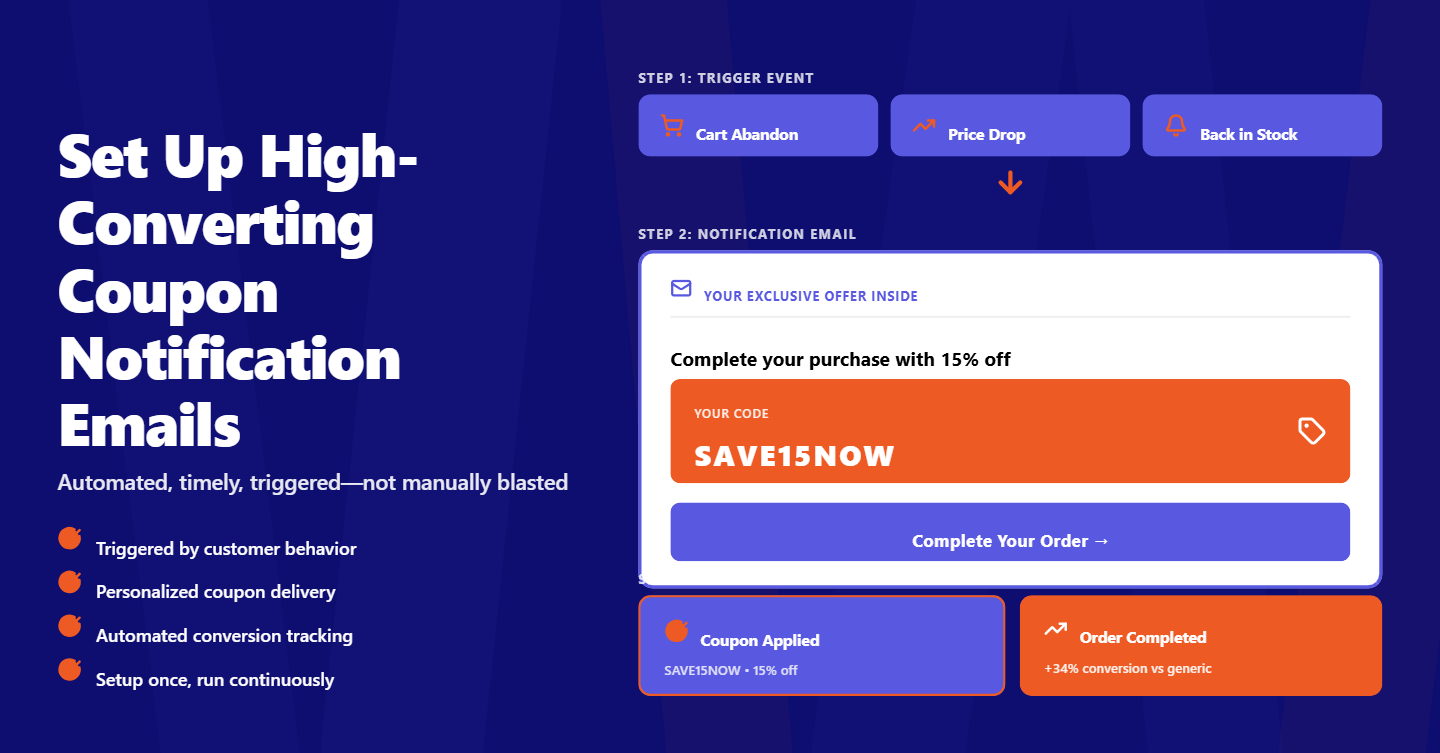
A coupon notifications email is a targeted, event-based message sent when a coupon is created, nearing expiration, redeemed, or running low on usage.
The goal is to maximize redemption and improve the customer experience with timely, relevant nudges.
The core triggers are simple. Delivery notifications fire as soon as a coupon is issued, so shoppers know they have an offer to use, ideally within minutes.
Expiration reminders build urgency on a cadence such as seven days, three days, and one day before the end date.
Usage confirmations arrive immediately after successful redemption, so customers feel confident the discount was applied.
Low‑balance alerts apply to coupons with limited uses or wallet balances, nudging the final use.
Email is the foundation, but SMS matters for time-sensitive alerts. Consider email for full details and instructions, with SMS as a concise reminder close to expiration.
Both channels working together amplify your redemption rate.
Setup and timing rules that maximize speed and respect preferences
Scheduling is where performance is won. Delivery notifications should be queued and sent within five minutes of code issuance to capitalize on the shopper’s current intent.
Expiration reminders should execute precisely on configured intervals, accounting for customer time zones to avoid confusion and late-night pings.
Frequency caps are your safeguard against fatigue. If a customer already redeemed the coupon, suppress further reminders.
If a shopper received multiple coupons, limit how many reminder emails they receive per day. Your system should avoid double-sending when multiple triggers fire at once.
Respecting preferences is non-negotiable. Promotional messages like expiration reminders must honor unsubscribes and preferences.
Transactional messages like usage confirmations should bypass unsubscribe because they are critical to the order and provide necessary confirmation.
This distinction keeps you compliant while ensuring essential notifications get through.
Deliverability must be protected. Use dedicated sending domains and proper authentication, keep your image-to-text ratio healthy, and avoid spammy formatting.
If you also use SMS, adhere to quiet hours and carrier rules, and always include opt-out language for promotional texts.
Templates and examples that actually get redeemed
A coupon notifications email template should be purpose-built for scanning and action.
Lead with a clear headline that names the offer value, date, or category.
Display the code prominently, ideally in a single line with strong contrast for easy copy and paste.
Place a single primary call-to-action button that lands shoppers on the most relevant product or category page tied to the offer.
Redemption instructions remove friction. Specify where to apply the code in checkout, the exact expiration date and time, eligible products or categories, and any exclusions.
Keep the fine print short and link to full terms for transparency.
Design for mobile first. Use large touch targets, 16px+ body text, and high-contrast color. Ensure images have alt text and never lock critical instructions inside images.
Test on iPhone and Android email clients to confirm the code and CTA render correctly.
Security is part of the template. Include unique, single-use codes for campaigns vulnerable to sharing. Avoid predictable code patterns that can be guessed.
Never expose sensitive account data, and only pass codes over secure links. If you host a barcode or code image, serve it via HTTPS and limit unnecessary tracking parameters.
Here’s a simple example in words. The subject line sets the context and urgency with the code value and countdown.
The preheader clarifies the expiration date. The header image is lean and fast-loading.
The hero section shows the code in large monospace text with a copy button and a single Continue Shopping or Apply Code CTA.
The next block shows up to three relevant products or a category match. The footer contains the expiration timestamp, instructions, terms link, and a visible manage preferences link to stay compliant.
Personalization that converts
Personalization turns a forgettable message into a revenue moment.
Pull in the customer’s first name, the unique code, the precise dollar or percentage value, and the exact expiration date and time.
Reference the most relevant category or product they browsed to spark interest.
Dynamic blocks keep the email clean. Show a different hero for new customers versus VIPs, and swap product recommendations by category interest.
If inventory is low or price dropped, highlight that urgency. If the coupon is for a specific category, show that category first and hide irrelevant blocks.
Thoughtful coupon code ideas strengthen your brand and reduce abuse.
For first-time buyers, choose playful but unique formats that feel welcoming.
For lapsed customers, hint at comeback messaging tied to favorite categories.
For VIPs, codes that subtly signal exclusivity perform well without encouraging sharing.
Avoid easy-to-guess sequences and recycle nothing across segments to protect margin.
Subject lines that boost opens
Subject lines carry the heavy lift. Urgent reminder copy works when a coupon is near expiration, especially with precise timing, such as ends in 24 hours.
A gentler nudge is better earlier in the lifecycle, such as your $15 thank-you is waiting.
Usage confirmation lines should be clear and reassuring, like your 20% discount was applied successfully.
A/B test structure, not just words. Trial urgency versus value-first framing, add or drop the expiration date, and test symbols and emojis sparingly.
Use preheaders to finish the thought and reinforce the CTA.
Keep the total length scannable on mobile, and front-load the value so it doesn’t get truncated.
If you leverage an AI email agent inside your platform, feed it outcomes, not just subject line variants.
Pair human judgment with machine-generated options, then roll winners into your control and keep testing quarterly.
Here are a few swipeable ideas you can adapt naturally in your tone.
Your 20% code is here, expires Friday.
Last chance: 12 hours to use SAVE20.
You just saved $15, here’s your confirmation.
Quick heads-up: your code ends tonight. Your code is active—shop denim picks under $60.
Automating at scale with automatic coupons and bulk codes
Automation is where coupon programs earn their keep. Configure automatic coupons for high-intent triggers like signup, first purchase, cart abandonment, and browse abandonment.
Assign the code at the moment of the trigger and send the delivery notification within minutes to ride the intent surge.
When running larger campaigns, use bulk coupons with unique code pools.
Map each campaign to its own pool and set rules for exclusivity, stacking, and eligibility so discounts don’t compound unintentionally.
Always include a fallback message in case a code pool is exhausted, and alert your team when pool capacity drops below a threshold.
Connect coupon pools to flows, not blasts. A triggered flow lets you schedule 7/3/1-day reminders that stop the moment a coupon is redeemed.
Add channel branching so urgent reminders can also go via SMS if the customer opted in.
Deduplicate across flows to avoid sending multiple codes to the same person in a short window.
List growth and compliance without compromise
Encourage shoppers to sign up specifically for coupon notifications and email updates by clarifying the value: faster access to codes, reminder timing, and last‑chance alerts.
Use double opt-in to protect deliverability and ensure you have permission for promotional messages.
Preference centers reduce unsubscribes. Let customers choose the types of promotional coupons they want, new arrivals, categories of interest, or VIP-only offers.
If a customer opts out of promotional emails, continue sending transactional usage confirmations as receipts, and make that distinction clear in your policy.
Healthy deliverability starts with clean data. Suppress complainers and hard bounces automatically.
Respect quiet hours for SMS, and never bury the unsubscribe link.
A great redemption program is worthless if your messages never reach the inbox or create spam complaints.
Measurement and optimization that tie to revenue
Track every step from send to swipe to sale. At a minimum, measure delivery rate, open rate, click-through rate, redemption rate, and time-to-redeem.
Watch how these KPIs change by trigger type, list segment, and channel.
Cohort tests reveal what moves the needle. Compare a 7/3/1-day reminder cadence to 5/2/0 for different ticket sizes.
Test value framing in subject lines versus urgency framing.
Trial send-time optimization models that consider individual engagement history rather than generic time windows.
Attribute properly to avoid over-credit. Use UTM tags and coupon-level attribution so you can connect usage confirmations to orders in your analytics.
Consider holding out groups on at least one reminder in each campaign to understand incrementality.
Where abuse is a risk, monitor unusual redemption patterns and tighten eligibility or switch to unique codes.
The simplest optimization is speed. Redemptions climb when delivery notifications and confirmations arrive within minutes.
If performance drifts, review your queue and processing times to keep messages snappy.
Conclusion
A modern coupon program is not a weekly blast; it’s a precise system of event-triggered messages that create momentum toward redemption.
When you combine a crisp coupon notifications email template, personalized content, a 7/3/1 reminder cadence, and bulletproof compliance, you convert more shoppers without burning your list.
TargetBay Email & SMS helps e-commerce brands build this system end-to-end. You can generate automatic coupons, manage bulk coupons, map code pools to flows, send in minutes, and track redemptions down to revenue.