



⭐ Quick Summary
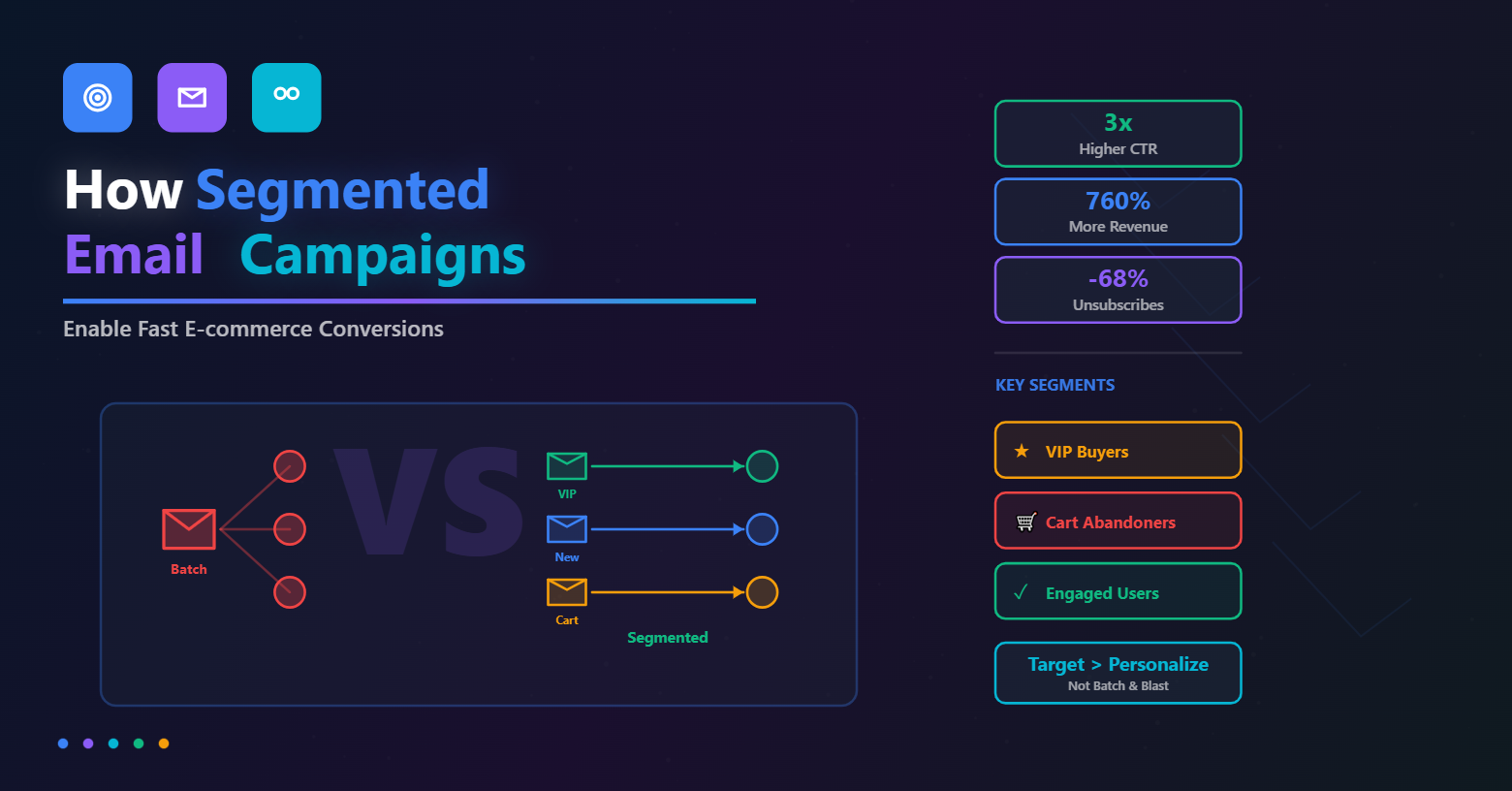
🎯 Relevance beats blasts: Segmented email campaigns outperform blasts by matching timing and relevance to intent, increasing opens, clicks, conversions, and protecting sender reputation while creating predictable, compounding revenue streams for e-commerce brands.
⚙️ Recipes that remove complexity: Pre-built Segment Recipes remove guesswork and accelerate launch, adapting to available data fields so marketers can deploy engaged, lapsed, VIP, cart, and browse audiences without wrestling with complex logic or messy attributes.
📈 Segments that drive ROI: High-ROI segments include engaged subscribers, lapsed customers, VIP buyers, first-time and repeat purchasers, cart and browse abandoners, and seasonal shoppers, each with clear triggers, timely messages, and measurable revenue impact.
📊 Visibility fuels prioritization: Segment Statistics make ROI visible by tracking member counts, growth trends, engagement rates, purchase frequency, CLV, freshness, and overlap, enabling side-by-side comparisons and confident prioritization decisions across your audience.
🚀 Unified segmentation engine: TargetBay Email & SMS unifies Segment Recipes, Segment Statistics, and an AI email agent so e-commerce teams can build, send, and optimize segmented campaigns quickly, proving value by segment and scaling results with less manual work.
Batch-and-blast is costing you attention, revenue, and sender reputation.
Segmented email campaigns win because they match intent with timing and relevance, not volume.
If you want conversions this week, not next quarter, swap generic blasts for targeted messages backed by segment data and simple, repeatable workflows.
This guide shows e-commerce marketers how to move fast with segmented email marketing.
You will learn which segments to prioritize, how to work around messy data, what to send to each audience, what to measure, and how to optimize without guesswork.
What are segmented email campaigns (and why they outperform batch-and-blast)
Segmented email campaigns are targeted sends to subscribers grouped by shared traits or behaviors, such as purchase history, engagement recency, or intent signals like cart activity.
Instead of pushing the same message to everyone, you send segment-specific messages that reflect where each subscriber is in their journey.
This relevance makes your messages easier to act on.
Expect higher open and click-through rates because the subject lines and offers fit the moment.
Expect better conversion rates because calls-to-action match the buyer’s goals.
Expect fewer unsubscribes and spam complaints because you stop over-emailing disinterested contacts.
Over time, these improvements lift your sender reputation, which further improves inbox placement and organic reach.
When done right, segmented campaigns compound in impact. Each segment becomes a mini-performance engine with its own engagement baseline, purchase frequency, and lifetime value, giving you control over revenue levers you simply do not have with one-size-fits-all blasts.
Quick-start segmentation with templates (“recipes”) instead of building from scratch
You do not need weeks of analysis to get started.
Pre-built segment templates, often called Segment Recipes, give you proven logic for common e-commerce audiences so you can go live in hours.
Think of them as best-practice blueprints that you can deploy, preview, and fine-tune before activation.
A good recipe library lets you browse categories like engagement, purchase behavior, lifecycle stage, and cart abandonment.
You can preview the logic, such as “purchased two or more times in the last 12 months and average order value above your median” for VIPs, or “no opens or clicks in 90 days and no purchases in 180 days” for lapsed customers.
One-click deployment creates a copy you can customize, including thresholds, lookback windows, and names that fit your brand conventions.
The best part is adaptability. Recipes automatically adjust to the customer data you already have, including events from your e-commerce platform.
If certain fields are missing, conditions pivot to available signals, so you are never blocked from launching segmented emails while your data matures.
High-ROI e-commerce segments you can deploy today
Start with segments that reflect high-intent actions and clear lifecycle stages. These groups have predictable needs and responses, making them perfect for segmented campaigns that pay off quickly.
Engaged subscribers
This segment includes subscribers who opened or clicked within the last 30 to 60 days and have not purchased recently.
They are primed for content-rich emails with soft offers. Use them to test subject lines, new arrivals, and education that warms them toward a purchase.
Lapsed customers
These are past buyers who have not purchased within a defined window, often 90 to 180 days, and show declining engagement.
They respond well to win-back hooks like replenishment reminders, modest incentives, or social proof that reignites interest without over-discounting.
VIP buyers
VIPs buy frequently, spend more than average, or exhibit high lifetime value. Treat them like insiders.
Offer early access, limited drops, or bundled value they cannot get elsewhere. Even simple recognition messages lift retention and referral behavior.
First-time versus repeat customers
First-time buyers need reassurance and onboarding to become second-time buyers. Repeat buyers are ready for cross-sells, bundles, and loyalty nudges.
Separate these groups to tailor your tone and calls-to-action based on familiarity with your brand.
Cart abandoners
Cart abandoners have shown explicit intent but got interrupted or experienced friction.
Send a fast follow-up sequence that addresses objections, offers help, and reinforces value. Small trust builders often outperform heavy discounts here.
Browse abandoners
Browsers who viewed product or category pages multiple times without adding to cart are earlier in the journey.
Nudge them with back-in-stock alerts, size guides, or customer reviews for the exact items they viewed to build confidence.
Seasonal shoppers
Some customers purchase around holidays, events, or seasonal needs. Tag them based on prior seasonal orders and tailor reminders before the next relevant season.
Previews and limited-time collections keep your brand top of mind at the right moment.
Segmenting email lists fast: required data and practical workarounds
You can start segmenting email lists with a handful of reliable fields. Engagement events like opens, clicks, and last seen dates define recency and interest.
Purchase events like order count, average order value, product categories, and time since last purchase define lifecycle and value.
Basic profile traits like location, device, and acquisition source refine timing and creative.
Data is rarely perfect. Fill gaps with conservative logic that fails gracefully. If average order value is missing, pivot to order count or recency.
If location is unknown, avoid time-zone-based send times and rely on engagement windows from past opens. If product tags are messy, use category-level behavior or URL patterns until taxonomy is cleaned.
Modern segment templates can adapt to your data reality. Conditions prioritize available fields and skip those you do not yet track.
As data quality improves, you tighten thresholds and introduce more granular sub-segments.
If you collect product reviews with TargetBay Reviews, fold in attributes like rating averages or review recency to spotlight advocates and product loyalists.
If you run a loyalty program with TargetBay Rewards, include points balance or tier status to elevate members into VIP-style messages that reinforce exclusivity.
Build-and-send: example of an email marketing campaign for each key segment
Turn segments into outcomes with clear, lightweight flows. Here is an example of an email marketing campaign for four high-impact segments you can ship right away.
For cart abandoners, launch a three-part series over 24 to 72 hours.
The first message reminds them of the items left behind and addresses practical barriers like shipping thresholds or return policies.
The second message adds social proof with star ratings and short testimonials, and invites questions with a direct reply or chat link.
The final message uses a time-bound incentive only if revenue per recipient lags your target, preserving margin while closing the loop.
For lapsed customers, build a win-back sequence over one to two weeks.
Start with a genuine “we miss you” note that surfaces new collections or improvements since their last purchase.
Follow with a tailored recommendation based on past categories or replenishable items, and include useful content that reduces decision friction.
Close with a respectful limited offer for those who still have not engaged, and remove non-responders to protect list health.
For VIP buyers, send early access announcements ahead of general launches.
Lead with exclusivity and preview products before they hit the main list. Add a private perk like free expedited shipping or a bonus sample to reward loyalty.
Wrap with a thank-you note that recognizes their status and invites feedback, which also feeds higher-quality UGC and advocacy.
For recent purchasers, run a post-purchase cross-sell program timed to product usage.
The first message confirms their decision and offers setup or styling tips.
The second recommends complementary items based on the original SKU and includes reviews tied to that use case.
The third invites a review through TargetBay Reviews, which reinforces trust for future buyers while keeping your brand in the customer’s inbox for the right reasons.
Measure what matters with segment statistics
Winning with segmented campaigns requires segment-level visibility.
A dedicated Segment Statistics view gives you the essentials in one place, including current member count, historical growth trends, and daily or weekly growth rates.
This context shows whether each audience is gaining or losing momentum and how effective your acquisition or reactivation efforts are.
Quality is as important as quantity. Track engagement metrics like average open rate, click rate, and purchase frequency over the last 90 days to assess segment health.
Monitor additions and removals to understand how your rules shape membership and to spot leaks caused by overly strict conditions.
Evaluate freshness by looking at how recently members engaged or purchased, which helps determine send cadence and offers that fit their heat level.
Overlap analysis prevents fatigue and cannibalization.
If a subscriber sits in both VIP and cart abandoner segments, decide which message takes priority and cap frequency accordingly.
Compare segments side by side to identify which groups generate the highest revenue per recipient, which grow fastest, and which deserve budget, creative attention, or pruning.
Tie it all to customer lifetime value at the segment level to prove ROI in terms that finance and leadership respect.
Optimization playbook
Treat every segment as a living asset. Run controlled subject line tests tailored to each audience’s intent, such as urgency for abandoners and exclusivity for VIPs.
Rotate offers and creative by segment, and let winners graduate into your default playbooks.
Adjust send cadence based on freshness and engagement, sending more frequently to high-heat segments and pausing or suppressing those who have cooled.
Keep your lists clean. Remove or downshift unengaged members after a defined window to protect sender reputation.
Retire or merge segments that no longer show strong revenue per recipient or that heavily overlap with more effective groups.
Revisit thresholds and lookback windows quarterly to reflect seasonality, promotional calendars, and shifts in acquisition sources.
Finally, close the loop with CRM-quality reporting. Attribute revenue by segment, not only by campaign, and trend it month over month.
When your dashboards show which segments drive purchases and CLV, prioritization becomes obvious and your roadmap stops relying on guesswork.
Conclusion
The path from batch-and-blast to profitable segmented email marketing is shorter than it looks.
Start with proven segment recipes, ship focused campaigns for high-intent groups, measure what matters at the segment level, and tune continuously.
If you want to execute this approach without heavy lifting, TargetBay Email & SMS brings Segment Recipes, Segment Statistics, and an AI email agent together so e-commerce teams can launch segmented campaigns in days, learn fast, and scale revenue with confidence.