



Key Takeaways
🎊 1: Promotions placement is universal in this New Year Email Marketing window, not a penalty. During New Year 2025, 100 percent of emails landed in the Promotions tab, and even higher-frequency senders avoided Spam completely. Design and write for Promotions to capture intent where shoppers actively browse offers.
🎊 2: Afternoon timing aligns with real behavior. The most-used hours were four, two, three, and five in the afternoon, reflecting mobile checking and end-of-day browsing. Schedule your anchor and follow-up in these windows to increase the odds of quick decisions.
🎊 3: Midweek and Friday are high-opportunity days. Wednesday led with 333 emails, followed by Friday and Thursday, with Tuesday as the next tier. Choose to either bring your strongest offer to these peak days or strategically send on an off-peak day to reduce competition.
🎊 4: Two emails are enough when spaced with discipline. The average frequency was 1.94 emails per brand with two to four days between touches. Pair a New Year’s Eve or Day anchor with a value-adding follow-up that changes the angle rather than repeating the first message.
🎊 5: Subject lines and previews must carry the load. In a Promotions-dominant environment, clarity wins. Put “New Year” and the benefit up front, and use preview text to add urgency or a second incentive such as free shipping, extended returns, or bonus rewards.
If your New Year campaigns keep landing in Gmail’s Promotions tab, you’re not alone—and you’re not doomed.
For the 2025 season, we analyzed 1,228 emails from 634 e-commerce brands sent between December 1, 2024 and January 31, 2025.
The headline finding is blunt: every single message placed in Promotions, and high-frequency senders still dodged Spam entirely. In other words, the fight isn’t about avoiding Promotions; it’s about winning inside it.
This playbook turns those findings into an actionable strategy for new year email marketing that boosts opens, clicks, and revenue without risking deliverability.
Deliverability Reality Check (New Year 2025)
The most pressing pain point for e-commerce marketers is placement.
The data shows a uniform outcome: 100 percent Promotions tab placement, with a zero percent spam rate even among brands sending more aggressively. That should be liberating.
If you’ve been burning cycles trying to force primary inbox placement, pivot that energy toward crafting Promotions-optimized content that captures attention in a crowded tab where customers actively look for deals.
Scale matters when interpreting norms, and this dataset carries real weight. Across 1,228 emails from 634 brands, placement behavior was consistent through the full holiday-to-New-Year window. For new year email marketing, that means Promotions is the default, not the exception. Success favours marketers who accept the channel’s reality and retool their creative, timing, and cadence to match actual subscriber behavior in January.
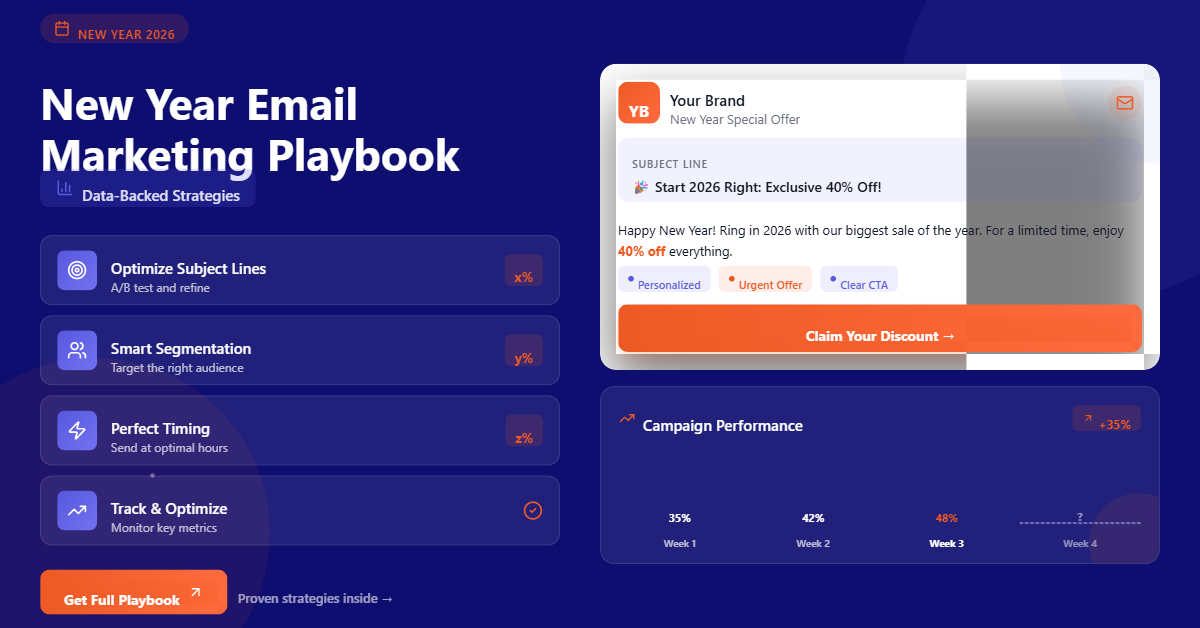
🚀 Ready to Boost Engagement?
Get the Outsmart the Inbox This Year
Stop guessing and start growing with our definitive New Year Email Playbook
Timing by Hour and Placement
Inbox placement rate by hour
Whether campaigns went out in the morning, midday, or evening, the result held steady: 100 percent Promotions across the board. If you were hoping to thread the needle with a magic hour that sneaks into Primary, this season’s data doesn’t support it.
What this means for your strategy
Shifting focus from “escaping Promotions” to “owning Promotions” changes how you build emails. Lead with unmistakable value in the subject line and preview text, create scannable layouts for quick decision-making on mobile, and make the opening block unmistakably about the New Year so the Gmail snippet earns the click. Treat the Promotions tab like a curated storefront display; your job is to be the window that stops the scroll.
More New Year Email Marketing Resources for You
Best Send Days (Volume Leaders)
The crowd gravitated toward midweek and Friday. Wednesday, which included New Year’s Day, saw the highest volume with 333 emails. Friday followed with 277, Thursday with 232, and Tuesday with 120. You can read this two ways. One, lean into the peak by bringing your best offer and clearest message when shoppers are primed for holiday deals and resolutions. Or two, zag when others zig by choosing an off-peak day to claim more attention share with less competition in the tab. Both approaches can work, and the better choice depends on your audience and offer.
If your brand competes on price or limited-time value, Wednesday and Friday are natural anchor days. For high-consideration purchases or creative bundles tied to resolutions, a quieter Tuesday or even a weekend test can help your message breathe. The key is to decide intentionally rather than default to a crowded calendar simply because it’s crowded.
Best Send Times (Afternoon Wins)
Afternoons dominated. Four o’clock emerged as the most-used hour with 109 emails, followed by two o’clock with 103, three o’clock with 92, and five o’clock with 80. This aligns with mobile checking patterns when shoppers are wrapping up their day, browsing on the commute, or planning purchases for the evening. For new year email marketing, aligning offers with this rhythm increases the chance that a shopper not only opens but acts.
There’s also a psychological advantage to afternoon sends around the New Year. It’s when resolution thinking turns into action—adding items to cart, signing up for programs, or redeeming loyalty points. Match your message to the moment. Position time-bound incentives like “ends tonight” or “first 48 hours of 2025” to guide quick decisions. If you operate with limited stock or fast-moving bundles, those afternoon windows convert urgency into revenue.
Cadence and Discipline
The average brand sent just under two emails in this period—1.94, to be precise—with two to four days between follow-ups. This cadence offers a tight, respectful rhythm that keeps your brand top-of-mind while minimizing fatigue. Crucially, even higher-frequency senders in this dataset still landed in Promotions, not Spam, with a zero percent spam rate observed.
This gives you cover to plan a deliberate two-touch sequence for your new year email campaign without fearing deliverability blowback. Anchor your first message around New Year’s Eve or Day, and schedule a second touch two to four days later to capture late shoppers or resolution-makers once inbox clutter settles. Use the second email to add new value rather than repeating yourself: adjust the offer angle, highlight social proof, or introduce a limited quantity to nudge undecided subscribers.
Practical Playbook for New Year 2025
The most reliable approach is simple and purposeful. Start with two emails, give them the best shot with afternoon timing, and build every element to thrive in Promotions.
Begin with an anchor send on New Year’s Eve or New Year’s Day. This is your flagship message tied to “New Year” intent. Make the subject unmistakable, and match the preview text with a direct benefit. Think “Happy New Year” but with substance. For example, a fitness brand might lead with “New Year, New Mileage: 25% Off Running Essentials” and pair a preview like “Free returns through January 31—start strong.” A home goods brand could riff on a resolution theme such as “Refresh Your 2025 Space: Up to 30% Off + Double Rewards Today.”
Follow with a value-added send two to four days later. This second touch should do one of three things: narrow the offer with urgency, reshape the value with bundles, or build trust with proof. If your first email was a broad sale, your second might introduce curated “Resolution Bundles” that pair complementary products. If you led with a discount, reframe the follow-up around loyalty, such as “500 bonus points when you finish your 2025 setup this week.” If your list is cautious or high-ticket, feature reviews in the hero and use a few customer quotes to remove doubt.
Schedule both sends between two and five in the afternoon, and prioritize Wednesday and Friday slots when the calendar lines up. If you anticipate heavy category competition, consider placing your follow-up on a less crowded day like Tuesday to stand out. The decision here should be driven by your category and audience, but the data-backed starting point is clear: afternoons win, and midweek-to-Friday is the volume norm.
More New Year Email Marketing Resources for You
Craft subject lines for Promotions, not Primary. New year email marketing subject lines should surface the core value within the first 40 characters. Put the New Year theme and the incentive early so it appears in the Promotions snippet. Examples you can test include “Happy New Year: 20% Off Ends Tonight,” “New Year Reset: Free Shipping on 2025 Bestsellers,” and “Resolution-Ready: Starter Kits 25% Off.” Pair them with preview text that completes the thought and adds a reason to open, such as “Double rewards today only” or “Extended returns through January.”
Design for decisive scanning. Assume your subscriber is viewing in the Promotions tab on a phone with a short attention span. Put the headline and offer above the fold, keep copy crisp, and use a single primary call-to-action. If you’re promoting bundles, lead with three simple cards with clear benefits. If inventory is limited, call it out immediately. The goal is to help a distracted shopper make a quick yes-or-no decision without scrolling to decode the value.
Use social proof to break ties in crowded tabs. New year email examples that consistently drive clicks pair offer clarity with trust cues. Feature a short testimonial block or star ratings near the primary CTA. If you collect user-generated content or review snippets, this is the moment to showcase them. With TargetBay Reviews, you can highlight photo and video reviews and trigger unlimited requests ahead of the holiday to ensure you have fresh, relevant proof for January campaigns.
Tie in loyalty to increase return purchase rates. Happy new year email marketing is a perfect moment to strengthen relationships, not just chase one-off orders. A modest points boost or tier accelerator nudge can be enough to shift indecisive shoppers. If you run TargetBay Rewards, frame your second email around a time-bound bonus, such as double points on “resolution kits,” or offer early access to 2025 arrivals for members.
Segment lightly but intentionally. Even with a two-touch plan, you can prioritize your highest-intent audiences without overcomplicating the build. Recency segments who opened in the past 30 days should receive both touches by default. High-value segments might get a slightly richer benefit in the second email, like a loyalty multiplier. Lapsed buyers could receive social proof-forward creative with extended returns or hassle-free exchanges to reduce hesitation.
Coordinate email and SMS when appropriate. Afternoon emails pair well with early-evening SMS reminders for campaigns that end at midnight or have tight windows. TargetBay Email & SMS can orchestrate both from one place, and the AI email agent helps quickly generate subject lines, offers, and follow-ups that match your product catalog and loyalty incentives. Keep SMS succinct and respectful—use it to confirm urgency, not to repeat email copy.
Repurpose winners into evergreen New Year flows. Once you identify your strongest-performing new year email ideas, convert them into a scheduled sequence for next season and early January customer lifecycle moments. A “Resolution Start Kit” message, for example, can be adapted for first-purchase customers acquired in late December who are primed to buy complementary products during the first week of January.
Methodology and Timeframe
Findings are based on 1,228 emails sent by 634 e-commerce brands from December 1, 2024 through January 31, 2025. Placement, timing, volume by day and hour, and cadence patterns were assessed across this window with an emphasis on New Year’s Eve, New Year’s Day, and the first two weeks of January. The dataset reflects a broad mix of e-commerce verticals and list sizes and captures real-world behavior during the specific New Year 2025 period. While every audience is unique, the consistency of Promotions placement and the clustering of afternoon sends provide solid benchmarks for planning.
🚀 Ready to Boost Engagement?
Get the Outsmart the Inbox This Year
Stop guessing and start growing with our definitive New Year Email Playbook
Conclusion
The Promotions tab didn’t prevent strong New Year performance in 2025—it set the stage for it. Brands that accepted reality, timed sends for afternoon windows, and kept a disciplined two-email cadence positioned themselves to win attention and revenue without tripping spam filters. A focused approach to creative, timing, and follow-up will outperform endless hacking at placement. If you want a simpler way to execute this plan, unify your program with TargetBay. With TargetBay Email & SMS, TargetBay Reviews, and TargetBay Rewards working together, you can launch on-brand new year email campaigns faster, prove value with social proof, and motivate repeat purchases through loyalty, all from one stack built for e-commerce.
FAQs
Does landing in the Promotions tab kill performance?
No. In this dataset, 100 percent of messages went to Promotions and none to Spam, even for higher-frequency senders. The winning move is to optimize for Promotions by making value obvious in the subject and preview, scheduling during proven afternoon windows, and aligning offers to New Year intent. Promotions is where shoppers look for deals; meet them there with clarity and relevance.
How many New Year emails should I send?
Aim for two touches spaced two to four days apart. The average brand sent 1.94 emails during this period, and that cadence balanced visibility with respect for subscriber attention. Lead with a New Year’s Eve or Day anchor email and follow with a complementary message that adds urgency, bundles, or social proof.
What are the best days and times to schedule?
Use midweek and Friday as your starting points. Wednesday, which included New Year’s Day, saw the highest send volume with 333 emails, followed by Friday at 277, Thursday at 232, and Tuesday at 120. Afternoons performed as the dominant send window, with four o’clock, two o’clock, three o’clock, and five o’clock as the most-used hours. Treat these as benchmarks and test against your audience’s behavior.