



Quick Summary
⭐ Respectful timing and mobile-first design: Lead generation popups feel helpful—not intrusive—when they appear at the right moment, provide clear value, and are optimized for mobile performance.
🎯 Match popup type to user intent: Use email subscription popups for list growth, discount popups to prompt immediate action, survey popups for zero-party data, and exit-intent popups to save abandoning visitors.
📱 Optimize placement and triggers: Tailor popup positions and activation rules by device and page context, add frequency caps, and keep animations quick and subtle to reduce close rates and build long-term trust.
📝 Collect high-quality data with minimal friction: Request only essential fields, use instant validation and consent checkboxes, and map hidden fields to customer profiles so TargetBay Email & SMS automations stay relevant and compliant.
📊 Close the loop with analytics: Track views, submissions, conversion rate, close rate, and revenue attribution to iterate on offers, timing, and variants—compounding list growth and overall sales.
If your store traffic is growing but your list isn’t, you don’t have a traffic problem—you have a capture problem.
A well-built lead generation popup turns passive visitors into subscribers and buyers without wrecking your user experience.
Done right, it boosts email and SMS signups, recovers carts, and personalizes onsite journeys. Done wrong, it feels intrusive, slows pages, and gets closed on sight.
This guide shows you how to plan, launch, and optimize lead generation popups that your shoppers actually welcome.
You’ll get practical frameworks for offers, timing, compliance, UX, thank‑you experiences, and analytics, all aligned with the realities of ecommerce performance.
What is a lead generation popup?
A lead generation popup is an onsite message that captures contact information in exchange for value. That value might be a discount, early access, or a helpful resource.
Why does it still work for ecommerce?
In ecommerce, the goal is list growth that actually converts, not just more emails on file. The right popup also supports cart recovery through exit-intent offers and improves onsite CX by delivering timely, relevant prompts.
Despite mixed opinions, popups still work because they meet visitors where they are in the journey. When your messaging is aligned to intent, and your timing respects attention, shoppers see a helpful nudge, not an interruption.
That’s why a high-quality email subscription popup can consistently deliver 3–8% conversion rates and much higher on exit intent or segmented offers.
Types of popups for lead generation
An email subscription popup is your always-on list builder for new visitors. Use it on high-intent pages with a clear, low-friction offer.
Keep it clean, load fast, and make the reward immediate.
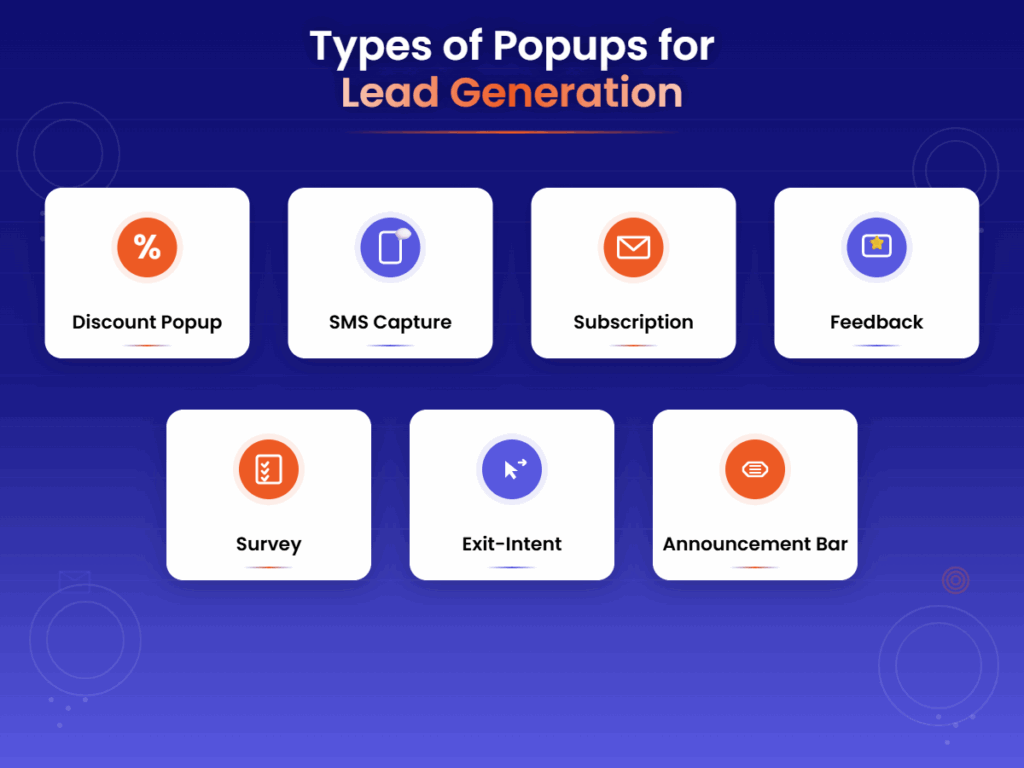
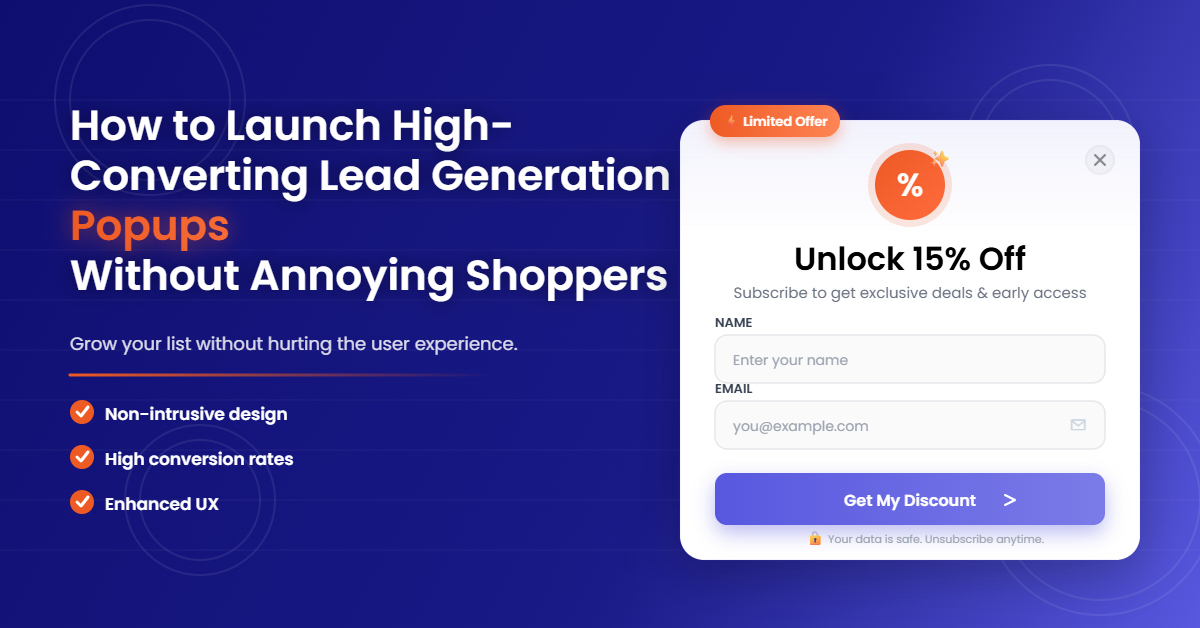
A discount popup drives action with a monetary incentive. Percentage off works best for higher AOV, while a dollar-off offer can feel more tangible at lower price points. Free shipping is a strong fallback when margins are tight.
SMS capture popups work best as a separate, dedicated flow or a two-step approach after email. The goal is to avoid scaring off signups with too much friction upfront. Always include clear TCPA consent and manage expectations around message frequency.
A subscription popup can also be used for back-in-stock, product waitlists, or exclusive drops. It’s ideal for seasonal campaigns or pre‑launch hype where urgency and exclusivity are authentic.
A feedback popup gathers qualitative insights at key moments, such as a visitor struggling with a category page or a user who just completed a purchase. Keep it one question, two taps, max. It builds trust and improves conversion paths.
Survey popups are powerful for zero‑party data. Ask one to three questions about preferences, fit, or use case, and map those answers to customer profiles for tailored email and onsite personalization. The trick is to keep it fast and rewarding.
Exit-intent popups trigger when a visitor is about to leave. This is your last, best chance to save the session or recover a cart with a compelling “don’t miss this” angle. Keep the copy urgent but not pushy.
Announcement bars aren’t traditional popups, but they deserve a place in your toolkit for subtle, persistent messaging. Use them for sitewide promos, shipping thresholds, or lead magnets that don’t require an overlay.
Lead Generation Positions and Timing That Don’t Annoy Shoppers
Choice of display matters as much as the offer. Modal overlays are attention-grabbing on desktop when the value is crystal clear and high.
Slide-ins and corner popups are gentler on mobile and let visitors continue browsing while considering your message. Top or bottom bars are ideal for ongoing incentives that don’t block content.
Think of lead generation positions as a spectrum, from subtle to bold, and match them to device, page, and intent.
Product pages and cart screens tolerate fewer interruptions, while blog or category pages can handle more data capture if the content is truly relevant.
Triggers should respect engagement. Entry popups can work for time-limited events, but scroll-based and inactivity triggers are generally more welcomed.
Exit intent is the least intrusive for new visitors. Frequency capping is non-negotiable.
Cap impressions per session or day, and suppress after a submission or a recent close to keep your close rate down and goodwill up.
More Popup Marketing Resources for You
Offer and Copy Frameworks That Convert
Your incentive must feel immediate and fair. Percentage off creates a value halo on big orders; dollar off is concrete for small baskets; free shipping removes a top purchase objection without punishing margins.
Lead magnets such as fit guides, sample packs, or lookbooks build brand value when discounts aren’t feasible.
Copy should make the value obvious in the first line. Use a strong headline with a benefit, a short body line that clarifies terms, and a direct CTA.
Add urgency when it’s real, like limited release or expiring codes. Layer in social proof sparingly—logos, review counts, or a single line of credibility.
If you use TargetBay Reviews, pull a recent rating or testimonial snippet that matches the page context.
Microcopy reduces friction where it matters. Clarify that you’ll never spam, explain that codes appear instantly, and confirm that unsubscribing is easy. Reassure users with concise privacy language instead of legal walls of text.
Form best practices for quality data and compliance
Short forms convert. Start with an email-only field for your primary lead generation popup unless SMS is a top priority.
If you want both, use a two-step flow that asks for the phone number after capturing the email. You’ll collect more contacts and keep friction low.
Validate email and phone formats instantly. Real-time error messages prevent bad data from leaking into your lists. Include consent checkboxes for GDPR where applicable and clear TCPA language for SMS.
Map fields to customer profiles, including hidden fields that capture source, campaign, and landing page, so downstream journeys in TargetBay Email & SMS stay relevant.
Collect custom fields if they serve segmentation that pays for itself. For example, a quick style preference or pet type can power more relevant recommendations later. If it won’t change your messaging, don’t ask.
UX and performance: launch settings that boost conversions
Your popup should look like your brand and feel native to your site. Use responsive, mobile-first templates that load asynchronously and don’t block page rendering.
Subtle animations under 500ms help catch the eye without creating motion fatigue or jank.
Overlay choices matter. Soften the background just enough to focus attention while keeping the page visible.
Always show clear close control, support the ESC key, and ensure keyboard navigation works. Accessibility is a conversion feature, not just a checkbox.
Customize with care. Simple, brand-aligned templates will outperform heavy designs that slow performance. If you need custom CSS for a perfect fit, keep it light.
In TargetBay Email & SMS, Launch Settings let you pick display style, animation, position, overlay, and close options so you can match each campaign to its use case without code bloat.
Thank‑you experience that drives immediate revenue
The post‑submission moment is where many brands leak revenue. Confirm the action in the popup instantly, show a unique coupon code, and explain redemption steps right there.
If you promised a download, provide the link inline and set it to expire to protect your assets.
Use merge tags to personalize the message and reinforce value. Add a primary CTA like Shop Now that deep‑links to a relevant collection, and consider a secondary CTA to Continue Browsing to reduce pogo-sticking.
If your goal is momentum rather than depth, set a short auto-close so shoppers return to the page with the code copied.
When coupons are part of your strategy, deliver them consistently. Unique codes reduce abuse and tighten attribution. TargetBay’s Thank You options support in-popup confirmations, redirects, dynamic codes, download delivery, social sharing, and tracked next actions so you can convert the moment into measurable sales.
Optimization and ROI tracking
You cannot improve what you don’t measure. Track views, submissions, conversion rate, close rate, and abandonment to spot friction fast. Compare performance by page, device, traffic source, and geography to understand where each popup resonates and where it gets ignored.
Variant testing should be ongoing. Test one change at a time—offer, headline, timing, or form length—to find reliable winners. Use time-series trends to see how seasonality, promos, or site updates affect performance. Export CSVs when you need deeper analysis or want to share results with finance or merchandising.
Tie list growth to revenue. Attribute revenue from popup subscribers within a clear window so you can justify investment and double down on what’s working. TargetBay’s Popup Analytics tracks conversion funnels from views to submissions, variant performance, and revenue attribution in near real time, so you get a trustworthy read on ROI without spreadsheets that go stale.
Bringing it together
A high-performing lead generation popup is a disciplined system. Choose the right popup type for the page and audience, time it respectfully, offer real value, collect clean data, and deliver a delightful thank‑you experience. Then prove the impact with analytics and keep iterating.
If you want a faster path from idea to impact, TargetBay Email & SMS brings templates, forms, launch settings, thank‑you options, and analytics together so ecommerce teams can launch in hours and optimize with confidence. Layer in social proof with TargetBay Reviews or build repeat purchase momentum with TargetBay Rewards when it serves the offer, and keep your growth engine humming.
FAQs
What’s a good conversion rate for a lead generation popup?
Benchmarks vary by offer, traffic quality, and device, but 3–8% is a reliable range for healthy stores. Strong offers with mobile-first UX and exit-intent timing can exceed 10% on qualified traffic.
How do I reduce popup “pop‑off” close rates?
Choose gentler lead generation positions on mobile, like slide-ins, delay triggers until engagement via scroll or brief inactivity, frequency cap impressions, align the incentive to page intent, and test softer animations and copy.
Should I ask for phone numbers or just emails?
Start with email-only to minimize friction and grow your list faster. If SMS is a priority, use a separate SMS popup or a two-step flow, and always include clear TCPA consent language.
Do discount popups train shoppers to wait for sales?
Not if you’re intentional. Use discounts strategically for the first purchase and pair with loyalty value, education, or exclusivity. Mix in non-discount offers like free shipping, early access, or helpful guides.
How do I track ROI from popup subscribers?
Attribute revenue to subscribers acquired via the popup within a defined window and view time-series trends by variant, page, device, and source. TargetBay’s Popup Analytics automates this with conversion funnels and CSV exports.