



⭐ Quick Summary
🎯 Intent-driven segmentation: Relevance scales when segments reflect intent and lifecycle, not just demographics, delivering higher opens, clicks, and revenue while protecting list health and sender reputation across every stage of the customer journey.
📊 Data-driven precision: A durable data foundation blends profile attributes, purchase behavior, engagement signals, custom events, and lifecycle stages to power precise email marketing segmentation that stays accurate and actionable at all times.
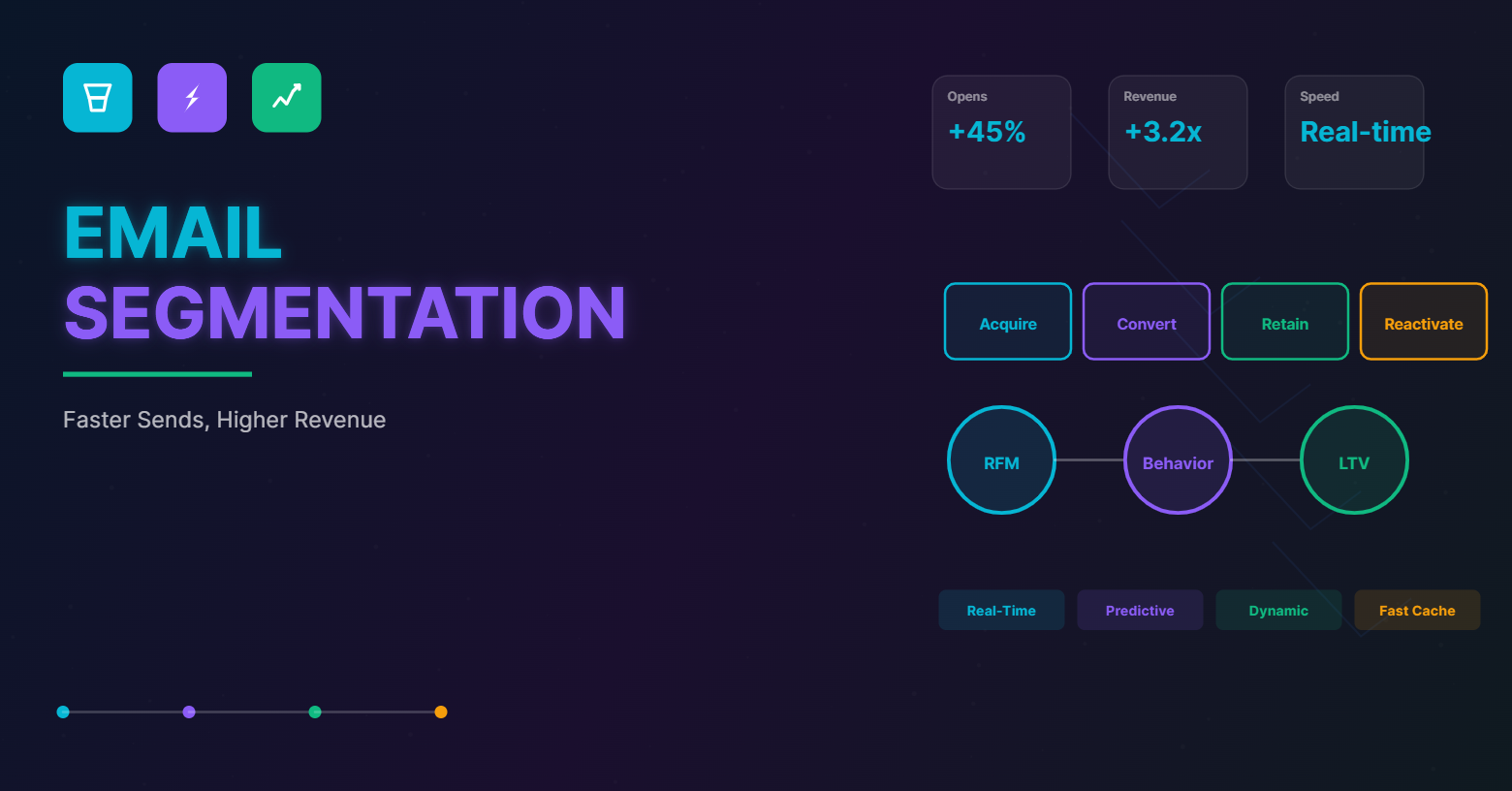
⚡ Real-time, predictive segmentation: Advanced email segmentation thrives on real-time triggers, predictive tiers like RFM and LTV, overlap control to avoid mixed messages, and cache-and-refresh strategies that keep large segments fast and fresh.
📈 Proven e-commerce segments: Proven Shopify and ecommerce segments include new versus returning buyers, VIP and high-AOV cohorts, churn-risk audiences, seasonal shoppers, product or category affinity groups, and discount-sensitive customers aligned to profitability.
🔧 Tools that scale with you: Choose email segmentation software that supports dynamic updates, nested logic, real-time flows, smart caching, and robust segment statistics, and consider TargetBay Email & SMS to unify strategy, speed, and measurable growth.
Batch-and-blast is burning your list and your budget. The fastest path to higher opens, clicks, and revenue is smarter, fresher email segmentation.
Email list segmentation that is designed to update in real time and send at speed.
When you plan segments around intent and lifecycle, and keep them technically efficient, your campaigns cut through the noise and reliably drive profit.
Email segmentation and why it matters in digital marketing
Email segmentation is the practice of grouping subscribers by shared traits or behaviors so each message is more relevant.
In other words, you are segmenting email lists to deliver content that matches intent, timing, and value.
Within email segmentation in digital marketing, this approach consistently outperforms one-size-fits-all blasts because people engage with messages that reflect who they are and what they need right now.
Marketers who commit to email list segmentation see clear improvements across the funnel.
Segmented campaigns typically drive stronger open and click rates, higher conversion, and better revenue per send, while also protecting sender reputation and list health.
The most compelling email segmentation statistics inside your own account will show this lift segment by segment, when you can measure growth, engagement, and customer lifetime value over time.
That proof wins budget, speeds testing, and saves your list from fatigue.
If you are wondering about the difference between email segmentation and personalization, segmentation groups people by common characteristics, while personalization customizes content for the individual inside those segments.
Use both to keep relevance high without fragmenting your strategy.
Data foundation: The must-have email segmentation criterion for e-commerce and Shopify
Strong segments start with reliable data. For e-commerce email segmentation and especially Shopify email segmentation, these criteria form your core building blocks.
Profile attributes establish who the subscriber is.
Think location, language, gender, device type, acquisition source, and consent status.
For Shopify stores, this also includes tags, account status, and loyalty tier if you run a rewards program.
Purchase behavior captures what customers buy and how often.
Use first vs. repeat purchase status, AOV bands, SKU or category affinity, discount usage, time since last order, and refund history.
This is where RFM and LTV tiers originate and where your most profitable segments usually live.
Engagement signals track how subscribers interact with your emails and site.
Recency and frequency of opens, clicks, site visits, product views, and cart events indicate intent.
Separating your highly engaged from dormant audiences keeps your messaging cadence appropriate.
Custom events enrich context. Back-in-stock alerts, review submissions, wishlist adds, loyalty redemptions, and subscription pauses are valuable triggers.
If you use TargetBay Reviews or TargetBay Rewards, these events can feed directly into customer segmentation email marketing for smarter follow-ups.
Lifecycle stage indicates where someone is in their journey. New subscribers and first-time buyers need onboarding and proof.
Repeat customers want timely cross-sells and VIP treatment. Lapsed customers need incentives and social proof to return.
The right email segmentation criterion stack lets you mix and match these data points to reflect intent.
The more current the data, the more accurate the targeting.
Email segmentation strategy: Plan for acquisition, conversion, retention, and reactivation
Effective email segmentation strategy starts with a map.
Anchor every segment to a lifecycle outcome and choose content that meets that intent.
For acquisition, treat new subscribers and first sessions differently from high-intent browsers.
Identify visitors who signed up for a discount, requested back-in-stock alerts, or viewed key categories.
Send education, social proof, and easy next steps. Shorten the path to first purchase with time-bound incentives only where necessary.
For conversion, use behavior-led segments such as product-category viewers, cart starters, and discount-sensitive shoppers.
Align offers to friction points, like reassurance on shipping, sizing help, or price anchoring.
Personalization slots inside each segment can pull in dynamic product blocks and real-time inventory cues.
For retention, build RFM and LTV cohorts, new repeat buyers, loyalists, and VIPs, then give them reasons to keep engaging.
Test exclusive access, loyalty point boosters, and early drops for your top tier. Keep frequency thoughtful to avoid fatigue and segment cannibalization.
For reactivation, target churn-risk subscribers using time since last open, click, or purchase.
Tailor win-back messages with category favorites, reviews from similar shoppers, and a gentle incentive.
If they stay cold, suppress them to protect deliverability and reintroduce later with a refreshed value proposition.
Advanced email segmentation: Predictive tiers, real-time triggers, overlap control, and speed
Advanced email segmentation goes beyond static rules. It blends predictive scoring, real-time behavior, and operational discipline to keep segments both fresh and fast.
Real-time and predictive approaches accelerate relevance.
Use browse and cart intent to trigger timely nudges, then layer predictive tiers like RFM and expected lifetime value to decide who gets what incentive.
A customer who just viewed a high-margin product should not get the same message as a VIP with a repeat pattern in a different category.
Overlap control prevents mixed messages and discount leakage.
Establish rules for segment priority so a subscriber belongs to the single most relevant campaign at any moment.
When segments overlap, use intent scoring and lifecycle stage to determine the winner and gracefully suppress the rest.
Keeping segments fresh and fast is a technical discipline.
Dynamic segments must update automatically as data changes, but heavy queries can slow your sends. An efficient cache and refresh strategy solves this.
The idea is simple: cache segment membership with a sensible time-to-live, refresh on a schedule, and automatically invalidate the cache when data or segment conditions change.
Large segments benefit from partial refreshes, while high-velocity flows should be evaluated in real time and bypass the cache.
Campaigns pull from fresh cached results, so your send time stays quick and your targeting remains accurate.
Having visibility into cache hit rates and the ability to trigger a manual refresh adds control without adding complexity.
Ecommerce and Shopify email segmentation: Proven segments that convert
The most reliable ecommerce segments combine lifecycle and value.
Start by separating new and returning customers because the messages they need are different.
New buyers respond to onboarding and how-to guidance. Returning customers prefer product discovery, refills, or bundles.
High AOV and VIP segments deserve special handling. Give them early access, free expedited shipping, or exclusive products.
Their engagement rate is usually higher, and the incremental revenue from a well-timed VIP launch can be outsized.
Churn-risk segments are built on the time since the last purchase or last engagement.
Keep the tone helpful, share social proof, and right-size discounts. Too much, too soon, can train for promos; too little, too late may miss the moment.
Seasonal shoppers respond well to reminders before the season hits.
If a customer buys during Mother’s Day or Black Friday every year, seed the journey early with curated guides that match past behavior.
Product and category affinity segments tighten relevance at scale.
Send content that reflects what someone browsed or bought, including complementary accessories.
Inventory-aware messaging, back-in-stock notices, and price-drop alerts deepen this connection.
Discount-sensitive buyers need a different lever. They engage with bundles, tiered offers, and loyalty boosts.
Align offers with margin constraints and track response so the segment does not expand beyond your profitability threshold.
B2B email segmentation: Account context, roles, and intent signals
B2B email segmentation adds a layer of complexity because you are mapping accounts and contacts.
Start by distinguishing industries and company sizes because needs and buying cycles vary. Pair this with roles, economic buyers, champions, users, and influencers, so messaging addresses value, ROI, and adoption with the right depth.
Lifecycle stages such as subscriber, MQL, SQL, opportunity, and customer guide your content. Early-stage contacts need problem framing and proof.
Mid-funnel contacts want comparison content and implementation clarity. Customers look for onboarding, training, and expansion plays.
Intent and engagement scores help prioritize. Recency and frequency of email engagement, site actions like pricing or demo page views, webinar attendance, and trial usage patterns belong in your scoring model.
In b2b email segmentation, these signals should dictate follow-up timing and level of personalization. The result is a tighter focus and fewer generic nurtures.
Email segmentation examples that you can launch quickly
A welcome path for new subscribers builds trust and momentum.
Start with brand story and top social proof, then introduce bestsellers or categories based on sign-up source.
Cart and browse abandonment flows recover revenue by reacting to intent.
Use dynamic product blocks, shipping reassurance, and a final push before the cart expires. Keep the tone helpful, not pushy.
Post-purchase cross-sell journeys unlock the next order. Time messages to product use cycles and recommend complementary items.
Reviews and UGC lift confidence, which you can collect through tools like TargetBay Reviews.
Win-back campaigns re-engage dormant buyers. Reference category affinity and highlight what changed, new collections, improved fabrics, or a refreshed policy.
Consider small loyalty boosts for returning customers.
Replenishment reminders respect usage cadence. Use past order timing and SKU to calculate the window.
Keep the call to action simple and add one-click checkout if available.
Back-in-stock alerts perform well because they are permission-based and timely. Couple the alert with relevant alternatives to catch interest if the item sells out again.
Lead-nurture for B2B should adapt to stage and role.
Share case studies, ROI calculators, and implementation guides at the right moments, and ask for soft commitment steps like a sandbox or consultation.
Email segmentation best practices and how to choose the right tool
Testing is your growth engine. Test segment definitions, message angles, incentives, and send times.
Keep each test focused and run it to statistical confidence. Use segment-level reporting to document the lift and share wins.
Control frequency to protect deliverability. Engagement-based capping ensures highly active subscribers can receive more messages while low-intent contacts do not get overwhelmed.
Suppress chronic non-openers and reintroduce them thoughtfully.
Avoid segment cannibalization through prioritization. Decide which segment should win when profiles overlap and document that logic.
This clarity prevents over-messaging and keeps results clean for analysis.
Measure segment quality with real segment statistics, not just campaign metrics. Track membership growth, engagement rates over the last 90 days, purchase frequency, average order value, and lifetime value by segment.
Monitor overlap across key cohorts so you understand how audiences intersect. Look for freshness indicators, such as how recently members were active, so you can time your outreach precisely.
Choosing an email segmentation tool or email segmentation software matters as much as the strategy.
Seek dynamic segment management with nested AND/OR logic, previews for member counts, and automatic updates when data changes.
Prioritize real-time triggers for flows and smart caching for campaigns so large or complex segments do not slow your sends.
Configurable cache policies, partial refresh for very large segments, and safe fallbacks to live queries maintain both speed and accuracy.
A robust statistics dashboard that shows trends, demographics, devices, acquisition sources, and segment overlap gives you the insight to plan next.
Integrations for Shopify and your data ecosystem, along with AI-assisted content, will accelerate execution from segment to send.
Conclusion
Smart, scalable email marketing segmentation means aligning intent, content, and timing while keeping your operations fast.
When segments update dynamically, flows react in real time, and campaigns send from fresh cached results, your targeting stays accurate and your revenue per send climbs.
If you want this balance of speed and precision without complexity, TargetBay Email & SMS brings dynamic segmentation, real-time triggers, cache-aware campaign sending, and deep segment statistics together for ecommerce brands.
Pair it with TargetBay Reviews and TargetBay Rewards to enrich your segments with powerful signals like UGC and loyalty tiers, and you will keep every message relevant from the first send to the fifth order.