



⭐ Quick Summary
🛑 Margin protection by design: Discounts stop leaking margins when rules are centralized, validation stays under 200ms, and enforcement is consistent across products, audiences, channels, and checkout, with clear messages that prevent confusion and abandoned carts.
🔐 Dynamic codes beat sharing: Dynamic, one-time codes tied to identities and strict per-customer usage limits are the most reliable defense against coupon sharing, brute-force enumeration, and code leakage to public deal sites.
🏗️ Built-for-scale architecture: A sound coupon management system design models Coupon and CouponCode separately, guarantees uniqueness, scales to millions of codes, and treats validation as a low-latency, cached read path with idempotent usage writes.
📊 Strategy over blanket discounts: A thoughtful ecommerce coupon strategy segments by lifecycle, channel, and catalog, applies minimum purchase thresholds, controls stackability, and measures incremental lift to avoid cannibalizing full-price orders and eroding contribution margin.
⚠️ Production ≠ open source: Open-source references on a coupon management system GitHub can inspire architecture, but production needs security, rate limiting, and accurate reporting; “free” implementations carry real operational costs without disciplined governance.
Discounts should drive profitable growth, not drain your margins.
If your promo codes regularly leak to deal sites, stack unexpectedly, or fail at checkout, the problem isn’t your customers; it’s your system.
A well-designed coupon management system is one of the highest-leverage tools an e-commerce brand can implement because it directly controls how, when, and to whom you give away margin.
Marketers and store owners rarely lack ideas for promotions. They lack the infrastructure to execute with precision, prevent abuse, measure ROI, and keep checkout fast.
That’s what this guide delivers: a practical blueprint for designing a coupon management system that stops leakage and turns discounts into a reliable, revenue-driving lever.
Why Discounts Leak Margin. And How a Coupon Management System Fixes It
Margins evaporate when static codes escape their intended audience, when stack rules clash with shipping promos, and when minimum thresholds aren’t enforced consistently.
The most common sources of leakage are predictable: one generic code shared widely, the absence of per-customer limits, and slow or unreliable validation that leads to checkout frustration and abandoned carts.
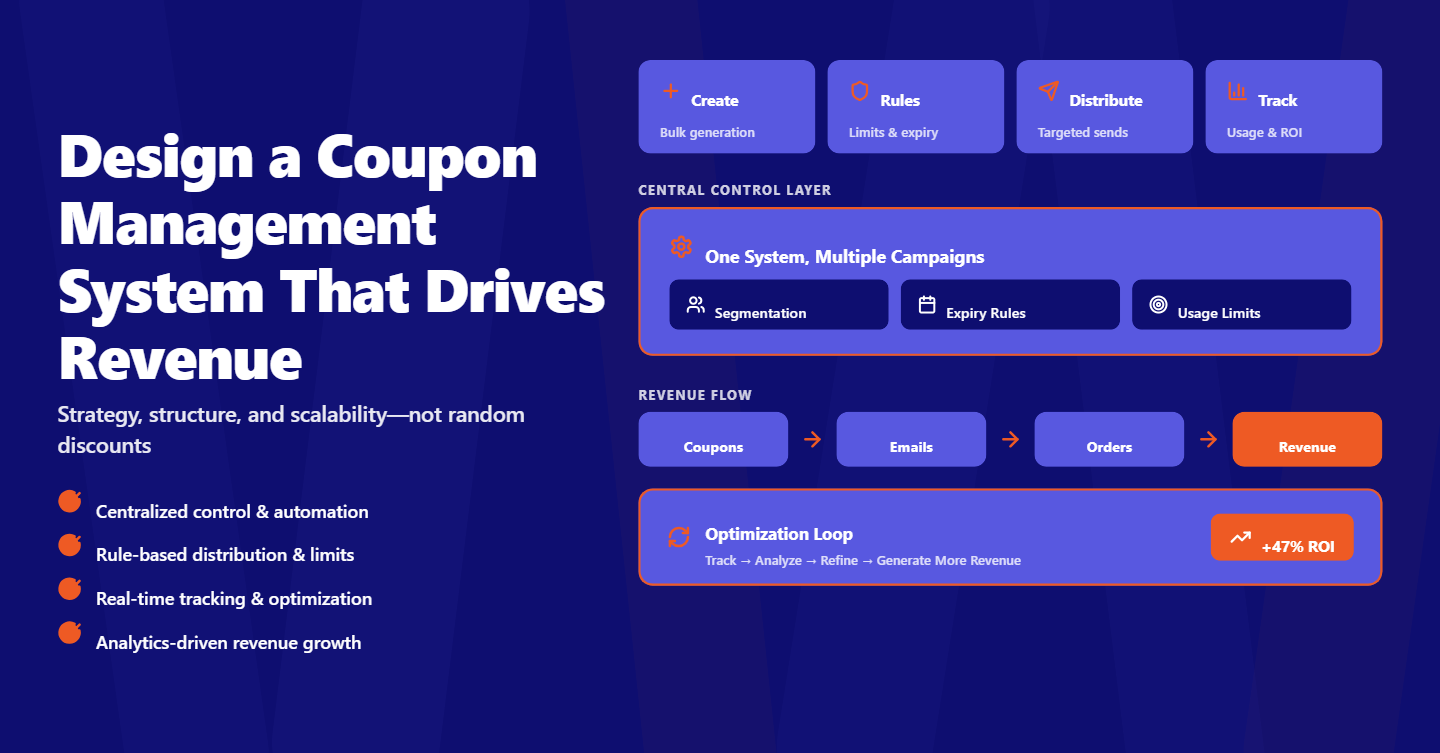
A robust coupon management system fixes these problems by centralizing the rules and enforcing them in real time.
Instead of ad hoc code creation and manual spreadsheets, you define the discount types, targeting rules, and usage limits once and apply them across campaigns, channels, and product catalogs.
The result is fewer unintended discounts, cleaner attribution, and guardrails that protect profitability.
It also helps align marketing and engineering. Marketers can self-serve with safe presets and templates.
Developers get a clear interface with strict guarantees, like uniqueness and 200ms validation, so the checkout experience remains fast under peak load.
Together, these improvements eliminate the guesswork and plug the most common holes.
Core Capabilities Your System Must Provide
Every effective solution starts with CRUD. Marketers need to create, read, update, and delete coupons without tickets or developer support.
That means a clear administrative interface with templated campaigns, duplication for rapid iteration, and role-based access to maintain control.
Support both static and dynamic codes. Static codes are best for broad, time-bound promotions where controlled sharing is acceptable.
Dynamic, one-time codes are unique per recipient and are essential for targeted email or SMS campaigns, VIP offers, and post-purchase win-backs.
Your coupon management system should generate both types reliably and at scale.
Offer multiple discount types and precise eligibility. Percentage-off, fixed-amount, and free shipping are table stakes.
The difference is the targeting: apply offers at the product, collection, or storewide levels, with optional exclusions for specific SKUs.
Add minimum purchase requirements and order-level constraints to protect contribution margin.
Control stackability and compatibility. You need explicit logic for whether a coupon can be combined with other discounts, whether shipping promos count as a “stack,” and how multiple applicable offers are prioritized.
This is where many systems break because edge cases accumulate during holidays and flash sales.
Write the rules up front, enforce them consistently, and keep them visible to both your marketing team and engineering.
Design Essentials and Low-Level Design (LLD)
Modeling makes or breaks your platform. At a minimum, use two core entities: Coupon and CouponCode.
A coupon defines the campaign-level configuration, discount type and value, eligibility filters, usage limits, start and end dates, and stackability.
CouponCode represents an actual redeemable string associated with a specific coupon.
Static campaigns have a single CouponCode with high usage ceilings, whereas dynamic campaigns can generate millions of unique CouponCode rows.
Guarantee uniqueness at the database level. Enforce a unique index on code strings scoped by tenant to prevent collisions.
For dynamic campaigns, generate codes using cryptographically strong randomness and avoid predictable patterns.
Store a normalized uppercase version to enforce case-insensitive matches, and consider a short checksum to detect typos.
Hit the 200ms validation target. Validation happens at a checkout’s critical path, so treat it like a high-performance read.
Co-locate a validation service near your e-commerce platform, cache active coupons and usage counters, and minimize cross-region hops.
Preload product eligibility and customer usage summaries into memory or a low-latency data store.
The read path should check activation state, expiration, usage limits, eligibility filters, and stackability with other currently applied promos, all within a couple of network round-trip times.
Scale to millions of codes. Dynamic campaigns can explode in size when you run large email or SMS blasts.
Partition CouponCode tables by campaign or time window, use consistent hashing in your caching layer, and maintain counters separately from transactional order writes to avoid lock contention.
Write usage counts as idempotent operations tied to an order ID, so retries don’t double-consume a coupon.
Choose your stack pragmatically. If you are on a PHP stack, a coupon management system PHP service can live as a lightweight microservice with a REST or GraphQL interface, backed by Redis for hot reads and a relational store for durability.
If you explore a coupon management system open source or browse a coupon management system GitHub repository for inspiration, treat those examples as architectural guides rather than production-ready modules.
Security, rate limiting, and data accuracy are rarely “coupon management system free” features once you factor in maintenance and compliance.
In regulated environments or multi-tenant contexts, a hardened, audited approach is essential.
Anti-Fraud Tactics That Actually Work
Dynamic, one-time codes are your first line of defence against sharing and deal-site leakage.
Generate a unique code per recipient, tie it to a customer profile or hashed email, and enforce a single redemption.
If a code surfaces publicly, it simply runs out the moment it’s used once.
Enforce per-customer and total usage limits. Store-level guardrails prevent runaway discounts on viral campaigns.
Customer-level limits protect against multiple redemptions across devices or sessions.
Tie every redemption to a customer ID, email, or phone, and use device fingerprinting or IP checks when identity is fuzzy.
Defend against brute force and enumeration. Rate-limit code validation requests per IP, require a minimum code length, and avoid human-readable patterns that encourage guessing.
Consider alphanumeric formats with ambiguous characters removed for usability, and include a short integrity checksum to reduce accidental valid collisions.
Monitor anomalies over time. Spikes in failed validation attempts, unusually high redemption rates from a single ASN, or rapid-fire redemptions in the same minute often signal automation.
Automate alerts and auto-disable suspected campaigns while maintaining detailed logs for investigation.
Configuration That Protects Margins
Minimum purchase thresholds ensure you do not subsidize low-order baskets where shipping and fulfillment eat your profit.
Link thresholds to product-level margin where possible, not just revenue, so thin-margin categories are better protected.
Usage limits should be explicit and layered. Combine total campaign caps with per-customer and per-order constraints.
Consider lowering caps for stackable campaigns and setting stricter limits during peak seasons when leakage risk increases.
Expiration rules need clarity and precision. Use either date ranges or duration-from-issue for dynamic codes.
Enforce time zones consistently, display the rules at checkout, and auto-deactivate campaigns when their end date passes.
Activation and deactivation are operational safeguards.
Give marketers a kill switch for problematic promos, and require approvals or checklists for high-velocity changes.
Store and surface status clearly in your administrative UI so there are no surprises during deployment.
An Ecommerce Coupon Strategy That Segments Smartly
Lifecycle segmentation is the backbone of an effective e-commerce coupon strategy.
Offer modest signup incentives to first-time purchasers to reduce initial friction.
Use stronger win-back offers for lapsed customers who have not purchased in a defined period, and create premium, high-value incentives for VIPs with demonstrated loyalty and high lifetime value.
Channel matters. Dynamic codes distributed via email perform best when coupled with personalized product recommendations and clear expiration messaging.
SMS is ideal for short, time-boxed offers because immediacy drives action.
Align code duration and value with each channel’s engagement pattern, and keep frequency caps to protect list health.
Catalog targeting sharpens your unit economics.
Apply discounts at the product or collection level to promote high-margin items, liquidate overstock, or introduce new categories.
Storewide promos generate buzz but should be constrained by minimum basket size, stackability rules, and time-limited windows to prevent cannibalization of full-price purchases.
Tie strategy to identity and value. Link redemption eligibility to known customers and loyalty tiers to ensure the right customers receive the right benefits.
Even if you operate a separate voucher management system for affiliates or wholesale, unify the rules engine so conflicts are resolved predictably, reporting is unified, and your team speaks a single promotional language.
Checkout Experience That Converts
Customers tolerate almost anything except uncertainty at checkout. Your validation responses must be instant, specific, and helpful.
If a code is invalid, expired, or ineligible for the items in the cart, explain why and how to fix it. Clear, human-readable messages reduce support burden and salvage revenue.
Stack logic must be transparent. If a free shipping promotion is already applied, and the customer adds a percentage-off coupon not eligible for stacking, display which discount will be kept and why.
Preserve the highest-value option automatically to align with customer expectations and reduce decision friction.
Performance is part of the user experience. Keep your coupon validation asynchronous when possible, prefetch eligibility as customers enter the checkout flow, and rely on cached configuration to avoid cold-start delays.
During peak periods, implement graceful degradation that defaults to the safest rules rather than timing out and applying unintended discounts.
Measurement and ROI You Can Trust
Attribution begins with identity. Tie every redemption to a customer profile, order ID, and campaign source.
For dynamic codes, the mapping is straightforward. For static codes, rely on referral UTM parameters and channel-level reporting to infer attribution.
Track redemption at the moment of purchase, not merely at validation. Logging attempts is useful for fraud detection, but only successful redemptions reflect the actual cost.
Persist discount amount, pre-discount subtotal, shipping adjustments, and profit estimates to analyze true margin impact.
Report at the cohort level. Compare AOV, conversion rate, and repeat purchase rate for exposed versus control groups.
Highlight breakage, the percentage of distributed codes that go unused, as a positive contributor to margin.
Measure cannibalization by monitoring how many redemptions would likely have occurred without a discount using holdout groups and incremental lift analysis.
Test systematically. Run A/B tests on discount values, expirations, and minimum basket thresholds.
Measure not only immediate conversion but also downstream behavior like repeat purchase and return rate.
Small improvements in structure and targeting often outperform bigger discounts on absolute profit.
Conclusion
A modern coupon management system is a revenue engine, not a cost center.
When you treat discounts as governed products, with clear rules, fast validation, smart segmentation, and tight measurement, you cut leakage, protect margins, and earn the right to use promotions strategically.
If you want to operationalize this playbook, connect your campaign execution to a messaging platform that handles dynamic, one-time codes and attribution natively. TargetBay Email & SMS helps e-commerce teams distribute unique offers by audience and channel, track redemptions back to profiles, and report on lift without friction.