



⭐ Quick Summary
🏷️ Codes that convert and protect: Unique, readable, brand-aligned coupon codes outperform generic strings by improving redemption, preventing sharing, and powering accurate attribution across email, SMS, popups, and automated flows.
✍️ Naming patterns that scale: Use consistent naming patterns with prefixes, suffixes, and campaign tags, aim for eight to twelve characters, avoid ambiguous letters, and filter reserved words to keep your codes clean and on-brand.
🔐 Margin-safe delivery: Deliver codes in real time with pre-generated pools and single-use uniqueness, apply short expiries and exclusions, and protect margins with inventory or order thresholds that align to profitability.
📊 Test, segment, optimize: Track generated, distributed, and redeemed status, segment results by audience and channel, and A/B test offer types, code wording, and deadlines to find your highest-margin conversion levers.
🚀 Unified offer engine: TargetBay Email & SMS unifies code generation, distribution, and reporting, enabling ecommerce teams to scale personalized offers confidently and pair them with loyalty and UGC strategies using TargetBay Rewards and Reviews.
Coupon codes are more than discounts; they’re micro-conversions that shape your customer’s experience, protect margins, and power attribution.
If you’re stuck recycling the same generic strings, redemption rates drop, sharing spikes, and your reporting gets messy.
This guide gives you high-performing coupon code ideas, practical naming templates, and a simple operational playbook, so you can scale personalized offers without leaks, lag, or confusion.
What Makes a Great Coupon Code
Great codes are short, readable, and unmistakably tied to your brand.
Aim for eight to twelve characters, use uppercase for clarity, and avoid ambiguous characters like O/0 and I/l to prevent errors.
Make typing effortless on mobile, minimize special characters, and keep patterns consistent across campaigns to build recognition.
Clarity converts, so let the code name hint at the offer, audience, or timing.
Add expiry cues in the landing copy or context lines, and if relevant, suffix the code with -24 or -2026 to communicate urgency without clutter.
Uniqueness is non-negotiable; unique single-use codes stop sharing and keep profit intact.
When every code inherits rules for exclusions, redemptions, and duration, customers have a frictionless experience while you maintain control.
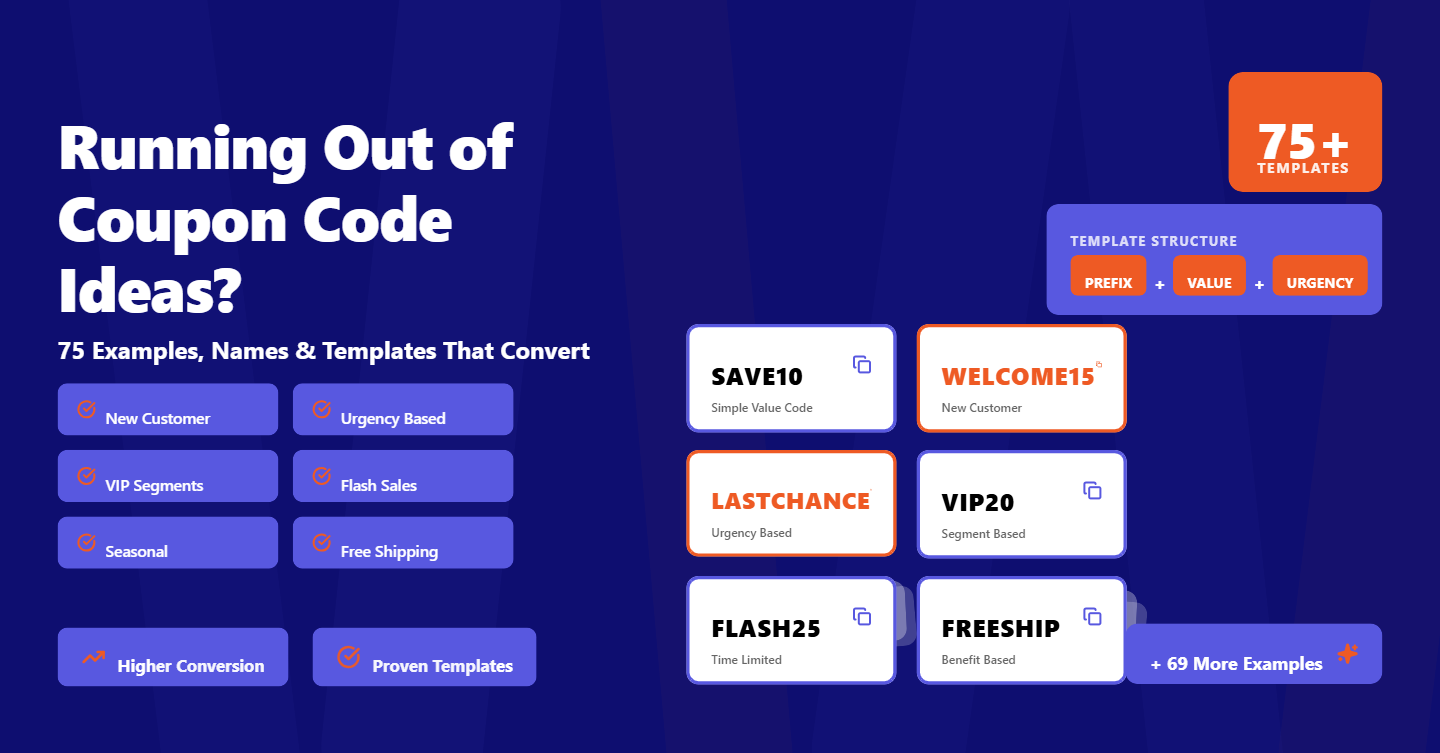
75+ Coupon Code Ideas by Goal
New subscribers coupon code ideas
Welcome codes should feel like a warm handshake and a nudge to place that first order.
Try clean names or personalized templates such as WELCOME10, HELLO15, FIRST15, NEWHERE10, STARTSAVE15, JOINUS10, SIGNUP15, TRYBRAND10, HELLO2026, NEWTHANKS15.
If you prefer tokenized patterns that scale, use WELCOME-{FNAME}-15, JOIN-{BRAND}-10, FIRSTORDER-{RAND6}, or HELLO-{CITY}-10 for geo-friendly targeting.
Returning customers coupon code ideas
For the best coupon code ideas for returning customers, acknowledge loyalty and remove hesitation with simple, friendly language.
Use BACKAGAIN10, WEMISSEDU15, RETURN20, SECONDTIME10, COMEBACK15, REPEAT10, AGAIN15, LOYALTY10, WELCOMEBACK12, BACK4MORE15.
For business buyers or wholesale accounts, promo code ideas for business like B2B-REPEAT15 or TEAMORDER10 reinforce account value without sounding pushy.
VIP and loyalty coupon code ideas
VIP codes reward status and can align tightly with tiers.
Use VIP20, GOLD25, PLATINUM30, ELITE25, INNERCIRCLE20, TOPFAN15, INSIDER20, PRIORITY15, PREMIER20, VIP-2026.
Templates like VIP-{TIER}-20, LOYAL-{RAND6}-25, or ELITE-{MONTH}-20 keep codes on-brand while preventing sharing.
If you run a loyalty program, connect codes with TargetBay Rewards tiers to automate exclusive offers.
Referral and UGC coupon code ideas
Referral and UGC codes should be easy to share yet protected individually.
Try REFER15, FRIEND20, SHARE10, TAGUS15, POSTANDSAVE15, UGC15, REVIEW10, TELLAFRIEND20, INFLUENCE15, BRINGABUD10.
Scalable templates such as REF-{FNAME}-15, FRIEND-{RAND6}-20, or UGC-{PLATFORM}-10 let advocates promote you while your platform tracks each redemption.
Abandoned cart coupon code ideas
Promo code ideas for abandoned cart sequences work best when they feel time-sensitive and helpful rather than pushy.
Use DONTGO10, CARTREMINDER15, SAVEMYCART10, ALMOSTTHERE15, FORGOT10, LEFTINBAG10, LASTSTEP15, TAKE10NOW, FINISHORDER12, COMPLETE15.
Templates like CART-{HOURSLEFT}-10 or BAG-{RAND5}-15 allow flows to personalize urgency and limit overuse with short expiries.
Win-back (lapsed customers) coupon code ideas
Win-back codes should feel like a genuine invitation to reconnect.
Use MISSEDYOU20, COMEHOME20, LAPSED15, BEENAWILE15, REACTIVATE20, BACKIN2026, RETURN2SAVE10, NUDGE10, REJOIN15, AGAIN20.
Tokenized naming such as WINBACK-{MONTH}-20 and MISSED-{FNAME}-15 keeps personalization intact while a unique pool preserves margins.
Birthday coupon code ideas
Birthday offers are inherently personal, so let codes reflect that joy.
Try BDAY15, CAKE20, CANDLE15, BIRTHDAY20, HB2U15, PARTY15, WISH20, MYBDAY10, CELEBRATE20, BDAY-{MONTH}-20.
Add expiry clarity in the message copy, “expires 72 hours after your big day”, so customers feel prompted, not pressured.
Seasonal and Christmas coupon code ideas
Seasonal codes anchor to moments your customers already celebrate.
For Christmas coupon code ideas and holiday events, use XMAS20, HOLIDAY15, MERRY20, SLEIGH15, SNOW10, NOEL15, SANTA20, ELF10, GIFT15, NEWYEAR20.
Templates like CYBER-{RAND6}-25, HOLIDAY-{YEAR}-20, or GIFT-{FNAME}-15 pair beautifully with sales calendars and boost urgency during peak periods.
Notes on voucher code ideas
If your market prefers the term “voucher,” mirror that vocabulary without changing your structure.
VOUCHER15, VCHR20, or VOUCHER-{RAND6}-10 align with UK, EU, and AU conventions while maintaining your standard naming architecture.
Naming Templates and Patterns That Scale
Consistent patterns make codes instantly recognizable and easy to audit.
Prefixes like WELCOME-, VIP-, CART-, and REF- set context at a glance, while suffixes like -2026 or -WEEKEND frame timing.
Standardize length between eight and twelve characters to balance readability and randomness; use alphanumeric sets without ambiguous letters and filter profanity or reserved words to prevent awkward surprises.
Sample patterns that work across campaigns include {BRAND}-{OFFER}-{YEAR}, VIP-{TIER}-{RAND6}, WELCOME-{FNAME}-{DISCOUNT}, CART-{HOURSLEFT}-{RAND5}, and REF-{CUSTOMERID}-{RAND5}.
If you bulk-generate unique codes, enforce tenant-wide uniqueness, cryptographically secure randomness, and automatic validation so there’s zero overlap across promotions.
Reserved-word filtering ensures brand safety at scale, and campaign tags baked into prefixes give you clean reporting later.
Channel Playbooks: Email, SMS, Popups, and Flows
Email remains your highest-converting channel for delivering personalized coupons, especially when each subscriber receives a unique, single-use code.
Pair welcome offers with browse or cart behavior to avoid over-discounting, and add deadlines in subject lines or preview text to lift open rates.
SMS thrives on immediacy. Keep codes short and tappable, and include a direct link with the offer auto-applied.
Segment by customer lifecycle so promo code ideas for business buyers differ from consumer segments, and avoid repeating static strings that leak into coupon sites.
Popups and onsite reveals reward intent in real time. Use code reveal after an email or SMS opt-in and pre-generate pools of unique codes so there’s no lag.
Flows for signup, browse abandon, cart abandon, post-purchase, VIP milestones, and birthday messages should auto-issue unique codes and check pool levels before sending.
When you use TargetBay Email & SMS, you can pre-generate code pools, trigger codes in real time within flows, and track performance per audience and channel, all without manual uploads or slow delivery.
Prevent Sharing and Protect Margins
The fastest way to protect margins is to stop using static codes. Single-use unique codes, validated tenant-wide, all but eliminate sharing.
Enforce redemption limits, exclude high-return or low-margin SKUs, and set short expiries for sensitive events.
Add inventory or price thresholds so the code only applies when it makes business sense, and set minimum order values to maintain average order value.
If codes leak, reduce exposure by tightening durations, requiring account login, and distributing via channels tied to identity, like email and SMS.
For high-risk scenarios, cap per-customer redemptions and restrict stacking with other promotions.
Tracking and Measurement You Can Trust
Reliable attribution starts with clean lifecycle tracking: generated, distributed, and redeemed.
When every unique code maps to a person and campaign, you can compare lift by segment and source and see where value is created.
Benchmark opt-in incentives against cart recovery and win-back offers, and A/B test percent-off versus fixed-dollar discounts to gauge margin impact.
Test naming variants, deadlines, and code length for friction, and monitor abuse signals like sudden redemptions from unknown domains or mismatched geo.
With TargetBay Email & SMS, you can pull performance by campaign and audience, filter by status, and export results, enabling rapid iteration instead of guesswork.
Coupon Code Design Ideas That Boost Redemption
A coupon is a small piece of UI, so design it like one. Use high-contrast backgrounds and large, mobile-first typography so codes are scannable at a glance.
Add copy-to-clipboard on web and “tap to copy” in email and SMS.
If you operate in-store or run omnichannel campaigns, include a QR that carries the code and your offer pre-applied.
Consider code reveal versus always-on presentation. Reveal gates add perceived value and discourage scraping, while always-on boosts speed in lifecycle emails.
Pair coupons with a visible countdown timer near the call-to-action to increase urgency, and reiterate expiry and exclusions directly under the code to minimize support tickets.
Operational Checklist for Scalable Coupon Management
If you plan to distribute thousands of personalized codes daily, prepare your system as carefully as your creative.
Bulk-generate unique codes in advance, with automatic retries for any failed generation attempts, and validate uniqueness during creation so pools don’t collide.
Choose length and character sets that meet your brand’s readability standards, automatically filter reserved words and profanity, and align code prefixes with your campaign taxonomy so analytics stay clean.
Export pools to CSV if you need a backup or offline workflow, but prioritize automatic distribution through campaigns, flows, and popups for speed and accuracy.
Make code pools replenish by default, and keep codes immediately available for use so there’s no delay in time-sensitive flows like abandoned cart.
If you’re handling VIP or referral incentives, connect codes to their parent coupon settings so exclusions and redemption limits follow every unique code.
Conclusion
Inventive coupon code ideas are only half the battle; operational excellence makes them profitable.
When codes are readable, on-brand, unique, and delivered in real time, you raise redemption while cutting abuse and support overhead.
TargetBay Email & SMS helps ecommerce teams automate code distribution in emails, SMS, popups, and flows, pre-generate unique pools, and track generated versus distributed versus redeemed, so your creative energy translates directly into revenue.
If you also run loyalty or referral initiatives, TargetBay Rewards and TargetBay Reviews can reinforce VIP and UGC strategies that pair perfectly with your offer architecture.