



Key Takeaways
🎉 Afternoon wins the timing battle: Across 1,228 campaigns, the most used hours were 4 pm, 2 pm, 3 pm, and 5 pm, all within a 2–5 pm window. This is the most reliable starting point for the best time to send happy new year email campaigns across e-commerce lists.
🎉 New Year’s Day plus Friday is a high-yield sequence: Wednesday, January 1, saw the most sends at 333, with Friday close behind at 277. Use Wednesday for the flagship greeting and offer, then leverage Friday to reframe value and capture weekend intent.
🎉 Promotions tab is the default—and that’s okay: All analysed emails were placed in the Promotions tab, and Primary placement was not observed. Design for fast scanning with clear subject lines, a concise preheader, and unmistakable value above the fold.
🎉 Spam was a non-issue on peak days: Despite the high volume, the spam rate on these days was 0% in this analysis. Focus on list hygiene, authentication, and relevance rather than holding back for fear of spam filters during this season.
🎉 Local time and structured testing drive confidence: Schedule sends by recipients’ local time and validated with A/B tests between 2 and 5 pm on Tuesday, Thursday, Friday, and Wednesday. A holdout for your second send clarifies the true lift of a follow-up.
The New Year inbox is brutal. Between midnight greetings, flash sales, and “New Year, new you” offers, your message competes with thousands of others in the same 24 hours.
Guessing send times isn’t a strategy, and the risk of disappearing into the Promotions tab, or worse, spam, feels real.
To replace guesswork with certainty, we analyzed 1,228 Happy New Year campaigns from 634 e-commerce brands sent between December 1, 2024, and January 31, 2025.
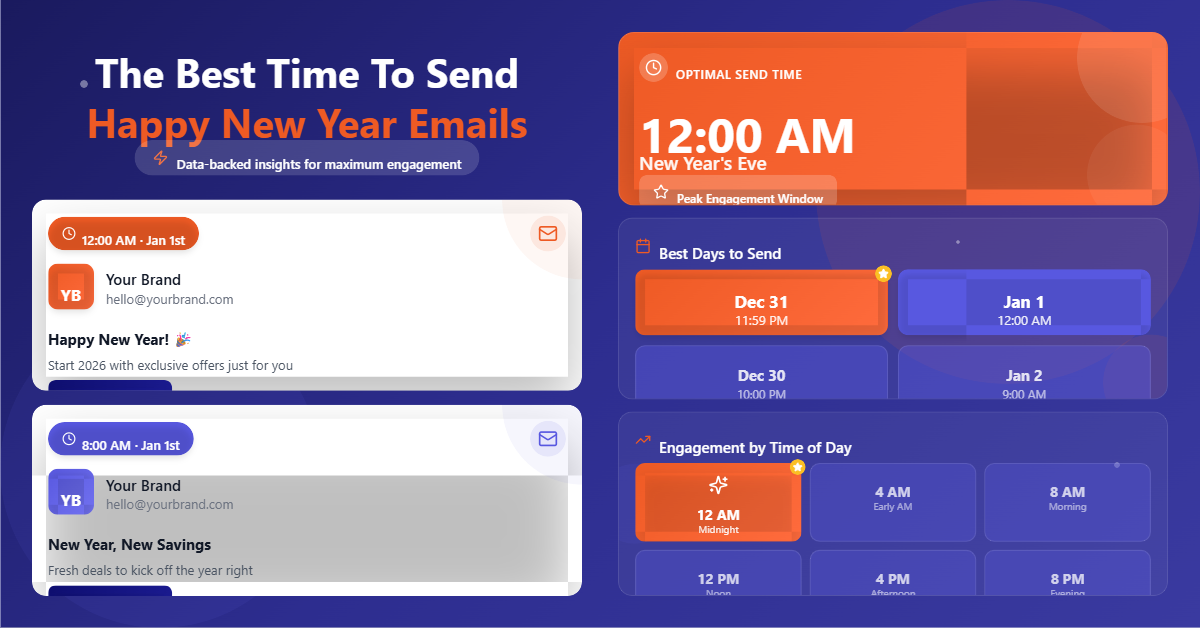
The headline insight is clear: the best time to send Happy New Year email campaigns is the afternoon, specifically 2–5 pm local time, with the strongest clustering at 4 pm and 2 pm.
And on the calendar, Wednesday (New Year’s Day) and a Friday follow-up dominated volume.
This guide turns those data points into a practical sending plan you can execute, test, and scale, without gambling your biggest seasonal touchpoint.
Methodology At A Glance: New Year 2025 Window
Our dataset covers the New Year 2025, spanning December 1, 2024, through January 31, 2025.
We analyzed 1,228 emails sent by 634 e-commerce brands to understand inbox placement by hour, spam placement by hour, best send days by volume, and best send times by hour.
All emails observed landed in the Promotions tab, with no Primary placement recorded. Despite the crush of holiday volume, spam placement did not cluster at any hour, and on peak volume days, we observed a 0% spam rate.
The highest concentration of campaigns went out on Wednesday (New Year’s Day), Friday, Thursday, and Tuesday.
By hour, the afternoon clearly led, with 4 pm, 2 pm, 3 pm, and 5 pm taking the top spots.
🚀 Ready to Boost Engagement?
Get the Outsmart the Inbox This Year
Stop guessing and start growing with our definitive New Year Email Playbook
What Inbox Placement Really Looked Like
Every campaign in this analysis surfaced in the Promotions tab. If you were hoping for Primary placement, the data suggests it’s unlikely for New Year sales and greetings.
That’s not a failure; it’s how mailbox providers categorize commercial content, especially during holidays.
Spam placement by hour showed no concerning spikes. Across the highest-volume send days, the spam rate was 0%.
This is a critical confidence boost. You can compete aggressively in this window without triggering spam filters, provided your list hygiene and authentication are in order.
More New Year Email Marketing Resources for You
When Should You Send? The Data-Backed Windows
If you’re searching for the best time to send happy new year email campaigns, afternoon local time is your friend.
The strongest hours were 4 pm with 109 emails, 2 pm with 103 emails, 3 pm with 92 emails, and 5 pm with 80 emails.
While the dataset reflects send volume rather than opens or revenue, this clustering aligns with consumer behavior in e-commerce.
Afternoon is when people emerge from morning obligations and casually shop, scan deals, and reply to missed greetings.
On the calendar, New Year’s Day dominated, followed by Friday, Thursday, and Tuesday. Wednesday (January 1) saw 333 sends, Friday 277, Thursday 232, and Tuesday 120.
Translating volume into strategy, it’s smart to plan a two-part play: a major New Year’s Day send and a Friday follow-up to catch those circling back with fresh paychecks, routines, and weekend intent.
Best Send Days For New Year Messages
Wednesday, January 1, drew the most sends at 333. This makes intuitive sense.
It’s the exact moment to greet customers, launch “New Year” bundles, and introduce fresh incentives without feeling late.
Framing matters on this day. Fast-shipping promises, limited-time loyalty bonuses, and “start today” messages resonate because shoppers are actively resetting routines.
Friday came next with 277 sends. For many shoppers, Friday is the tipping point between planning and purchasing.
It’s the first “normal” feeling day after the holiday chaos, and it transitions directly into a weekend of browsing.
Use Friday to follow up with those who didn’t convert on January 1, and reframe your offer with urgency or an added perk.
Thursday and Tuesday, at 232 and 120 respectively, round out the top sending days.
These are strategic options for audiences who need a breather after the holiday or who respond better once work rhythms resume.
If your list skews B2B, Tuesday and Thursday often deliver stable inbox availability and better attention.
Best Send Times By Hour
Afternoon wins. Four o’clock led with 109 sends, then 2 pm with 103, 3 pm with 92, and 5 pm with 80.
This 2–5 pm band is the sweet spot. It catches mobile scrollers between tasks, commuters, and end-of-day shoppers who are ready to redeem gift cards, spend loyalty points, or apply newly earned rewards.
If you operate across regions, lean on local time scheduling.
Eight in the morning in New York isn’t eight in the morning in Los Angeles, and what matters most is where your recipient is sitting with a phone in hand.
Afternoon local time smooths those differences and reliably aligns your message with a receptive window.
Why 2–5 Pm Works For E-commerce
Afternoons minimize head-to-head competition with early morning resets and internal work emails.
People have more mental space for discretionary browsing and deal evaluation. It’s also a mobile-heavy window, which elevates the importance of scannable creative, single-tap CTAs, and simple redemption mechanics.
There’s a behavioral layer as well. Post-lunch and late afternoon are when shoppers reconsider the “maybe later” items saved during the holiday rush.
A well-timed reminder with a slightly improved offer or loyalty kicker can push these fence-sitters over the line.
What This Means For E-commerce Senders
Timing gets you seen, but positioning earns the click. Your Happy New Year campaigns will land in Promotions, so design for that reality.
If you answer the question of when to send a happy new year email with the data’s 2–5 pm window, pair it with a creative and offer strategy that thrives in a fast-scroll environment.
Optimize For Promotions-tab Scanning
Subject lines should get to the point fast. Aim for clarity over poetry, “New Year, new reward: 15% today only” beats a vague greeting.
Pair your subject with a complementary preheader that reveals the next level of value, like “Stack with your points through 11:59 pm.”
This duo increases your footprint in the Promotions bundle and raises your open odds.
Above the fold, make the value unmistakable. A single hero visual with one concrete benefit and a primary CTA will outperform a busy collage.
Keep copy compact, with purposeful line breaks that double as anchors during a casual scroll.
If you’re offering tiers, show the first two clearly and link to the full details.
Plan A Two-Send New Year Sequence
Use Wednesday, January 1, for your flagship send. Lead with the best reason to act now, limited bonuses, fresh bundles, or a “day one” loyalty accelerator.
Then plan your Friday follow-up as a reframe, not a replay. Switch the hero, adjust the incentive, and acknowledge laggards with language like “We saved one perk for late deciders.”
For brands that prefer lower pressure, use Tuesday or Thursday for a cleaner “Happy New Year” message with subtle commerce hooks.
This can strengthen brand warmth without overwhelming customers already inundated on January 1.
Localize By Time Zone
Schedule in recipients’ local time, especially if you have national or international coverage.
The same 2–5 pm window holds, but conversion intent varies by region, climate, and routine.
If you can segment by metro or country, align offer framing too.
Cold-weather cities may lean toward indoor comfort and self-improvement bundles, while warm-weather regions respond to outdoor or travel themes.
This is also where list hygiene pays dividends. Send to engaged segments first to lock in strong sender signals, then open the aperture to wider audiences as the campaign progresses.
Creative That Matches Afternoon Intent
Mobile-first layouts are essential in the afternoon window. Use large tap targets and compressed image formats for fast loading.
Keep the price-to-value ratio tight near the top so shoppers can decide without scrolling past the fold.
Reserve your extended story for those who want it, linked under a prominent CTA.
Consider New Year-specific mechanics like “start today” checklists, short self-gift angles for gift-card holders, and rewards multipliers for first-week purchases.
These nudge actions align with the moment’s energy.
More New Year Email Marketing Resources for You
Testing Plan To Validate On Your List
A sound testing plan solidifies the best time to send a happy new year email for your brand, rather than relying solely on global patterns.
Start with the highest-confidence window, 2 to 5 pm local time, and use A/B splits at 2 pm and 4 pm on the same day.
Hold subject lines constant while varying send time to isolate the timing effect.
Run each test with enough volume to achieve significance and observe performance over a 24–48 hour window to capture late conversions.
Next, test days of the week across Tuesday, Thursday, Friday, and Wednesday.
If your audience spans geographies, test time zone-localized sends against a single national time to confirm lift from localization.
Layer in creative tests that reflect Promotions-tab reality, such as one-hero designs versus multi-module grids, or clear numeric incentives versus benefit-led copy.
Finally, structure your New Year sequence as a controlled experiment.
Use a holdout that receives only the January 1 message while the test cohort receives both January 1 and a Friday follow-up.
Compare revenue per recipient and unsubscribe rates to determine the net value of the second touch.
🚀 Ready to Boost Engagement?
Get the Outsmart the Inbox This Year
Stop guessing and start growing with our definitive New Year Email Playbook
Conclusion
The New Year rush doesn’t have to bury your brand. The data points to a clear plan: schedule by local time in the 2–5 pm window, prioritize a New Year’s Day send with a 2-day follow-up, and optimize creative for Promotions-tab scanning.
That combination protects deliverability, maximizes attention, and drives action when shoppers are primed to engage.
If you want to operationalize this playbook without juggling multiple platforms, a unified stack helps. TargetBay Email & SMS can be scheduled by local time, automate your New Year sequence, and assist with message creation using its AI email agent.
Pairing your campaigns with TargetBay Reviews and TargetBay Rewards can also add social proof and loyalty incentives right when customers are ready to act. With your timing disciplined and your experience cohesive, your brand will stand out in the busiest inbox week of the year.
FAQs
When is the best time to send a Happy New Year email?
Afternoon local time performs best in our analysis. The strongest send windows were 2–5 pm, with 4 pm and 2 pm leading the dataset. On the calendar, Wednesday (January 1), Friday, Thursday, and Tuesday accounted for the highest send volumes. If you’re deciding when to send happy new year email campaigns this season, start with 2 or 4 pm in recipients’ local time.
Will my New Year email go to spam?
In our dataset, spam was not a concern during peak days. We observed a 0% spam rate on high-volume send days. However, expect placement in the Promotions tab rather than Primary. Maintain authentication best practices, segment for engagement, and keep your messaging clear to protect deliverability.
Does timing change by audience or time zone?
Yes, timing is sensitive to audience behavior and geography. Always schedule by the recipients’ local time. If you’re choosing when to send happy new year messages across multiple regions, test within the 2–5 pm window on Wednesday and Friday, and validate results against Tuesday and Thursday for your specific list.