



⭐ Quick Summary
🧾 Most brands don’t lead with deals: In a sample of 756 emails from 497 brands, 58.33% included no discount, and the median abandoned cart sequence was just one email. Value-first messaging is the norm, not the exception.
🎯 Simplicity wins when you discount: Percentage discounts appeared 191 times and flat dollar offers 119 times. Free shipping showed up only 9 times and tiered offers just 2, signaling a clear market preference for easy, one-step redemption.
📬 Deliverability penalizes hype-heavy emails: No-discount emails landed in Promotions 257 times, Inbox 46, Spam 138. Discount emails hit Promotions 145, Inbox 28, Spam 142. Discounts should be balanced with brand trust and relevance to protect visibility.
👀 Gentle subjects and clear previews get opened: Only 17.06% of subject lines mentioned offers, and just 144 preview texts referenced discounts. Even when a coupon is inside, subtle subject lines paired with clarifying previews outperform all-caps sales pitches.
⏰ Timing matters more than you think: Both discount and non-discount sequences perform best between 6–9 PM. After Email 3, discount flows diversify into midday and late night. Start abandoned cart discounts in the evening, then test alternative dayparts for follow-ups.
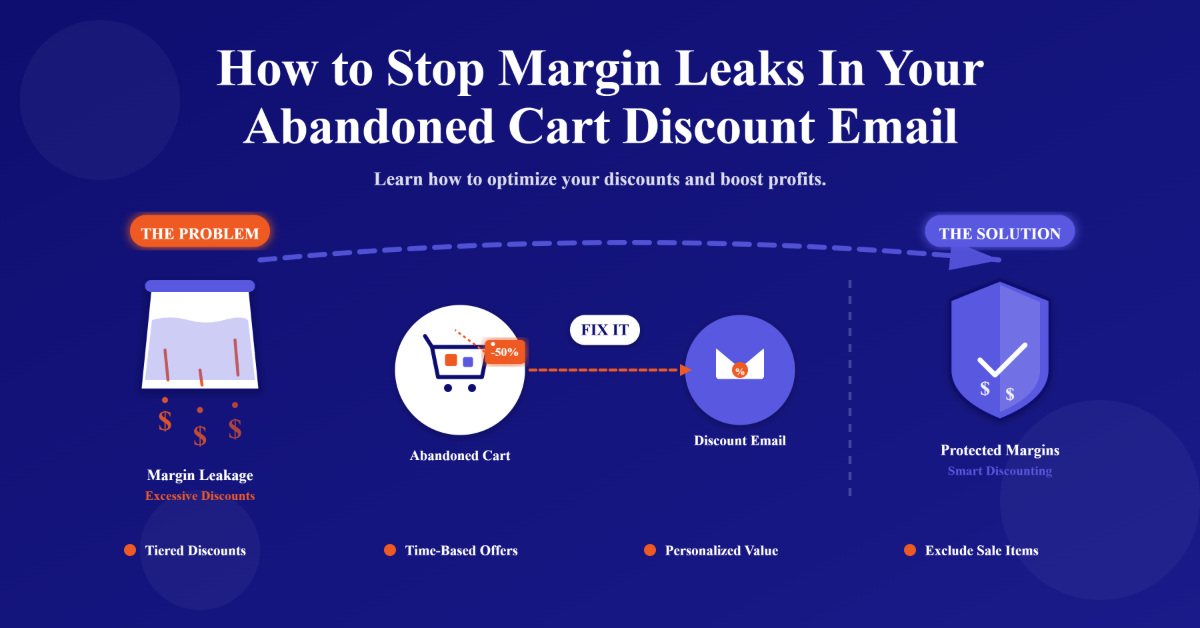
Abandoned cart discount email often feel like a double-edged sword. Use a coupon, and you risk eroding profit and training deal-seeking behavior.
Skip the offer, and you risk losing the order altogether.
The right answer depends on performance, not guesswork, especially if you want an abandoned cart discount email to pay for itself rather than cut into your bottom line.
We analyzed 756 abandoned cart emails sent by 497 brands to map what actually happens in the inbox. The data shows when discounts help, when they hurt, which subject line patterns get seen, how many emails most brands send, and the best time of day to win a return visit.
Use this as your practical playbook for deciding if your next abandoned cart email discount is a smart lever or a margin leak.
The Landscape at a Glance
Across 497 brands, we found the average abandoned cart email sequence length per brand is 1.52.
The median is just one email, which means most brands send only one abandoned cart email.
Only a minority sends two or more, and very few go beyond three. This is a crucial baseline: the majority of brands are not running long recovery sequences, so every send needs to work hard.
This brevity magnifies the importance of message design, timing, and whether you should introduce an offer at all.
If you only send one or two messages, you need to be crystal clear about when an abandoned cart email discount code earns its place and how to craft a relevant message that lands in the inbox.
Abandoned Cart Email Playbook
Turn abandoned carts into revenue with plug‑and‑play recovery flows, timing templates, and copy frameworks for ecommerce brands.
Should you include an Offer? Discount vs. no-discount prevalence
It’s tempting to believe every cart recovery email needs a deal. The data says otherwise.
Of all emails studied, 58.33% (441) included no discount, while 41.66% (315) used a discount. In other words, the default across the market is to lead without an offer.
This should permit you to start with value-first copy, solve friction, and only escalate to an incentive once you’ve addressed the customer’s hesitation.
Among the discount emails, the offer type breakdown shows brands favor simple formats.
Percentage discounts lead with 191 occurrences, followed by flat dollar discounts at 119. Free shipping appears just 9 times, and tiered or bundle-based offers appear only 2 times.
Complexity is rare and for good reason. Shoppers in recovery flows need clarity and speed, not cognitive load. If you test an abandoned cart email offer discount, choose a clear percentage or flat dollar incentive.
If margins are tight, a free shipping abandoned cart email can be a low-impact alternative, but it’s not widely used in this dataset.
A practical approach is to begin with a no-discount reminder that reiterates value, answers questions, reinforces trust, and highlights product benefits.
If that doesn’t convert, introduce an abandoned cart email discount in a second message using a clean structure and plain language.
When appropriate, test an abandoned cart email offers free shipping variant for categories with heavy or bulky items.
More Abandoned Cart Email Marketing Resources for You
Industry Benchmarks: Who Discounts The Most?
Discount prevalence isn’t uniform across categories, and these benchmarks can help you calibrate your own approach.
| Industry | Discount Usage |
|---|---|
| Beauty and Cosmetics Highest | 38.9% |
| Consumer Electronics | 38.7% |
| Fashion and Apparel | 35.9% |
| Home Decor and Furnishing | 34.8% |
| Baby Products | 33.3% |
| Automotive | 30.6% |
| Food, Tea, Coffee, and Beverages | 29.2% |
| Health and Supplements | 29.0% |
| Outdoor and Sport | 26.2% |
| Arts and Crafts Lowest | 18.9% |
If your vertical is highly seasonal or price-sensitive, you may need to deploy an abandoned cart email discount code earlier, but you can still avoid training customers to wait for deals.
Consider a product-led first email and a tightly controlled incentive in the second.
In premium categories or those with strong brand equity, you can lean harder on value and social proof, holding the incentive for a later message or for specific cohorts based on cart value.
Deliverability Reality Check: Inbox Placement With and Without Offers
An abandoned cart email that never gets seen can’t recover revenue. The inbox placement data shows real tradeoffs.
‘No-discount’ emails landed in the Promotions tab 257 times, reached the primary inbox 46 times, and hit spam 138 times. Discount emails landed in Promotions 145 times, reached the inbox 28 times, and hit spam 142 times.
Both groups skew heavily toward Promotions, but the spam counts tell a story.
Discount-heavy copy correlates with similar or worse spam placement than no-discount emails. This doesn’t mean you can’t send an abandoned cart discount email.
It means you need to balance promotional signals with brand and relevance signals. If you use an abandoned cart coupon subject, avoid stacking multiple trigger words in the subject line, and let your preview text do more work.
Clean list hygiene, recent engagement prioritization, and clear brand identity cues can lift inbox placement. When you do include incentives, your copy should still prioritize customer intent over hype.
Subject, Preview, and CTA Patterns that Actually Get Seen
Subject lines mentioning offers are less common than you might expect. Only 17.06% (129) mentioned offers, while 82.9% (627) did not.
The top discount keywords in subject lines were the percent symbol, used 82 times, and the word “off” used 81 times. “Save” appeared 30 times, “discount” 12 times, “free shipping” 5 times, and “deal” 3 times. Preview text referencing offers appeared 144 times, versus 612 instances without offer references. Discount-based CTAs were used 85 times, compared with 671 non-discount CTAs.
The takeaway is that a restrained approach dominates. Even when you plan to use an abandoned cart email offer discount, you don’t need to lead the subject with it.
Test a softer abandoned cart coupon subject such as “Still want this?” or “Your cart is waiting” against a more explicit “Take 10% off—Ends tonight” to measure impact.
If you go with the subtle version, pair it with a clear preview line that clarifies either the benefit, the timeline, or the reassurance angle, such as “Fast checkout, free returns,” or a gentle abandoned cart price drop message like “We set aside your price—here’s a little help.”
CTAs can stay product and value-based even in discount emails. Messages like “Complete your order,” “See your cart,” or “Return to checkout” maintain a trusted feel.
When you do reference an offer in the button, keep it literal and simple, such as “Apply 10% off.” Overly clever copy can dampen clarity, and clarity converts.
When to show the Discount in your Sequence?
In the data, most discounts appear in the very first email of a brand’s sequence.
The first email accounts for 90.67% of first-time discount appearances, while the second email accounts for 7.56%, the third for 1.33%, and the fourth for 0.44%.
This suggests that when brands use discounts, they usually deploy them immediately. That doesn’t mean you must do the same.
A balanced strategy is to begin with no discount, especially if your median sequence length is one or two emails.
Lead with value and friction reduction, then unlock an abandoned cart email discount in Email 2 if the customer hasn’t returned.
If you run a three-email flow, reserve a 3rd abandoned cart email coupon for holdouts.
This lends you a final nudge without becoming predictable. When you do use that third email, keep the offer time-bound and simple, and consider adding a trust signal such as flexible returns, verified reviews, or warranty protections that address lingering objections.
Send-time Patterns that Lift Engagement
Both discount and non-discount sequences overwhelmingly start in the 6–9 PM window.
Evening is king for initial sends, when shoppers have more attention and time to complete checkout.
After Email 3, discount sequences diversify earlier and spread across midday, late night, and afternoon.
Non-discount sequences tend to move earlier in later stages, with morning becoming dominant around Email 6 and 7.
If you are testing abandoned cart discount rates or a free shipping abandoned cart email, slot your first test in the high-intent evening window for maximum comparability.
Stagger later-stage tests by cohort and time-of-day to capture shoppers who browse at different hours.
For brands that rarely send more than two emails, that first evening window is your prime real estate.
If your second message introduces an abandoned cart email discount code, consider a next-day, late afternoon, or early evening send to catch the same rhythm without fatiguing the recipient.
Quick Implementation Checklist you can Run This Week
Start with the subject line. Aim for a balance of urgency and clarity. “Still want this?” is a strong opener when you do not plan to lead with a discount.
When you do, “Take 10% off—Ends tonight” sets a clear expectation without shouting.
Use the brand name, product name, or category in the subject or preview to send helpful relevance signals that aid deliverability.
When experimenting with an abandoned cart coupon subject, keep it short and let the preview carry supporting detail.
Frame the offer for simplicity. The data shows that percentage and flat dollar amounts dominate.
Start with one of these. If you need a low-margin lever, test an abandoned cart email with a free shipping variant, especially for categories with weight-related friction.
Avoid tiered or bundle complexity for cart recovery; it is used only 2 times across the entire dataset and risks confusion.
Write copy that earns attention before you discount. Begin with the product’s why, common questions, and practical reassurance, such as shipping times and returns.
Layer in social proof. Only then reveal the incentive if needed, and present it as a helpful nudge rather than a bribe.
When referencing abandoned cart discount rates, use plain language and make the redemption experience one click.
The smoother the application of your abandoned cart email discount code, the higher the recovery rate.
Putting it together in a two to three-email sequence
A one-email flow should prioritize clarity and trust. If you only send one message, decide whether your audience truly needs discounts to move.
Many brands choose not to discount in that lone message, leaning instead on relevance and reassurance.
If you can support two emails, lead the first with no discount and follow with a concise abandoned cart email discount in the second if there’s no conversion within 12–24 hours.
For brands that can sustain three emails, hold a 3rd abandoned cart email coupon as a final, time-bound offer for high-intent laggards.
Keep the messaging friendly, consistent with brand tone, and focused on removing friction.
More Abandoned Cart Email Marketing Resources for You
Examples you can adapt without training customers to wait
Consider a subtle opener that does not include an offer in the subject. “Still want this?” pairs well with preview text such as “Your picks are saved—fast checkout, easy returns.”
The email body reiterates value, answers shipping questions, and shows reviews.
If no purchase occurs, the second message can use a straightforward incentive like “Take 10% off—Ends tonight,” with preview text clarifying “Your code applies automatically at checkout.”
For teams wary of margin impact, a variant with a free shipping abandoned cart email can be tested to learn whether delivery cost was the obstacle.
A final follow-up can be framed as an abandoned cart price drop message with a tight expiration, making the action feel timely rather than habitual.
Abandoned Cart Email Playbook
Turn abandoned carts into revenue with plug‑and‑play recovery flows, timing templates, and copy frameworks for ecommerce brands.
How deliverability should shape your creative choices
Because both discount and non-discount emails skew to Promotions and see meaningful spam rates, you should reduce risky patterns that read like broadcast blasts.
Keep the subject line human and light on stacked discount terms.
Use product names, the shopper’s first name, and cart details as relevance markers. Keep the number of offer words low in the subject, shifting some clarity to the preview text.
Even when you send a discounted message, let your CTA remain neutral, like “Complete your order,” then apply the code automatically.
Combined with clean sending practices and segmentation based on recent engagement, these moves help more of your messages hit the inbox.
Why most brands skip complexity in incentive design
The dataset shows a stark preference for clean offers. Percentage and flat dollar amounts appear 310 times combined, while tiered incentives appear only twice.
While bundles and tiers can add average order value in campaigns, they rarely excel in cart recovery flows.
Shoppers at the edge of purchase want the simplest path back. When a discount is necessary, keep it single-step and auto-applied.
If you must mention details, restrict them to a single sentence near the CTA.
The role of brand, reviews, and loyalty in reducing discount dependency
You can recover more carts without leaning on constant incentives by improving perceived value and trust.
Verified reviews, clear returns, and loyalty benefits reduce hesitation without cutting prices.
If you run your abandoned cart flows with TargetBay Email & SMS, you can also weave in social proof from TargetBay Reviews and highlight available points or perks via TargetBay Rewards to nudge the purchase while protecting margin.
The strongest recovery programs combine helpful messaging with just-in-time incentives, not blanket discounts every time.
Conclusion
Discounts are a tool, not a strategy. The data shows that most brands lead with no offer, simplify incentives when used, and rely on high-intent timing, clear messaging, and trust signals to drive recovery.
If an abandoned cart discount email is part of your mix, introduce it thoughtfully, time it to when customers are most receptive, and keep it simple enough to apply in one click.
A unified stack helps. TargetBay ties Email & SMS, Reviews, and Rewards together so you can sequence value-first messages, layer social proof, and deploy the right incentive only when it earns back more than it costs.
Transparency & Disclaimer
This guide is based on an analysis of 756 abandoned cart emails from 497 e-commerce brands, collected between 1 August 2024 and 5 June 2025 through InboxEagle.com, a platform that tracks public e-commerce email campaigns.
Important context for interpretation: Reported percentages and averages represent trends within this dataset, not universal benchmarks. Results can vary by industry, audience, region, and email platform. Metrics such as inbox placement, opens, and clicks are also influenced by list quality, deliverability, and recipient behavior.
Disclaimer: All emails analyzed were sourced from third-party e-commerce brands. TargetBay has no affiliation with any brands in the dataset.
These insights are intended as directional guidance and benchmarking, not guaranteed outcomes. Brands should validate and adapt strategies based on their own performance data.