


Quick Summary
◼️ A/B testing email subject lines works best when your winning metric aligns with the campaign’s goal, whether visibility, traffic, or sales, and you track open, click, click-to-open, or conversion accordingly.
◼️ Reliable test design requires 10 to 90% of your list, at least 1,000 recipients total, and a duration of 1 hour to 7 days to confidently reach a 95% significance threshold.
◼️ Start with high-impact variables like length, personalization, urgency, offers, emojis, brackets, numbers, and brand voice consistency, and isolate one variable per test to create reusable insights.
◼️ Automation unlocks compounding gains by auto-tracking performance, calculating significance, and deploying winners to remaining recipients quickly, preventing delays and preserving deliverability at scale.
◼️ Tools built for e-commerce like TargetBay Email & SMS make testing effortless with configurable metrics, fast winner selection, AI-assisted ideation, and clear insights that roll into future campaigns efficiently.
Guesswork is expensive in e-commerce email. Every weak subject line burns deliverability, wastes a send, and delays revenue you could have earned today. A/B Testing Email Subject Lines turns that uncertainty into a repeatable system for improving opens, clicks, and conversions—without slowing your team or risking your list health.
Why Subject Lines Matter For E-commerce: Impact On Opens, CTR, And Revenue
Subject lines decide if you get a shot at revenue at all. If inbox placement and open rate falter, even a perfect creative will never be seen. Strong subject lines earn attention, lift deliverability signals, and move more shoppers into the body of your message. Better opens improve the pool that clicks, and stronger click-through rates ignite sessions and sales. Over time, consistent uplift compounds across your calendar, improving list hygiene, reducing spam folder placement, and raising average revenue per recipient.
Subject lines also act as fast-learning levers. You can test them often, collect statistically sound results quickly, and apply those insights across product drops, holidays, and automations. These insights can be fed directly into your HubSpot pipeline, helping sales and marketing teams align faster and forecast revenue with greater confidence.
Choose The Right Winning Metric
Choosing the right metric aligns the test with your business goal and your current deliverability reality. The wrong metric creates false wins that don’t drive sales or can even harm inbox placement.
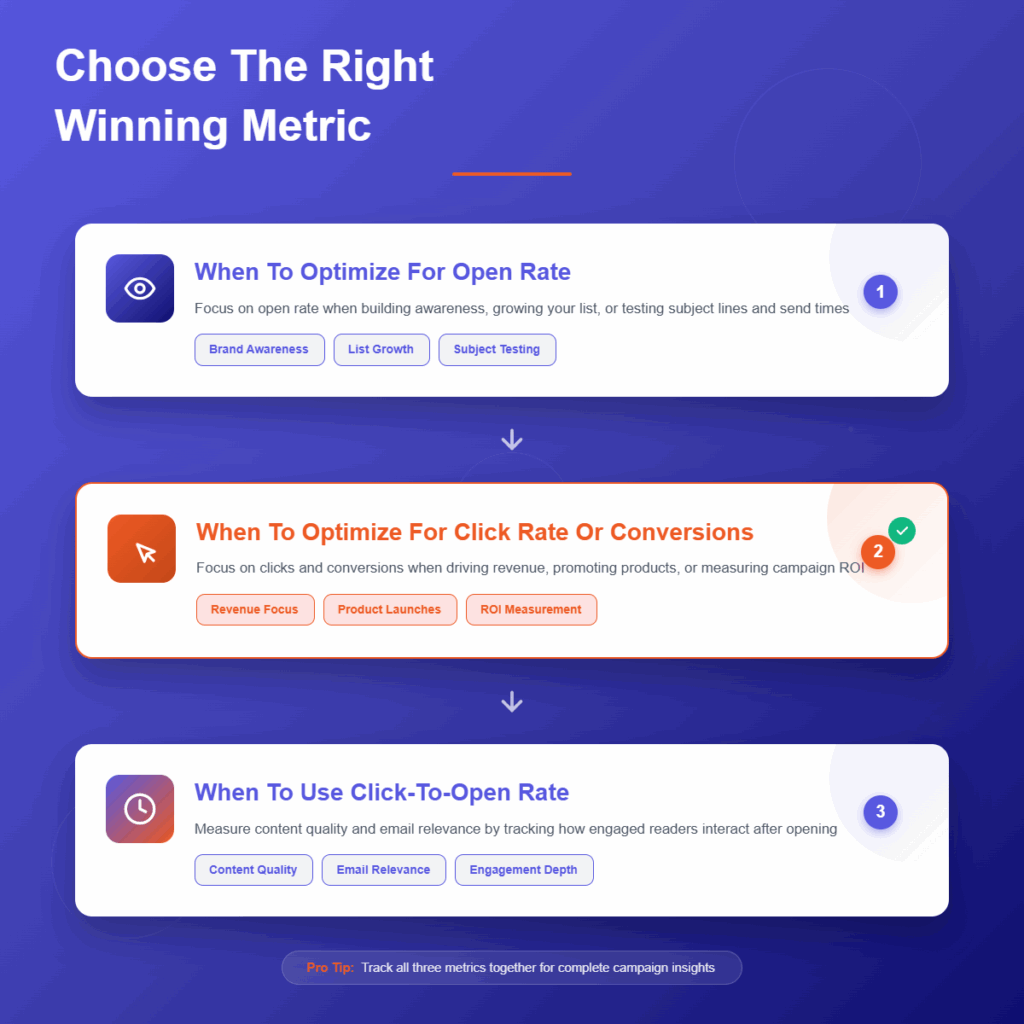
When To Optimize For Open Rate
Open rate is ideal for top-of-funnel or awareness plays. If you’re warming up a new list, announcing a brand moment, or re-engaging lapsed subscribers, maximize opens to widen the funnel. Open rate is also useful when your body copy and offer are fixed, and your immediate goal is attention and reach. Use it for campaigns where the main value is message exposure, like press coverage, back-in-stock news, or important policy updates.
When To Optimize For Click Rate Or Conversions
For sales-focused campaigns, prioritize click rate or conversion rate. Clicks are a reliable early proxy for revenue when on-site conversion is stable. If your ecommerce data is integrated, conversion rate settles the question with a purchase signal. Use one of these when you’re running promos, drops, bundles, or time-bound offers where revenue is the scorecard. This is especially effective when your list is warm, traffic quality is high, and on-site merchandising is aligned.
When To Use Click-To-Open Rate
Click-to-open rate controls for inboxing and subject line allure by measuring how compelling the email is to those who actually opened it. If deliverability is shaky, inbox placement is fluctuating, or you’re testing high-variance subject lines, CTO gives you a clean read on the email’s relevance post-open. It helps ensure you’re not overvaluing curiosity-bait lines that open but fail to drive action.
Test Design 101: Sample Size, Minimum Audience, And Duration To Reach 95% Confidence
Good design generates confident decisions you can scale. Weak design wastes time, misleads your team, and erodes trust in testing.
Sample Size And Minimum Audience
Aim to test between 10% and 90% of your total recipients. This range balances learning depth with revenue protection. If your list is small, wait until you can reach at least 1,000 total recipients across both variants. Below that threshold, variance can mask real differences and produce false winners. As your list grows, larger samples improve precision and shorten the time to significance.
Duration And Timing
Run tests for a minimum of one hour and no longer than seven days. Many e-commerce lists see 80% of engagement within a few hours, but allow enough time for late openers and time-zone spread. Avoid testing across noisy periods when inboxes behave differently than usual, unless seasonality is your intent. For example, a Black Friday subject line test is valid for Black Friday tactics but not for a regular Tuesday campaign.
Confidence And Significance
Target 95% confidence for winner selection. This protects you from selecting a variant that appears to win by chance. Use tools that compute statistical significance as data arrives, rather than relying on manual spreadsheets after the fact. Stopping early without significance increases false positives; running too long slows growth and delays revenue from the better variant.
More A/B Testing Marketing Resources for You
What To Test First In Subject Lines
Focus on big levers before micro-tweaks. Start with clarity and benefit, then refine style.
Length And Clarity
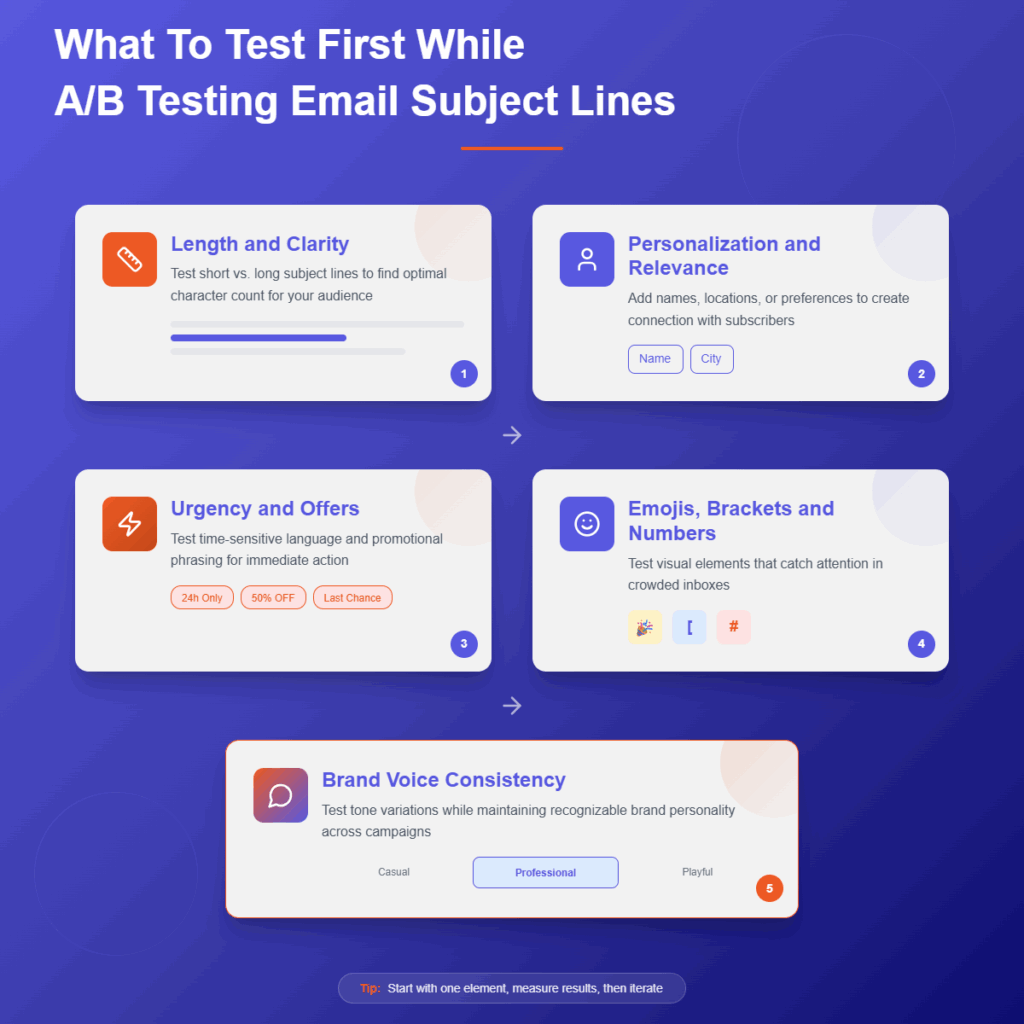
Shorter subject lines often perform better on mobile, but clarity always wins. Test ultra-short lines under 30 characters against slightly longer, benefit-driven versions. If truncation hides the key offer on mobile, rewrite to front-load the value in the first few words.
Personalization And Relevance
Personalization signals relevance when it feels real. Test using first name, product category affinity, or last-browsed items in the subject. Avoid token overuse that looks robotic. Match personalization to lifecycle stage so the message follows recent behavior.
Urgency And Offers
Urgency drives action when it’s honest and specific. Test time-bound language, deadlines, and countdowns versus steady value framing. Test offer clarity—such as “Save 20% today” versus “Exclusive pricing ends at midnight”—to find the balance between specificity and intrigue.
Emojis, Brackets, And Numbers
Visual cues can lift scannability, but overuse hurts deliverability and brand trust. Test a single relevant emoji against none. Try brackets to highlight the promo tag, like [New], [Restock], or [Deal], and test numerals for social proof, such as “10,000+ five-star reviews,” when available through TargetBay Reviews.
Brand Voice Consistency
Subject lines should sound like you, even when optimized. Test tone—playful versus direct—without abandoning your brand. Consistent voice builds recognition, improves inbox placement over time, and reduces unsubscribes from whiplash messaging.
Methods For A/B Testing Email Copy And Subject Lines
Clean testing creates clean learnings. Messy variables muddy results and lead to brand drift.
Isolate Variables
Change one thing at a time. If you test urgency language, don’t also change the preview text and sender name. When testing email body copy alongside subject lines, run separate experiments or schedule sequential tests. This approach embodies rigorous a/b testing email copy and subject lines methods that scale.
Avoid Overlapping Promotions And Confounds
Don’t test two different offers at once in subject lines, especially if price or discount changes. Overlapping promos in the inbox during your test window can contaminate data and depress engagement. Keep your calendar tidy and your test windows clear.
Segment By Lifecycle Stage
New subscribers, active buyers, and lapsed customers behave differently. Segment your audience by lifecycle stage and run parallel tests. Learn which a/b testing email subject line optimization strategies work for each group, then codify those rules into your campaign templates and automations.
Automation Strategies That Compound Wins
Manual analysis costs you time and leaves money on the table. Automation increases speed, confidence, and scale.
Auto-track And Calculate Significance
Set the winning metric up front and let your platform track variant performance in real time. Automated significance calculations remove guesswork and prevent premature winner calls. With TargetBay Email & SMS, performance tracking and 95% confidence checks are built in, so your tests meet rigorous standards without spreadsheets.
Auto-deploy The Winner Without Delays
After the test period, deploy the winning variant to the remaining recipients immediately. This turns a small learning sample into a full-campaign lift. TargetBay Email & SMS automatically selects the winner based on your configured metric and sends it to the rest of the list, preserving momentum and maximizing revenue during the same send.
Scale Without Hurting Deliverability
Large lists introduce risk if you blast unproven subject lines to everyone. Use a test sample size between 10% and 90% to learn safely, then scale the winner to the remainder. Respect frequency caps, suppress inactive segments when needed, and monitor bounce, complaint, and unsubscribe rates. Healthy deliverability sustains repeat testing and protects long-term revenue.
Interpreting Results And Edge Cases
Not every test ends with a clear win. Decide how to react before you start, and document your rules.
Ties And Insufficient Data
If significance isn’t reached or your results are effectively tied, send the control to the rest of your audience and record the hypothesis for a future attempt. Increase sample size, extend duration within the seven-day cap, or simplify the variable under test. Avoid cherry-picking a variant that “feels” better; trust the math.
Seasonality And External Factors
Be mindful of seasonality, sales cycles, and inbox competition. If a flash sale, shipping deadline, or big retail event overlaps, note that in your analysis. Lessons from high-intent periods may not apply to routine sends. Keep a testing log so your team remembers context when reusing insights months later.
Roll Insights Into Future Campaigns
Translate results into reusable rules. If short, benefit-first subject lines consistently win for VIPs, build templates that default to that format. If personalization drives opens for new subscribers but reduces clicks for lapsed ones, set lifecycle-specific logic. Over time, this becomes your playbook for a/b testing email subject lines for higher click-through rates and steady revenue growth.
Conclusion
Winning email programs don’t guess; they test, learn, and automate. A disciplined approach to A/B Testing Email Subject Lines—aligned to the right metric, grounded in solid sample sizes, and powered by automatic significance and deployment—delivers compounding gains across opens, clicks, and sales. With TargetBay Email & SMS, you set the rules once and let the system run the play, accelerating decisions, protecting deliverability, and turning every send into a measured step forward. If you also use TargetBay Reviews or TargetBay Rewards, connect social proof and loyalty perks in your copy to multiply the lift you earn from high-performing subject lines.
FAQs
How big should my test be, and how long should it run?
Test 10% to 90% of your total recipients, with at least 1,000 contacts across both variants. Run from one hour up to seven days, and stop when you reach 95% statistical confidence.
Which metric should I pick as the winner?
Choose the open rate for awareness and list warming. Choose click rate or conversion rate for sales-driven campaigns. If inbox placement or curiosity-bait is a concern, use the click-to-open rate to normalize for opens.
What if there’s no clear winner?
If the test doesn’t reach significance or results tie, send the control to the rest of the audience. Log the insight, refine the hypothesis, and rerun with a larger sample or a clearer variable.